gem-news-2012-v1

January – April 2012
- April 2012 Newsletter – April 16
- March 2012 Newsletter – March 15
- February 2012 Newsletter – February 15
- January 2012 Newsletter – January 18
April 2012 Newsletter
In this edition of our newsletter Pala International’s Bill Larson reports on his trip to Thailand and Burma, on the occasion of an historic vote.
Shows and Events
- Tenth Annual Sinkankas Symposium – Topaz – April 21, 2012
- Bill Larson to Keynote at Arusha International Gem, Jewelry and Minerals Fair: April 26–29, 2012
- Pala at Las Vegas – May 31 – June 4, 2012
Pala International News
Industry
- International Gems & Jewelry Expert Committee
- Runners-Up in Sotheby’s Sale
- Burma Bits: Pala’s Bill Larson witnesses history in the making
Pala Presents
- Where Nature Stores Her Jewels
by Edna Rowell Schley
Shows and Events
Tenth Annual Sinkankas Symposium – Topaz
Registration still open for Saturday, April 21, 2012 in Carlsbad, CA
The annual Sinkankas Symposium has been described by John Koivula as the “best gem mineral symposium in North America” and never fails to achieve sold-out enrollment. Perhaps that’s the reason why prospective attendees figured they might be out of luck when registration was scheduled to close last Friday. We’ve been told that the deadline has been extended to this Wednesday, April 18. To get in under the wire, email Anne Schafer or call her at 858.586.1637.
 |
This year’s topic is Topaz. The roster of symposium contributors, each authorities in their respective disciplines, will be introduced by keynote speaker D. B. Hoover. Known for his reference volume, Topaz (Butterworth–Heinemann, 1993), Dr. Hoover will speak on the “Historical Transmutations of Topaz,” examining ancient texts about the terms that he believes may have been applied to the mineral known today as topaz and speculating on its use as a gemstone in Classical antiquity.
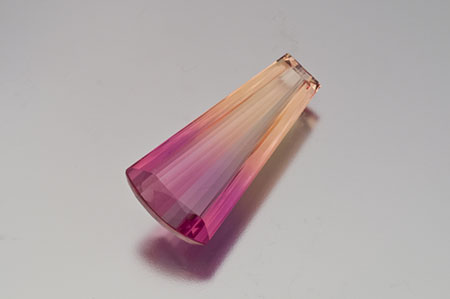 |
| A rare bi-colored topaz from Ouro Preto, Brazil. This pastel purplish-pink to golden-colored crystal weighs 13.35 carats and measures 27.0 x 11.8 x 5.42 mm. (Photo: Mia Dixon) |
Presentations will be made by regular Sinkankas Symposium contributors John Koivula, George Rossman and William “Skip” Simmons. GIA’s John Koivula will present a pictorial tour of “The MicroWorld of Topaz,” in which he discusses the internal features that attest to the gem host’s paragenesis and provide tell-tale evidence of treatment. Dr. Rossman, McMillan Professor of Mineralogy at Caltech, Pasadena, will discuss color in natural and treated topaz, leading the audience on an odyssey into the gem’s atomic structure. Dr. Simmons will travel from the University of New Orleans for a repeat appearance to present “Topaz Mineralogy” this year. Attendees can look forward to a reliably lucid and entertaining lecture, which has come to be known for its animated graphics and very animated speaker.
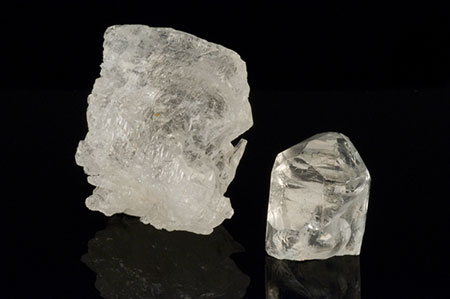 |
| A pair of topaz crystals from the Himalaya Mine, San Diego County. Topaz crystals such as these are extremely rare from this mine in Southern California (left: 4 x 3.5 x 3 cm; right: 3 x 2 x 1 cm). (Photo: Mia Dixon) |
Distinguished Research Fellow at the GIA laboratory in Carlsbad, Dr. James E. Shigley returns to the Sinkankas Symposium for a second engagement, this time to discuss worldwide localities of gem topaz. GIA’s director of gem identification services, Shane F. McClure, will speak on “The Treatments of Topaz,” an important topic in the gem trade. Local lapidary artist Meg Berry, a frequent Sinkankas Symposium presenter, will show step-by-step her process of carving topaz from gem rough to fashioned, polished carving in “Cutting Topaz.” This year, Robert Weldon, Manager of Photography and Laboratory Publications at GIA, will present an historical narrative, “How Brazilian Bandeirantes Blazed Trails to Topaz – and other Gems,” illustrated with his beautiful photographic images.
Visit the Sinkankas Symposium website for speaker bios and abstracts of presentation topics.
- Meg Berry – Cutting Topaz
- Dr. D. B. Hoover – The Historical Transmutations of Topaz
- John Koivula – The MicroWorld of Topaz
- Shane McClure – The Treatments of Topaz
- Dr. George Rossman – The Colors of Topaz
- Dr. James Shigley – Topaz Geology and Localities
- Dr. Skip Simmons – Topaz Mineralogy
- Robert Weldon – How Brazilian Bandeirantes Blazed Trails to Topaz – and other Gems
Pala International’s Bill Larson is slated to provide a pictorial tour of topaz specimens in a range of colors from localities around the world.
The Sinkankas Symposium is organized by Roger Merk, and co-sponsored by the San Diego Mineral & Gem Society and the GIA (Gemological Institute of America). It will be held Saturday, April 21, 2012, at the GIA World Headquarters and The Robert Mouawad Campus, 5345 Armada Drive, Carlsbad, CA 92008.
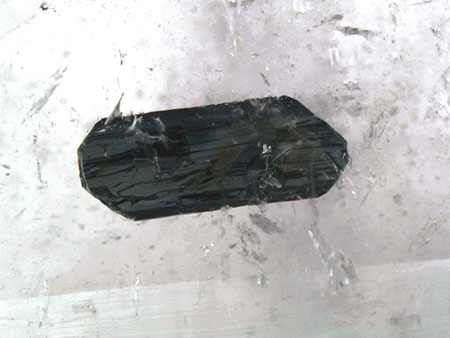 |
| Separated at earth. Although they are from entirely different geographic localities on virtually opposite sides of the Earth, inclusions such as columbite (2.62 mm) in a topaz from Gilgit, Pakistan and spessartine (5 mm) in a topaz from Brazil are indicative of the host gems having crystallized in complex granitic pegmatites. (Photomicrograph: John Koivula) |
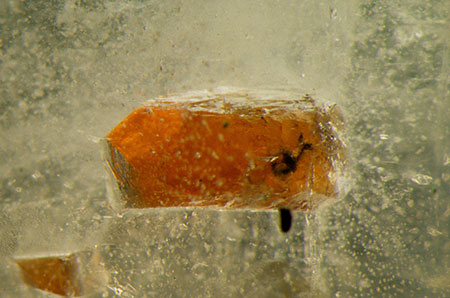 |
[back to top]
Bill Larson to Keynote at Arusha International Gem, Jewelry and Minerals Fair: April 26–29, 2012
 |
The Ministry of Energy and Minerals of Tanzania and the Tanzania Mineral Dealers Association are sponsoring a four-day Arusha International Gem, Jewelry and Minerals Fair, April 26–28, 2012. It will be held at the recently renovated Mount Meru Hotel in Arusha, in northeastern Tanzania.
The event will gather gem and mineral producers from thirteen sub-Saharan Africa countries. According to a press release:
Exhibitors will be required to showcase their work in the community, as well as participate in the sharing of best practices across their peers, with the continuous aim of making the mining/trading process in Sub-Saharan Africa one which invokes confidence in the end consumer. As a special feature in the AIGJMF event, organizers will be specifically focusing on empowering women in the gemstone trade through education in the areas of cutting and carving, and mentoring by strong female leaders. An evening gala will be held to raise funds to sponsor a group of women through the Tanzania Gemological Center training program in Arusha. Through this program, not only do we increase our skilled cutting and carving pool in Tanzania, we more importantly teach a sustainable trade to the women who serve as the family nucleus.
Keynote speakers addressing the fair participants will be AGTA CEO Douglas Hucker and Pala International’s Bill Larson. Larson will speak Friday night, at the ICA Reception and Dinner, on the importance of African colored gemstones in today’s market. Also on Friday, Larson will moderate the Industry Panel: “Africa, A Sustainable Gemstone Source.” Lapidary Stephen Avery will give three demonstrations during the conference. Attendees will have the post-conference option of one of several tours on April 29 to mines in Merelani, the Umba Valley (in the Usambara mountains, from which the “Usambara effect” in chromiferous green tourmaline received its name), Longido (ruby), Lemshuku (green garnet) and elsewhere.
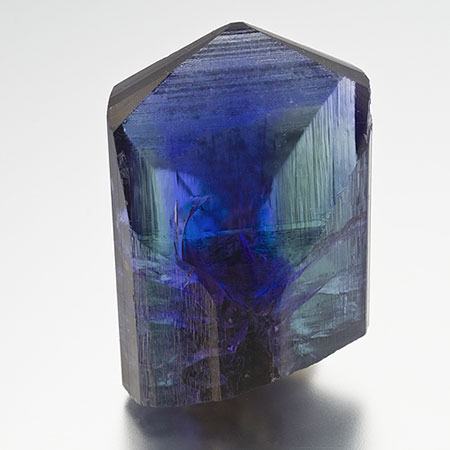 |
| Multicolored tanzanite crystal, a Pala International piece. Conference attendees will have the option of touring a tanzanite mine in Merelani. (Photo: Mia Dixon) |
[back to top]
Pala at Las Vegas – May 31 – June 4, 2012
 |
It’s time to plan for the JCK Las Vegas show. Pala International will be there in force, with one of America’s largest selections of fine colored gems.
Note: The JCK Show this year will run Thursday through Monday. The AGTA Pavilion will open the same day.
When: May 31 – June 4, 2012
Where: South Pacific and Islander Ballrooms in the Mandalay Bay Convention Center, Las Vegas, NV
Hours: AGTA Gemstone Section
Thursday, May 31 thru Sunday, June 3:
9:30 AM – 6:00 PM
Monday, June 4: 9:30 AM – 4:00 PM
Booth: AGTA Pavilion, booth AGTA514
We look forward to seeing our many friends there. Visit the Pala International Show Schedule for future events. [back to top]
Pala International News
Pala’s Featured Stones: Burmese Spinel &
Sri Lankan Sinhalite
This month we feature a couple of new jewels Bill was able to buy on a recent trip to Thailand and Burma. Other highlights included natural rubies from Mozambique, natural blue sapphires from Sri Lanka and Madagascar, blue zircon from Cambodia, and many other rare ones like hackmanite and amber from Burma.
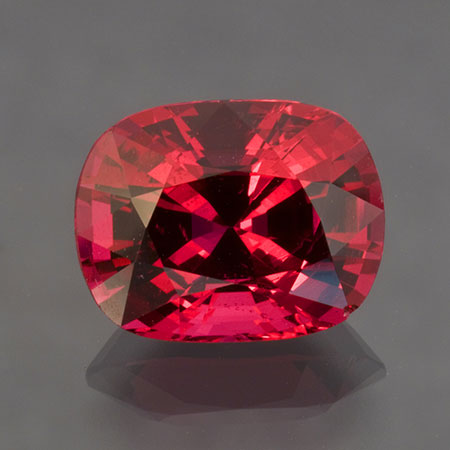 |
| Red spinel from Burma, 3.23 ct, 9.78 x 7.66 x 5.92 mm. Ask for Inventory #20075 no longer available. (Photo: Mia Dixon) |
Red spinel has been in high demand recently, while the supply is slow to fill the increasing interest. This intense orangey-red spinel exhibits the highly saturated reds that many collectors are looking for. The Pala team is always happy to welcome another spinel into our family even though they seem to move out fairly quickly. Enjoy this one while it lasts.
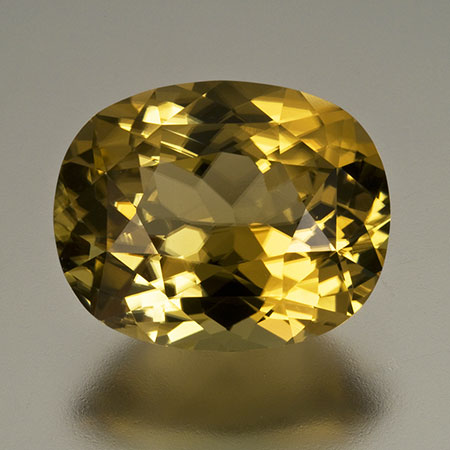 |
| Golden sinhalite from Sri Lanka, 14.36 x 11.64 x 7.93 mm. Inventory #20073. (Photo: Mia Dixon) |
Sinhalite was first identified as a new mineral species in 1952, previously thought to be a brown peridot because of its similar properties and color. Sinhalite is in the borate mineral group and is formed in metamorphic environments. This golden sinhalite is exceptional in size and color for this unusual species. Yet another exquisite gem to be plucked from the mineral-rich lands of Sri Lanka.
Interested? Select the inventory numbers above, call or email us to inquire. [back to top]
Industry News
International Gems & Jewelry Expert Committee
 |
We recently received information from George Shen about the International Gems & Jewelry Expert Committee, aka GemUs.org, which brings together gem and jewelry professionals from around the world. As stated on its home page, the purpose of the Shanghai-based organization is to allow these professionals to network in order to share information and knowledge. As China’s economy continues to grow an average of at least 9% per year, according to the International Monetary Fund, opening these lines of communication should be invaluable.
Experts listed on the GemUs.org website will be familiar to attendees of conferences that attract an international crowd. The website includes a designer gallery, collection pieces and news. We have accepted Mr. Shen’s offer to translate our own newsletter for the China market, to be posted in the Current Events section. [back to top]
Runners-Up in Sotheby’s Sale
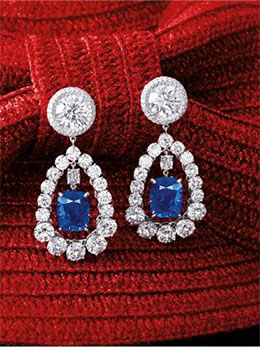 |
Sotheby’s Hong Kong set two second-place records earlier this month. The Magnificent Jewels and Jadeite Spring Sale on April 3 achieved the second highest total for such a sale in Hong Kong, at $64 million. An 8.01-carat emerald-cut fancy vivid blue diamond garnered the second-highest at-auction price-per-carat for a blue, at $1.588 million/ct, falling just about $100,000 per-carat below the champion.
The sale might have done better if all of its lots had sold. Twenty percent of them languished, leaving thirty percent by-value untouched, including the natural 7.75- and 6.27-carat cushion-cut Kashmir sapphires pictured at right.
More photos and results are posted here.
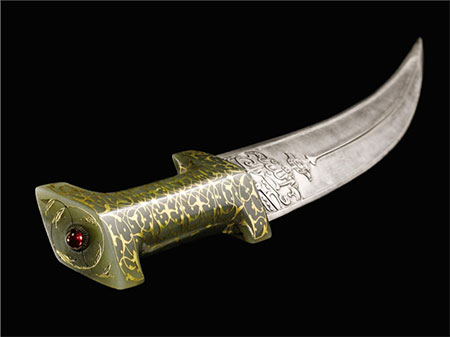 |
| And next week… Sotheby’s holds a sale in London of arts of the Islamic world on April 25, including this 17th century dagger with a gold-inlaid jade hilt. (Photos: Sotheby’s press releases) |
Carbon Trading
You won’t have to go to auction for investment opportunities, if the Securities and Exchange Commission okays the first diamond-backed exchange-traded fund, a topic we first mentioned in December 2010 (“Investments: Grabbing Green and Slumming with Soybeans”). The New York Times looks at the history and prospects in Friday’s “Diamonds as a Commodity.” [back to top]
Burma Bits
Pala’s Bill Larson witnesses history in the making
Pala International’s Bill Larson was lucky on his last trip into Asia (perhaps his 150th!) to be able to witness Aung San Suu Kyi win the election in Burma first hand. What follows is his account of the trip.
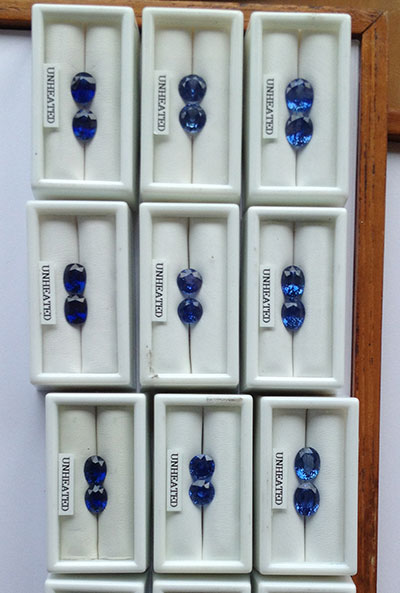 |
| Seeing double. Matched pairs of unheated sapphires examined by Bill Larson in Bangkok. (Photo: Bill Larson) |
On the first leg of my trip, I arrive in Bangkok. During my first three days there, I finish my first selection of gemstones, concentrating on natural sapphires from Sri Lanka and Madagascar, and natural rubies from Mozambique.
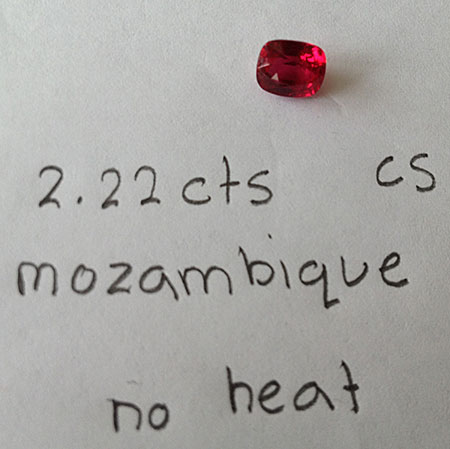 |
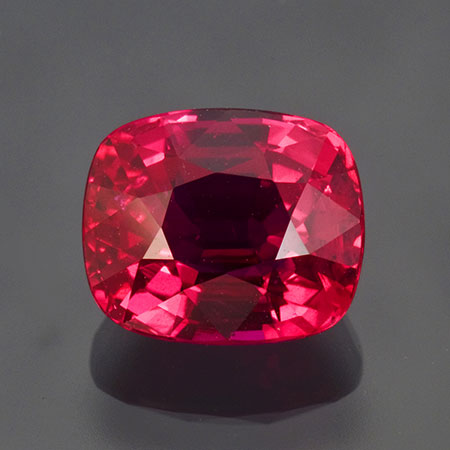
| Expat x2. This unheated ruby from Mozambique was procured by Bill Larson in Bangkok. Ask for Inventory #20076 no longer available. (Photos: Bill Larson, above; Mia Dixon, below) |
 |
During these days’ process I get my visa approved for a week’s visit into one of my favorite countries: Burma (also known as Myanmar). My flight arrives on Friday night, March 30, and I am met by several friends who are excited that I should have come the same weekend that their parliamentary elections are being held.
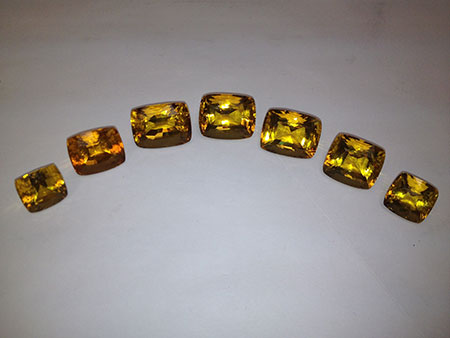 |
| Cretaceous amber. A suite of faceted amber shown to Bill Larson, with a total weight of 55.98 carats. Ask for Inventory #20060 no longer available. (Photo: Bill Larson) |
Saturday, I visit with several dozen geology students and independent miners (some I have known for the 19 years I’ve been coming here to visit). I am always shown whatever new and unusual things they have seen or found. This time, it is a large selection of insect inclusions in amber, which are quite interesting, and clean facet-quality amber. These have been newly mined and seem finer than I’ve seen in my past few trips. They tell me the Chinese are buying most of the amber produced and that this has increased production and prices. I tell the various people that if some of these came into some of my Thailand dealers’ markets and were recut and processed there, Pala International would be interested in marketing them. Various rough pieces of amber, as well as spinel and peridot, all of which would facet fine gems, are to be shown to me next week when I return to Bangkok.
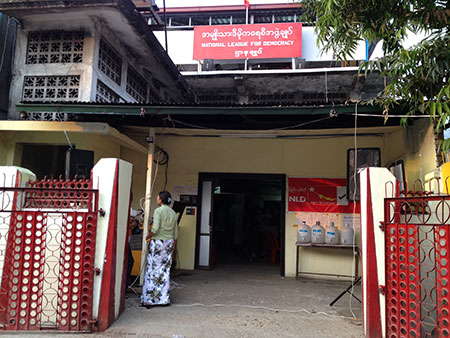 |
| NLD. Office in Yangon of Aung San Suu Kyi’s National League for Democracy. (Photo: Bill Larson) |
That being done, all my many friends talk about the positive changes for them in Burma, including a new wave of independent mining contracts that are being offered to them in Mogok district. This will lead to wonderful new things being produced, perhaps within a year. And the other topic, of course, is that they all will be voting—most at 7 a.m.—tomorrow, Sunday, April 1. Being that the whole group of small dealers, gemologists, miners, geology students and brokers that I know in Yangon (formally known as Rangoon) are pro-West, they universally hope for a National League for Democracy (NLD; Suu Kyi’s party) victory. They all want the sanctions on gemstones and business lifted so that American dealers can come and openly do business in Burma, instead of them having to sell to Thailand dealers who then resell to the U.S.
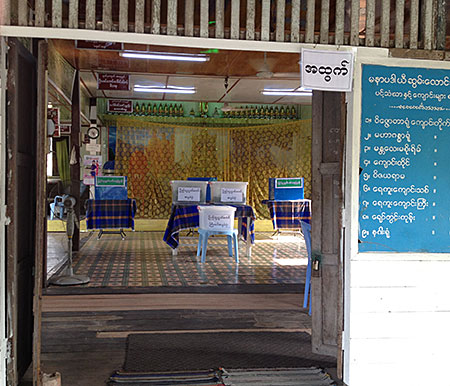 |
| An open door. Entrance to a polling station in Yangon. (Photo: Bill Larson) |
The following day, I witness history. Free elections. I am free to walk around and to watch voting booths; no one is bothering anyone. It is amazing that one can park and photograph Su Kyi’s home. In past years guards would not allow anyone to even stop; now there is a picture of her outside the gates with lots of people walking by. NLD has an open headquarters for meetings; today they are selling memorabilia—tee shirts are flying out the door, with dozens of customers coming and going. It’s a very historic day and, of course, the outcome is known the following day with Suu Kyi’'s party winning 43 out of 45 contests. Of course there needs to be more progress and there are years of work ahead, but my dozens of friends feel it has changed for the better.
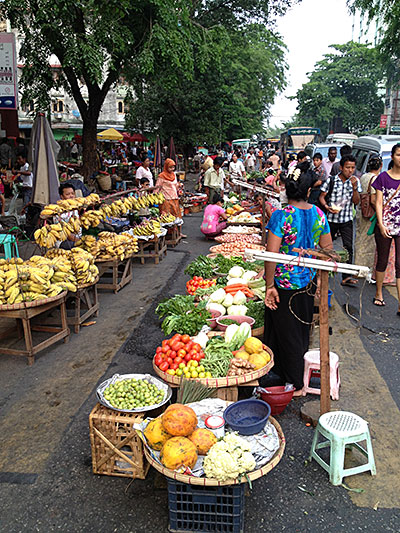 |
| An open market close to the polling station. (Photo: Bill Larson) |
I return on Thursday to Bangkok with an optimistic feeling about the future for my friends in Burma. On Friday I see many of the things I liked in Yangon have been exported into Bangkok and already cut so that business is concluded rapidly. Then I finish my selections from the previous week and get very lucky with one of the major dealers who is selling Pala some calibrated sapphires. His cutters have finished a 3.36-carat Burmese royal blue sapphire gem. This is exciting, as it is so hard to get a certified royal blue, clean gem sapphire from Burma these days. We negotiate a bit, but my Thai dealer friend knows that I know how rare these are. So I agree to his last price and we move on to a fine selection of newly cut Mocambique natural, unheated rubies. Here also I have good luck and obtain several over-3-carat ruby gems.
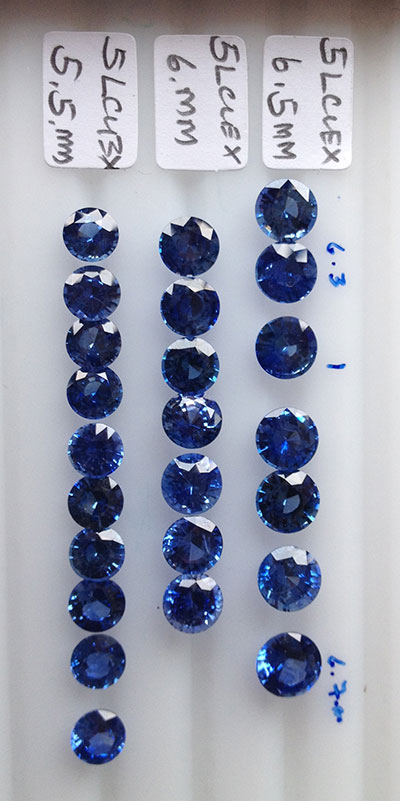 |
| Calibrated sapphires examined and purchased by Bill Larson in Bangkok. (Photo: Bill Larson) |
I have a last day’s meal Friday night with lobster sashimi and know I’ll be back in California in 24 hours. All around, an exciting and wonderful trip.
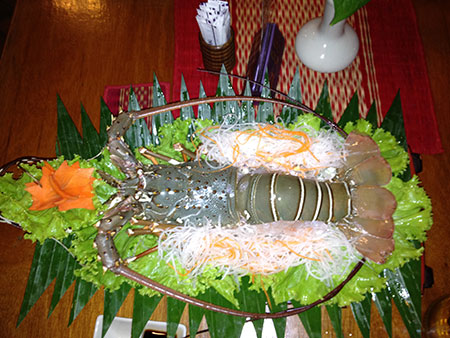 |
| Feast. Lobster sashimi the last night in Bangkok. (Photo: Bill Larson) |
Bite-Sized Bits
Xinhua reported on March 23 that Burma’s 49th annual gem emporium brought in only $702.66 million—compared with last year’s $2.8 billion. The sale was attended by 6,000 traders, half of which were foreigners. A total of 9,762 jade lots were sold, along with 227 gem lots and 8,367 pearl lots. And in other news…
- Myanmar Times: March gem emporium a boost to hoteliers
- Eleven Media Group: Fall in jade exports blamed for $1–2 billion shortfall in Burma’s total trade volume
- Xinhua: Burma bans mineral mining near four rivers, with a 90-meter limit
- BBC: After meeting with Aung San Suu Kyi, prime minister David Cameron called for sanctions against Burma to be lifted, in an April 13 story
- Arabian Gazette: Bill Larson’s friend M. S. Shah Jahan, in the Sri Lankan gem trade, writes on the extraordinary currency reform in Burma, as the kyat floats against the dollar
- AFP: U.S. to ease restrictions on investment in Burma and appoint an ambassador
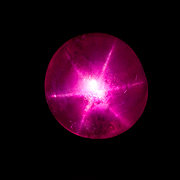 |
| Star power. A natural 5.85-carat round ruby from Burma. Inventory #19983 no longer available. (Photo: Mia Dixon) |
[back to top]
Pala Presents
 |
With Pala Presents, we offer selections from the library of Pala International’s Bill Larson, who will share with us some of the wealth of information in the realm of gems and gemology.
Where Nature Stores Her Jewels
A reprint by Edna Rowell Schley, from Sunset Magazine, 1905
Last month, we presented a contemporary overview of Baja California, 1906, and its varieties of gem minerals. This month we travel north in space and backwards in time, to San Diego, 1905.
A hundred years ago the fair site of a friar mission; eighteen years ago a village of 300 people; seventeen years ago a booming town of thousands; today a city of 25,000 residents with a floating population—visitors with money in their pockets—of 7,000…
Apart from those statistics is another: “In 1901–02, San Diego county produced more tourmaline than the rest of the world.” In “Where Nature Stores Her Jewels,” author Edna Rowell Schley, spends several pages describing the mineral bounty of San Diego County in the early twentieth century.
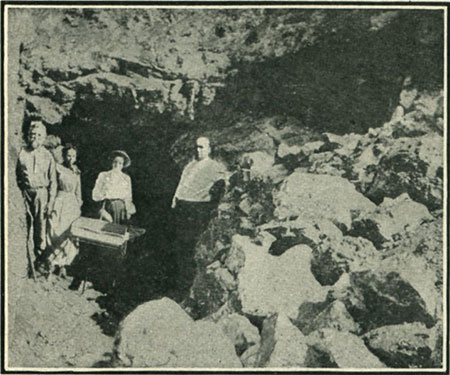 |
| The author, in hat, at the entrance of a tunnel where topaz and tourmaline are mined. |
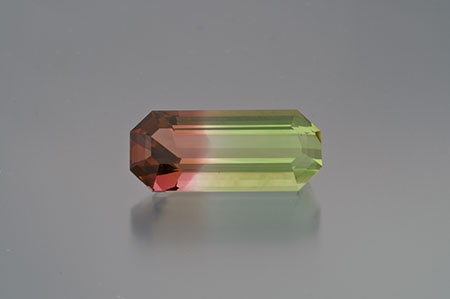 |
| Tre colori. Technically known as a bi-color, this 16-carat tourmaline from the Himalaya mine features an exquisitely undulating red, white and green—like the Italian flag. (Photo: Jason Stephenson) |
[back to top]
— End April Newsletter • Published 4/16/12 —
March 2012 Newsletter
In this edition of our newsletter we feature some thirsty Ethiopian opals, and for those who thirst for information we look at Renée Newman’s new book, and a roundup of recent research. And the latest in our Pala Presents series takes us prospecting south of Southern California, at the beginning of the last century.
Shows and Events
Pala International News
Gems and Gemology News
Industry
Books
- Rare Gemstones
by Renée Newman
Pala Presents
- Uncle Sam’s Oversight
by Elliott Flower
Shows and Events
Euro-Mineral, Euro-Gem on Standby
Last summer, the organizers Euro-Mineral and Euro-Gem announced a move from Sainte-Marie-aux-Mines to nearby Colmar. In November, Sainte-Marie officials, however, announced that they would mount their own show in the little Alsatian commune. Because the shows were scheduled for the same time in June 2012, exhibitors were placed in a predicament.
 |
No more quandary now: Euro-Mineral and Euro-Gem are cancelled for 2012. A full-time staff of four has been laid off as the show’s producers “go into a sort of stand-by mode.” Read the announcement here.
As we reported earlier, the competing show, in Sainte-Marie-aux-Mines, is scheduled for June 21–24. Visit the website here. [back to top]
AGTA GemFair Seminar DVD
 |
The American Gem Trade Association GemFair in Tucson is a trade-only affair. But that doesn’t mean you have to miss out on the seminars. AGTA is making 26 seminars from the recent show available on DVD to the general public.
See this PDF for the list and ordering information.
If you’re a member of AGTA, you’ll receive a complimentary copy. [back to top]
Pala International News
Pala’s Featured Stones: Ethiopian Opal
In recent times play-of-color opal has been discovered in Ethiopia’s Shewa Province (1994) and Wollo Province (2008). The Shewa material turned out to be very unstable and unsuitable for jewelry, while the Wollo opal was more stable and exhibited an unusual property know as hydrophane, i.e., the latter opals came out of the ground very porous, possessing the ability to absorb water. The rich rainbow of colors and transparency are a recipe for beautiful gems. The Wollo opal has the most similarities to the Mexican fire and water opals with play-of-color.
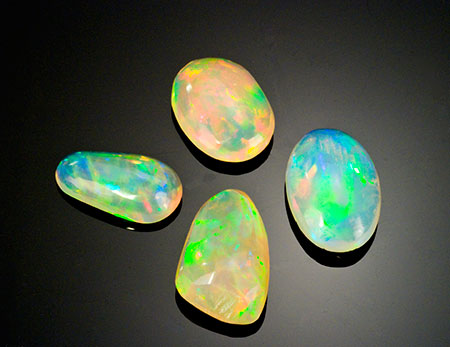 |
| Thirsty. Wollo opals from Ethiopia show a bounty of colors: clockwise from top, 2.75 ct, Inv. #19278 no longer available; 3.38 ct, Inv. #19407; 3.4 ct, Inv. #19274; 1.86 ct, Inv. #19284 no longer available. (Photo: Mia Dixon) |
Interested? Select inventory numbers above, call or email us to inquire. [back to top]
Gems and Gemology News
Research Roundup
GIA on Lead Glass-Filled Ruby
GIA has released a video providing an overview of the issue of lead glass-filled rubies. The video describes the material, looks at how to identify it, how to care for lead glass-filled rubies and nomenclature no longer available.
Pardieu on New Blue Sapphire in Sri Lanka (and more...)
It’s been a while since we visited Vincent Pardieu’s FieldGemology.org. We’ve missed out on a lot. First, a new discovery, in an old locality, of blue sapphire in Sri Lanka. Pardieu gives you a preview of the luscious material that was written up in GIA’s G&G eBrief this week. (Non-subscribers of Gems & Gemology won’t have access to the March 13 eBrief until June.)
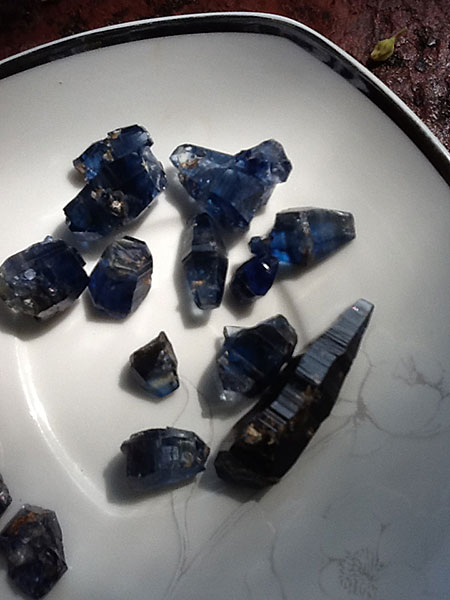 |
| Sri Lanka sapphire. One of Pala International’s many friends sent us this delicious photo to whet our appetite for this new find. |
 |
Next, Pardieu provides the abstract to a study, published in February in Mineralogical Magazine, titled “Conditions for emerald formation at Davdar, China: fluid inclusion, trace element and stable isotope studies,” and co-authored by D. Marshall, Pardieu, L. Loughrey, P. Jones and G. Xue. As always, a great photo of tempting emerald crystals—one 5 cm long—in matrix from Davdar, which is in Xinjiang Province in northwest China.
Then a personal remembrance of the late George Bosshart. Again a picture worth countless words: Bosshart, clearly impacted by the cancer that would fell him, delighted to present to the viewer a fromage-sized wedge of lustrous tanzanite.
And last, from the personal to the more personal, a memoir of Pardieu’s ten years as a working gemologist.
SSEF Facette No. 19
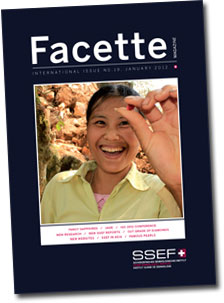 |
SSEF has published the 19th issue of Facette, a gemological journal. Pala’s Jason Stephenson was especially taken with this edition. “This research-based laboratory seems to be expanding and upgrading its journal’s content and exposure. Essential information for those involved in the gem trade.”
The contents include: fancy sapphires, jade, bastnäsite, corundum research, rostellite, odontolite and apatite, pearl testing and research, an expedition to Vietnam, a memorial of George Bosshart, and more.
Download the PDF here.
Gems & Gemology: Blue Topaz
We couldn’t resist this. The current issue of Gems & Gemology includes an article by Jian Zhang, Taijin Lu, Manjun Wang, and Hua Chen: “The Radioactive Decay Pattern of Blue Topaz Treated by Neutron Irradiation.” The team studied 15 neutron-irradiated blue topaz samples. The decay pattern of the samples was determined and the time for decay to safe levels was calculated. The results? Most of the material was safe when first measured at 95 days after leaving the reactor, but some samples indicated that it would be years before they would be safe, due to higher concentrations of radionuclide impurities. See our past coverage of this issue here. [back to top]
Industry News
The Argyle Pink Jubilee
Giving many a collector of fine mineral specimens a broken heart, it was announced that Australia’s largest pink rough diamond would be cut, following two months of study, by Argyle’s Richard How Kim Kam. As Pala International’s Bill Larson put it when he received the news, “The world’s best thumbnail crystal specimen... sacrificed to make a cut gemstone!” The 12.76-carat crystal was discovered by Australia’s diamond producer Rio Tinto at its Argyle mine, famous for its pink product, which commands 90% of the market. According to the company’s February 21 press release, only 18 polished pinks over 10 carats have been auctioned by Christie’s in its 244 years of existence.
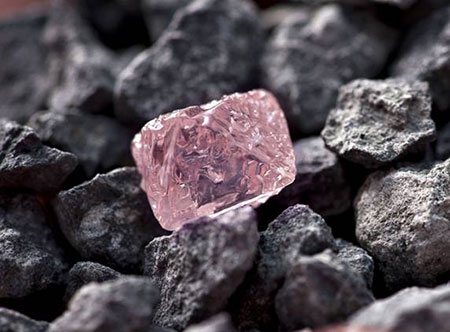 |
| The Argyle Pink Jubilee, in a handout photo provided by Rio Tinto. |
See two more handout photos from Rio Tinto via Agence France-Presse.
And if you, too, love thumbnails, you’ll want to check out BlueCap Productions’ Mineral Perspectives: Thumbnails – Volume #2.
[back to top]
Burma Bits
Calendar Year Gem Production Down
Last month, Burma’s Central Statistical Organization released gemstone production figures for December 2011, allowing us to look at a full calendar year. (Burma’s fiscal year runs April–March.)
- Jade: 25% increase over 2010
- Rubies: 37% decrease from 2010
- Sapphire: 17% increase over 2010
- Spinel: 3% increase over 2010
- Peridot: 7% decrease from 2010
- Total Gem Production: 12% decrease from 2010
- Pearls: 13% increase over 2010
Extrapolating from last year’s production, the 2011–12 fiscal year will see a slight drop in total gemstone production, a trend of the last three fiscal years—about 12 million carats. By comparison, 2007–08 produced nearly 23 million carats, and 2008–09 produced nearly 19 million.
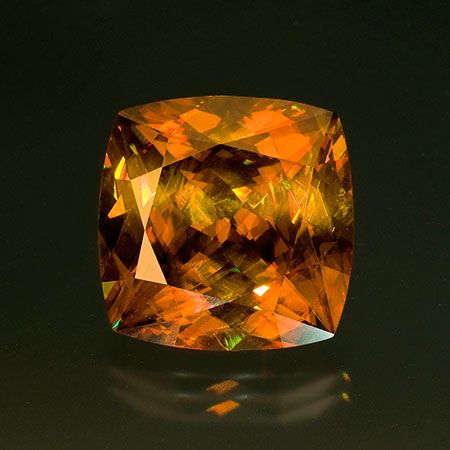 |
| Sphene. This golden brown sphene from Mogok, included in Renée Newman’s new book Rare Gemstones (p.84), was our featured stone for November 2010. It weighs 40.33 carats and measures 20.03 x 20.05 x 12.86 mm. Inventory #18755. (Photo: Jason Stephenson) |
Emporium Taking Place Now
Mizzima wrote on March 9 that the 49th annual gem emporium in Burma was to be held from March 9 to 18 in Nay Pyi Taw. Offered are nearly 17,000 jade lots, 227 gem lots and 367 pearl lots. The story provides a lot of detail regarding the nature of the lots, including 41 jade lots worth over €1 million and others worth €3.2–5 million.
Kachin: Chinese Jade Mining Outside Approved Sites
Chinese companies are running jade mining operations outside their licensed sites in Kachin state’s Hpakant and Dalon regions, according to a March 7 story on the Democratic Voice of Burma (DVB) website. The story quotes a Hpakant resident and prominent jade producer as saying the logic behind the renegade excavation is fear that a new government in Burma will not treat the Chinese as favorably as in the past. One reason for this fear could be the suspension of the Myitsone Dam project in 2011.
The story states that about 200 companies—Chinese and backed by the Burma government—operate in Hpakant. As we’ve noted previously, villages are at risk of monsoon flooding due to environmental consequences of jade mining. The DVB story stated that the Chinese companies are using heavier machinery than for which they are licensed and are operating 24 hours a day.
» Bill to Allow Local Jade Processing; Trade Group Formed
The Kachin State Assembly has passed a bill that will allow local processing of jade, including cutting and polishing, according to a March 7 story by Mizzima. The bill, introduced on March 1 and passed unanimously, is hoped to create jobs in Kachin. It now moves to the president for signature. As currently configured the processing of jade requires the boulders to be shipped to Nay Pyi Taw for cutting and polishing, which adds cost to the finished product.
Mizzima went on to write that a new trade organization was founded on March 3, The Jade and Gemstones Merchants Association (Myitkyina), which includes 400 members. A head office is in Nay Pyi Taw, and branch offices are in Hpakant, Mandalay, Sagaing and Mogok.
» Peace Talks Pause, Clashes Begin
Meanwhile, a breakdown of peace talks in China between the Burma army and Kachin rebels led to new fighting on Monday. The conflict is outlined in this March 3 Associated Press story, as the government claims it will have refugees relocated by May. And also in Ruby Land.
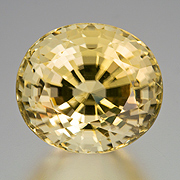 |
| Dusting off a danburite. This 20.58-carat pastel yellow Burma danburite was given the spotlight by our photographer Mia Dixon, in our Old Stock... New Pix section. Inventory #16134 no longer available. |
[back to top]
Books
Rare Gemstones
By Renée Newman
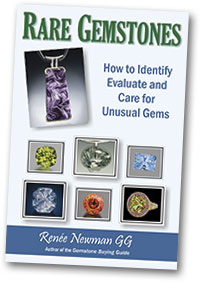 |
The latest book from Renée Newman, author of Gemstone Buying Guide, is actually a companion to that acclaimed book, which was first published in 1998. As tastes have become more sophisticated and as consumers attempt to satisfy their appetite for novelty, Newman’s Rare Gemstones provides information on dozens of stones not included in the earlier book, literally from A(mblygonite) to Z(ultanite).
The book, subtitled How to Identify, Evaluate and Care for Unusual Gems, is divided into two major sections. The largest, “Rare Gemstones Used in Jewelry,” covers nearly fifty gems and related varieties. Nearly twenty more are handled in “Rare Gemstones Sometimes Used in Jewelry.” Included for each gem is information on the identification properties, geographic sources, treatments, imitations, durability, uses, value factors and pricing. The entry for each gem is accompanied by several photographs—nearly 500 in all—and many of the stones are mounted in jewelry settings.
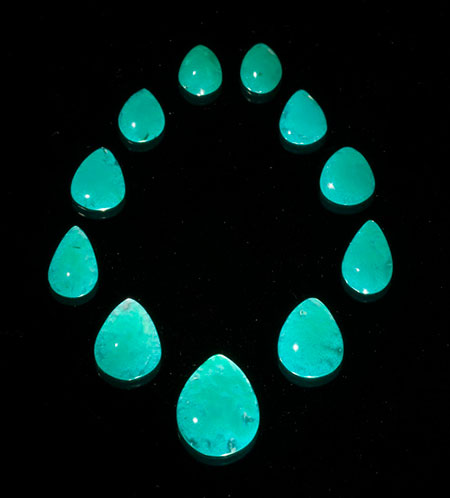 |
| Chrysocolla. This suite—our featured stones for August 2009—was cut from the same piece of rough, from the Globe Hills of Arizona, providing uniform color. It’s on p. 29 of Rare Gemstones. Inventory #17488. (Photo: Jason Stephenson) |
These sections are followed by “How to Care for Rare & Unusual Gems,” covering storage, cleaning, durability, setting tips, and more. Also included are appraiser directories; a list of birthstones; a bibliography and index; tables of Mohs hardness, refractive index and specific gravity; and a glossary. The endpapers have a photo of gemstones arranged in color groupings for quick identification of that hard-to-name tugtupite.
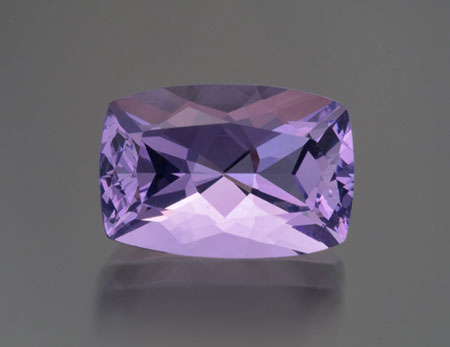 |
| Hackmanite. This 7.87-carat transparent lavender hackmanite was snapped up after it appeared as our featured stone for May 2009. It appears on p. 82 of Rare Gemstones. (Photo: Mia Dixon) |
It’s a lot of information packed into less than 140 pages. Rare Gemstones is available from your favorite bookseller or via a link on the book’s website.
Own a gem from the book
Several of the gemstones pictured in Rare Gemstones are available to the retail-buying public via the Collector’s Corner section of Palagems.com.
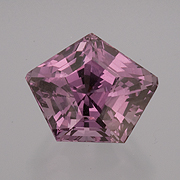 |
| Taafeite. This 8.5-carat taafeite is found on p. 114 of Rare Gemstones. Look for it in Collector’s Corner no longer available. (Photo: Wimon Manorotkul) |
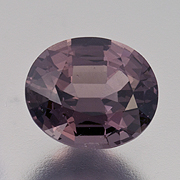 |
| Taafeite. Also on p. 114 is this moody 2.35-carat taafeite with brown body tone and slight lavender secondary. Look for it in Collector’s Corner no longer available. (Photo: Mia Dixon) |
As you browse Collector’s Corner you may recognize from the pages of Rare Gemstones several other stones that we’ve pointed to in the last year or so: a 28.55-carat oval calcite (p. 24, Inv. #11295), a 8.44-carat pear cabochon hackmanite (p. 82, Inv. #14861), and a 5.30-carat fluorite (p. 44, Inv. #14245).
[back to top]
Pala Presents
|
With Pala Presents, we offer selections from the library of Pala International’s Bill Larson, who will share with us some of the wealth of information in the realm of gems and gemology.
Uncle Sam’s Oversight
A reprint by Elliott Flower, from Technical World Magazine, 1906
The cover of the June 1906 edition of Technical World Magazine (forerunner of Popular Mechanics) declared “First Photos ’Frisco Ruins!”; the 7.7–7.9 magnitude earthquake had struck only about a month before, with fire destroying half of the buildings that would have survived the temblor. Before-and-after shots in the photo essay are humbling in their depiction of a world-class city brought to its knees. About a month before, Upton Sinclair’s The Jungle was published, creating shock waves of its own. It was the middle of the Progressive Era in which government began to intervene in ways it hadn’t before. The United States was on the move, as was alluded to in another article in the June 1906 Technical World.
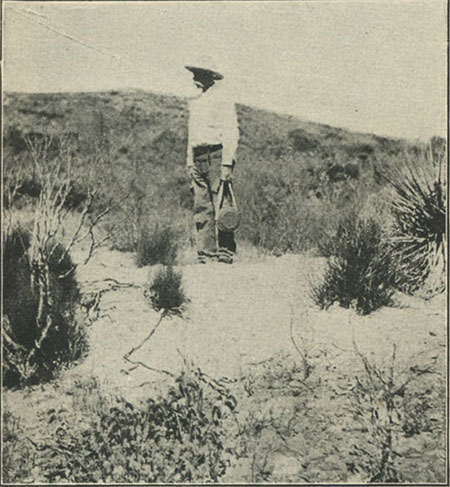 |
| Rancher and miner Eduardo Roderiquez, of Jasay, in north central Baja, stands at one of his mines. |
In “Uncle Sam’s Oversight,” the latest entry in our Pala Presents reprint series, Elliott Flower takes the reader on a tour of Baja California, and at nearly every turn he notes how, if only resources were brought bear in Baja, as they were north of the border, what a place Baja could be. In the third person he laments:
For, in Lower California to-day, there is no man so poor that he may not have a pleasant, plausible dream of wealth. Indeed, it is quite probable that, had the Mexican dreamed less, he would now have more of the wealth within his grasp. As for the American, he is after the wealth in his own strenuous way, tempered somewhat by climatic conditions; but he feels that he would have a much better chance under Uncle Sam’s beneficent rule.
As we note in the introductory note to “Uncle Sam’s Oversight,” Flower’s employment of the “sleeping Mexican” stereotype is curious because his article sets out to dispel another stereotype—that Baja is but a barren pile of rocks. Flower takes us on a tour of the peninsula, likening it to Italy. But also it is the rocks that Flower surveys—hyacinth (varieties of zircon) and jargoon, tourmaline, beryl, varieties of garnet, turquoise, jasper, epidote, rose quartz, and more.
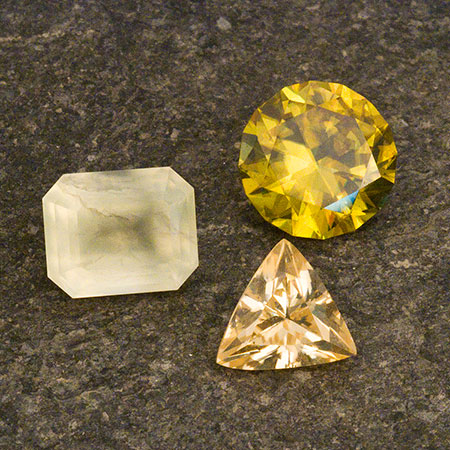 |
| Un trío baja californiano. Clockwise from left, yellowish-green prehnite weighing 3.21 cts, sphene from Pino Solo weighing 3.61 cts and a trillion scheelite from the El Fenomeno Mine, Sierra Juares, Baja California, Mexico. (Photo: Mia Dixon; Collection: Bill Larson) |
[back to top]
— End March Newsletter • Published 3/15/12 —
February 2012 Newsletter
In this edition of our newsletter Tanzania takes center stage, with a gem fair, a study of alexandrite and color-change chrysoberyl from the country’s Lake Manyara, and news (via AGTA) that tanzanite will go public (via Richland Resources). We also cover Burma, past and present, with vintage material from one J. F. Halford-Watkins (1936) and Martin Ehrmann (1957), and the latest from Jade Land.
Shows and Events
- GIA Presents “Tablet to Tablet: Treasured Pages from Past to Present”
- Mines to Market Show in Trends & Colors
Pala International News
- Pala’s Featured Stone
- Bill Larson to Speak at Arusha International Gem, Jewelry and Minerals Fair: Apr 26–29, 2012
- Bill Larson to Present at Dallas Symposium: August 25, 2012
- Tucson Time: Pala Pix
Gems and Gemology News
- Alexandrite and Color-Change Chrysoberyl from Lake Manyara, Tanzania
- George Bosshart on Bi-colored Beryl—“Emeraqua”
Industry
Books
- The Book of Ruby & Sapphire, From an Unpublished Manuscript by J. F. Halford-Watkins, 1936
Edited by Richard W. Hughes
Pala Presents
- Burma, The Mineral Utopia – Part Three
by Martin Ehrmann
Shows and Events
GIA Presents “Tablet to Tablet: Treasured Pages from Past to Present”
GIA (Gemological Institute of America) presents an exhibition of more than 26,000 pages from rare books dealing with gems, minerals and natural science—“Tablet to Tablet: Treasured Pages from Past to Present.”
The oldest book included in the show is a 1496 edition of Pliny the Elder’s (23–79 CE) Natural History; the “books” from this encyclopedia on mining and mineralogy, XXXIII–XXXVII, contain some of the most important classical writing on mineralogy and gemology.
 |
| As an amusing Quantum Theology blog entry explains, Pliny the Elder is said to have hunkered down to do his writing, including his Natural History, with a guard at the door, lest he be bothered. Bothered he was, in the end, by the eruption of Mount Vesuvius, which led to his death. |
Fifteen display cases in the GIA exhibit demonstrate “the development of gemology, crystallography, jewelry manufacturing and design, valuation of gemstones and precious metals, diamond mining and more,” according to a press release. The exhibit will be open to the public until early this summer.
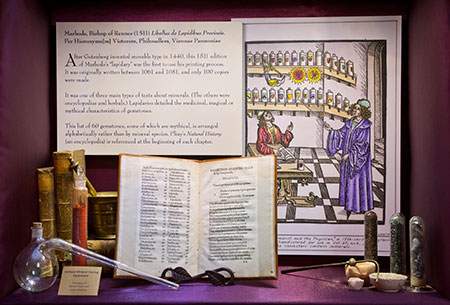 |
| Displayed is the first edition (1511) of Liber de lapidibus by Marbode (1030s–1123), Bishop of Rennes. Marbode composed primarily in verse, this lapidary being no exception; it originally contained 742 lines describing 60 gemstones—some mythical. A Mineralogical Record biography of the poet states that the book actually falls into the area of medical writing, since most of it touts the healing properties of the stones. (Image © GIA) |
[back to top]
Mines to Market Show in Trends & Colors
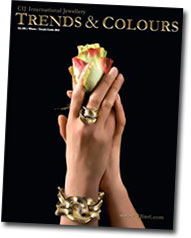 |
CIJ International Jewellery’s twice-yearly Trends & Colours trend-tracking guide, covered the First Mines to Market Coloured Gemstone Conference in India in its Winter 2012 edition. (Web edition available here; look for page 40.)
The article, by Cynthia Unninayar, begins with some statistics: India’s gemstone industry employs nearly one million people and colored stone exports in 2010–11 rose nearly 10% over 2009–10. The article is peppered with other statistics, such as Edward Boehm (RareSource, and InColor contributing editor) noting that 80 percent of colored gems, from the 47 nations that produce them, originate from artisanal and small-scale mining operations. This would raise issues of ethical mining and fair trade, which were addressed at the conference, amongst a number of other topics, covered in the article.
And for another colorful look at the Pushkar Camel Fair that rounded out the conferees’ visit, see Richard Hughes’s photo album, “Pushkar: India’s Camelot.” [back to top]
Pala International News
Pala’s Featured Stone: Purple-Pink Zoisite from Tanzania
This month we feature a purple-pink zoisite from Tanzania. The Merelani mines have produced large amounts of blue-to-purple tanzanite since its original discovery in 1968. The mines also have produced gem quartz, diopside, prehnite and calcite. Occasionally pink and purple zoisite (often referred to in the trade as pink tanzanite) is unearthed in small, localized pockets, but production of these colors is very limited.
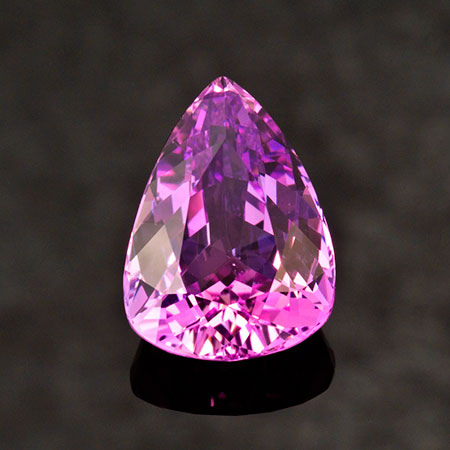 |
| Purple-pink zoisite, 4.28 carats, 12.18 x 8.89 x 5.61 mm, ask for Inventory #19821 no longer available. (Photo: Mia Dixon) |
When the team at Pala first saw the intensity and brilliance of this jewel we figured it was a spinel or kunzite. We were all shocked to hear it was in fact a natural zoisite, and the color was unlike any we had seen in the past. Apparently the small series of pockets that produced this purple-pink color only yielded a few pieces of facetable rough. Luckily we were able to score this 4.28-carat gem before the AGTA show began. Pala’s supplier was quite confident that this stone was perhaps the finest single gem produced from these pockets.
Bill Larson to Speak at Arusha International Gem, Jewelry and Minerals Fair: April 26–29, 2012
|
The Ministry of Energy and Minerals of Tanzania and the Tanzania Mineral Dealers Association are sponsoring a four-day Arusha International Gem, Jewelry and Minerals Fair, April 26–29, 2012. It will be held at the recently renovated Mount Meru Hotel in Arusha, in northeastern Tanzania.
The event will gather gem and mineral producers from thirteen sub-Saharan Africa countries. According to a press release:
Exhibitors will be required to showcase their work in the community, as well as participate in the sharing of best practices across their peers, with the continuous aim of making the mining/trading process in Sub-Saharan Africa one which invokes confidence in the end consumer. As a special feature in the AIGJMF event, organizers will be specifically focusing on empowering women in the gemstone trade through education in the areas of cutting and carving, and mentoring by strong female leaders. An evening gala will be held to raise funds to sponsor a group of women through the Tanzania Gemological Center training program in Arusha. Through this program, not only do we increase our skilled cutting and carving pool in Tanzania, we more importantly teach a sustainable trade to the women who serve as the family nucleus.
Keynote speakers addressing the fair participants will be AGTA CEO Douglas Hucker and Pala International’s Bill Larson, who will speak on the importance of African colored gemstones in today’s market. Lapidary Stephen Avery will give demonstrations. Attendees will have the post-conference option of one of several tours on April 30 to mines in Merelani (whence cometh this month’s featured stone), the Umba Valley (in the Usambara mountains, from which the “Usambara effect” in chromiferous green tourmaline received its name), and unnamed ruby and green garnet mines.
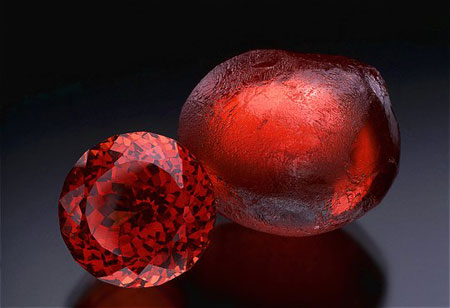 |
| Tanzalicious. Above, garnet, var. malaia (pyrope-spessartite), 23 cts (cut) from Umba, Tanzania, site of one of the post-conference excursions. Below, chromiferous green tourmaline from Tanzania. (Photos: Jeff Scovil) |
 |
[back to top]
Bill Larson to Present at Dallas Symposium:
August 25, 2012
The theme of this year’s symposium is “Expeditions to Bring Out Mineral Specimens from Around the World.” Pala’s Bill Larson will present on “Burma’s Ancient Valley of Gems and Rubies,” regarding travels to the source in Mogok. Herb Obodda will discuss “Dangerous Beauty: Minerals of the Hindu Kush,” regarding the opening of Afghanistan and Pakistan for mineral specimens, 1969–present. Mineral cleaning and preparation technology will be handled by Jon Voelter. Rock Currier will look at “Exploring the Mines of Dal’negorsk, Siberia,” and Les Presmyk will discuss “Bisbee, Arizona: History, Significance and Treasures.”
Two sessions will address “Science for the Collector.” Dr. David London, of the University of Oklahoma, will speak on “Gem-Forming Pegmatites: How Nature Makes Big, Clear Crystals.” Dr. Peter Megaw, president of IMDEX/Cascabel, will present on “Formation of Open Pockets of Collectible Crystals in Carbonate Replacement Deposits – Tsumeb , Dal’negorsk and Milpillas.”
Seating is limited, so see the symposium website for details.
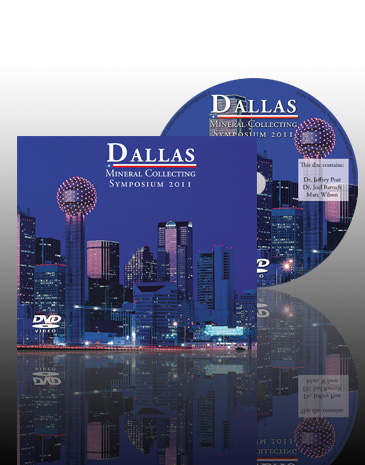 |
| Last year’s symposium featured luminaries from seven institutions from across the country. It’s available from BlueCap Productions. Just enter the code palaintl when you’re asked for it while ordering. |
[back to top]
Tucson Time: Pala Pix
A report by JCK on this year’s AGTA GemFair was upbeat, with American Gem Trade Association CEO Doug Hucker saying that attendance was at least steady with last year, or perhaps “slightly up.” Several dealers were quoted as saying that the finer stones were in demand, but only after careful deliberation. This year saw the debut of the AGTA Preferred Pricing Program, which rewards AGTA with a 5% discount on buys from more than 120 exhibitors.
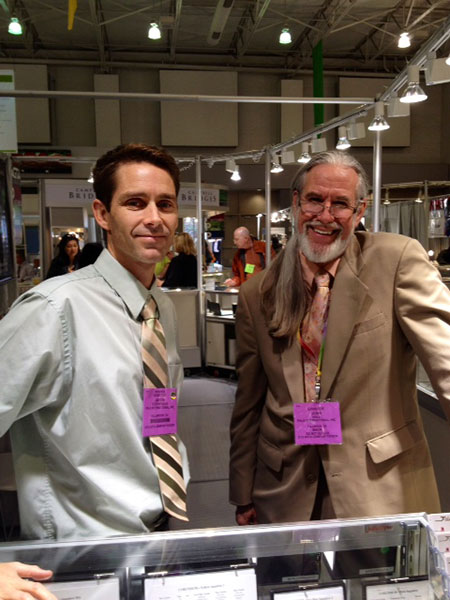 |
| Pala International’s Jason Stephenson, left, and Josh Hall at this month’s AGTA GemFair in Tucson. (Photo: Geri Vigil) |
“This year’s AGTA show definitely kick started 2012,” said Pala’s Jason Stephenson. “It seems like the show started off with a lot of excitement and stayed fairly busy throughout. All the usual clients and gem enthusiasts were out and about buying and swapping stories from the year past and looking forward to what new may come.” Regarding what clients were on the prowl for, Jason continued, “Natural sapphires and rubies, spinels, tourmaline of all varieties had the biggest amount of fingerprints at the end of the show. Garnets seem to be a big hit this year with a lot of interest in Russian demantoid and Nigerian spessartite.”
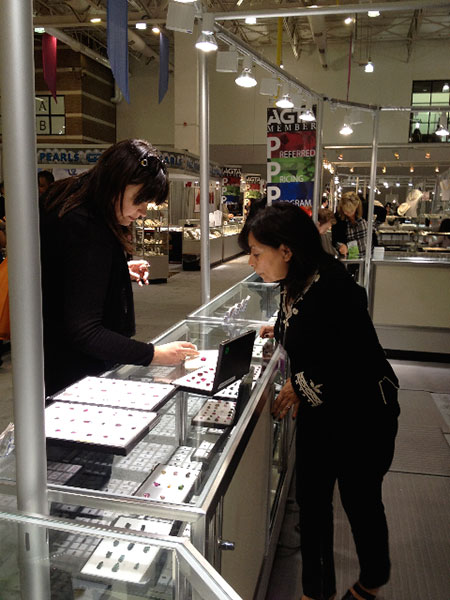 |
| Pala’s Gabrièl Mattice gets the red out at the AGTA GemFair. (Photo: Geri Vigil) |
As to the word from peers, Jason commented, “A lot of positive reviews from other dealers around the show as well, so it seems we are off to a good start as some economic indicators seem to be starting to point in the same direction.” Bill Larson capped that assessment: “Pala was extremely happy and successful this Tucson faire at all three venues—AGTA, Westward Look, and TGMS—with each one surpassing our best expectations.”
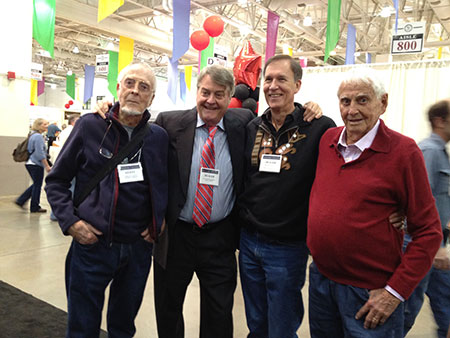 |
| Hundreds of years of expertise. At the AGTA GemFair, from left, photographer and crystal artist Harold Van Pelt, Pala’s Bill Larson, collector Alex Schauss, and Ed Swoboda, who was to give a rare talk at the Westward Look Show. (Photo: Laura Schauss) |
For on-the-floor reports, see Gary Roskin’s The Roskin Gem News Report; Roskin also includes his wrap-up from 2011 for handy comparing.
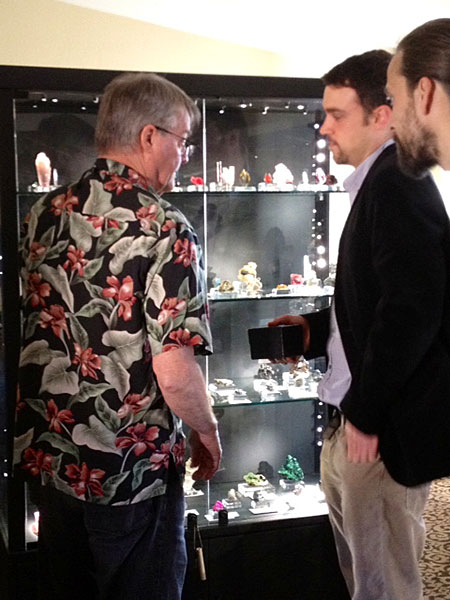 |
| Bill Larson, very happy to be out of a suit and tie at AGTA, dons a more relaxed style at the Westward Look mineral show, and finds just the thing for a client’s little black box at the Westward Look Show. (Photo: Geri Vigil) |
During the show, a benefit for the charity Jewelers for Children, the musical jam called GemJammin’, was held at local tropical-watering hole, The Hut. The 2011 event brought in $5,000 for the cause. Visit Facebook for a selection of jams.
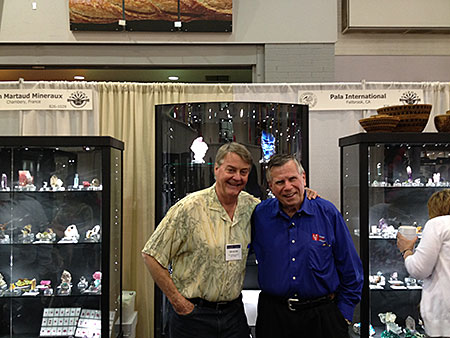 |
| Bill Larson at Pala’s booth at the Tucson Gem and Mineral Show with legendary mineral expert and host of “What’s Hot In Tucson” annual rockumentary, David Wilber. (Photo: Will Larson) |
[back to top]
Gems and Gemology News
Alexandrite and Color-Change Chrysoberyl
from Lake Manyara, Tanzania
Study by Dr. Karl Schmetzer and Anna-Kathrin Malsy
provides guide for gemologist, lapidary and jeweler
When first discovered in the late 1960s, the emeralds of Lake Manyara, 150 miles west of Arusha in northern Tanzania, caused at least one party to take note, even if a mica prospector had thrown some of the green crystals away as worthless. (See Hamza Kondo, Colored Stone, 2005.) That party, Hans Kristen (himself a prospector and mine operator), had seen the crystals in Arusha and finally was able to track down the source, in Maji Moto (hot springs) in the area of Lake Manyara. In early 1970, the primary deposit was located on the lake’s western bank and mined for the next couple of years, until the mine was nationalized by the Tanzanian government. Eduard Gübelin and Hermann Bank visited the mine (known as the Mayoka mine) in 1973–74 to find it in full production, with Kristen in charge, but the state stepped in again, and mining dropped off by the late 1980s. Until 2009 no mining to speak of had been done, although the occasionally smaller parcels of gem-quality emerald and alexandrite reached the market. Various claims in the area are now being worked again.
 |
| Alexandrite trilling from Lake Manyara, Tanzania, shown in daylight. From the collection of Werner Radl, Niederwörresbach, Germany. The trilling weighs 132 g, view almost parallel to the a-axis, size 62 × 43 mm, thickness along the a-axis 29 mm. (Photo: Karl Schmetzer). |
Forty-some years after the initial discovery, Dr. Karl Schmetzer and Anna-Kathrin Malsy have published a 31-page study, “Alexandrite and colour-change chrysoberyl from the Lake Manyara alexandrite-emerald deposit in northern Tanzania,” in the pages of The Journal of Gemmology (Vol. 32, No. 5–8, pp. 179–209). The study includes quite a lot of historical details and points to other sources for more.
Last year, the authors, along with two colleagues, discussed the formation of emerald and alexandrite in phlogopite (a brown micaceous mineral) bearing host rocks (see our overview of “Alexandrites from a Unique Deposit in Zimbabwe” regarding the Novello deposit). The present study recaps that information before looking at the geology of the deposit at Lake Manyara. Just as the prior study remarked on similarities between Novello’s emerald-alexandrite and the classical emerald-alexandrite-phenakite deposits in the Russian Urals, prior studies of Lake Manyara occurrences have pointed to a similar comparison. The present study, relying on published and unpublished reports, notes inconsistencies in the details, but concludes that the mining area at Mayoka is “the same kind” as those found in the Urals and Novello.
While citing reports that date back to the mid-1970s (see, e.g., Gübelin, Gems & Gemology, Vol. 15, No. 7, pp. 203–209), this new study observes that the morphological properties of rough crystals previously had been touched on only lightly, and no reporting had been done on growth patterns of rough and faceted samples. Trace element analysis was limited in earlier reports, as was analytical determination of inclusions. So this new study fills the void as regards the Lake Manyara material, while also building upon recent studies by Dr. Schmetzer and his colleagues in terms of comparison with material from the other sources.
The authors studied more than 200 complete crystals, crystal groups, fragments, and specimens in matrix, as well as 45 faceted stones from 0.15 to 3 ct, all collected from the 1970s through 2009. Differences between samples collected in different decades were not significant.
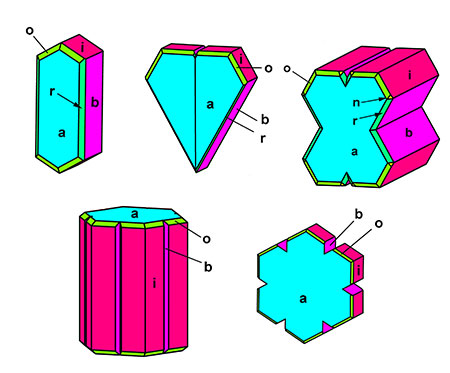 |
| Schematic drawings of alexandrites from the Lake Manyara deposit, Tanzania. Clockwise from upper left, single crystal, one contact twin, one penetration twin, one trilling with tabular habit and one trilling with columnar habit. (Crystal drawings and artwork: Karl Schmetzer) |
Out of eight possible crystal designations falling under three crystal forms—pinacoid, prism and dipyramid—all but one applied to alexandrites from Lake Manyara when determination of habit was made—single crystals, contact twins, penetration twins or cyclic twins (trillings). Two major habits were found within each of the latter four groups. Somewhat distorted trillings and irregular twins contributed to the conclusion that the variability of morphology “is enormous,” and thus is comparable with or perhaps exceeding that of the Russian Urals. Pleochroism is distinct and the colors of the alexandrites and chrysoberyls in daylight range from varied shades and intensities of green to yellowish green or bluish green.
Growth structures, twinning, inclusions and zoning were examined microscopically beginning with rough samples; the results are documented with five pages of photomicrographs. One characteristic of interest in some samples is the presence of a milky zoning that needs not detract from appearance in faceted stones, if the direction of the cut is chosen correctly. Direction of view, it turns out, is a key component of the study’s six pages dealing with composition and colormetric data, and the information here can be valuable to the gemologist, lapidary and jeweler. While the presence or absence (or quantity) of chromium has been assumed to distinguish alexandrite from chrysoberyl, the study demonstrates that color change in rough and faceted alexandrite depends on the amount of chromium present and on direction of view or orientation of the table facet. Such variability has contributed to debate in the gem trade regarding designation of alexandrite versus chrysoberyl, as the authors witnessed. After measuring colormetric data and placing thirteen stones of both varieties, which are displayed in two photographs, on a CIELAB color circle in both daylight and incandescent light, numerous dealers were asked to assign their designations of alexandrite or chrysoberyl, which, perhaps predictably, varied widely. Although the boundaries between alexandrite and green chrysoberyl were chosen differently by various dealers, there is, however, a general agreement that alexandrite must show a red colour component in incandescent light.
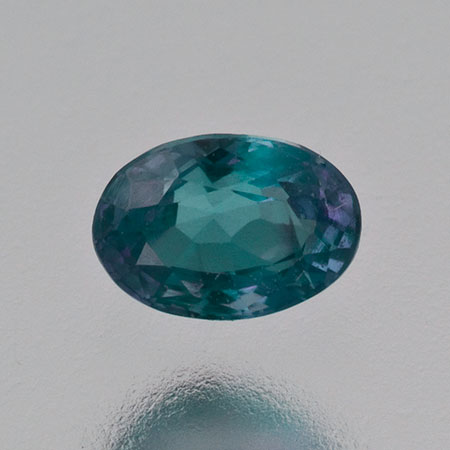 |
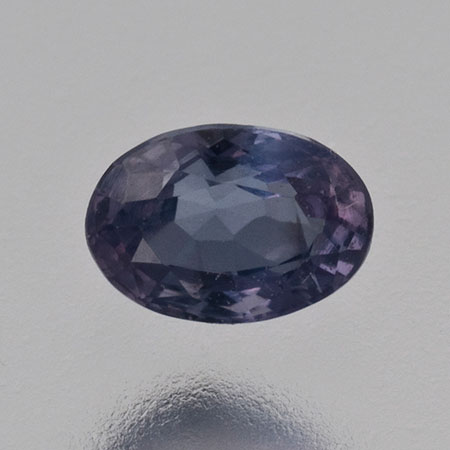
| Color change in faceted alexandrite from Tanzania is demonstrated by one of a pair in Pala International’s Inventory #14262 no longer available (0.26 ct, available separately). Note that the view in daylight, above, has a hint of the purple to be seen in incandescent light, below. (Photos: Mia Dixon) |
 |
A comparison of the Lake Manyara material with other, similar deposits, follows. For instance, whereas the main Novello emerald- and alexandrite-bearing deposits were found about 1 km apart, the distance in Lake Manyara varies from a few tens of centimeters to a few meters or tens of meters. While chromium content might point towards identification of locality between Lake Manyara, Novello and Russian alexandrites, the study concludes that trace elements—as demonstrated by two ternary diagrams—are a more valuable giveaway.
The depth of detail in this study allows it to be well placed alongside Dr. Schmetzer’s Russian Alexandrites monograph as well as the aforementioned study of alexandrites from Novello. [back to top]
George Bosshart on Bi-colored Beryl—“Emeraqua”
George Bosshart, who passed away last month, was a colleague of Dr. Schmetzer, and his contributions to the above study are mentioned in its acknowledgements and references. We thought our readers would be interested in one of the last reports undertaken by the late researcher. The following appeared in our sister e-newsletter, Pala Mineralis, earlier this month.
In November of 2010 Pala International’s Bill Larson was notified by the late George Bosshart of some intriguing crystals.
I have a topic for you, the connoisseur of the Afghanistan-Pakistan and other beryl-producing areas: You cannot be aware of our totally unexpected find of cm-size emerald crystals in the Binntal (the famous mineral paradise in the southwestern Swiss Alps) because we have published the find in a Swiss mineral magazine only (Krzemnicki M. S., Bosshart G.[2003]: Der Binntal-Smaragd als Juwel. Schweizer Strahler, 13, 4, 31-33. ISSN 0370-9213).
The topic has not been published in English.
Certainly it is not the size of the emeralds which is noteworthy but the optical and chemical properties which strongly resemble those of Colombian emeralds and even more so a phenomenon which truly is rare. A few of the longer double-ender crystals are bi-coloured, chromium-green on one and aquamarine-blue on the opposite end. This catapults our tiny babies into a world of their own, the emerald-aquamarines or “emeraquas.”
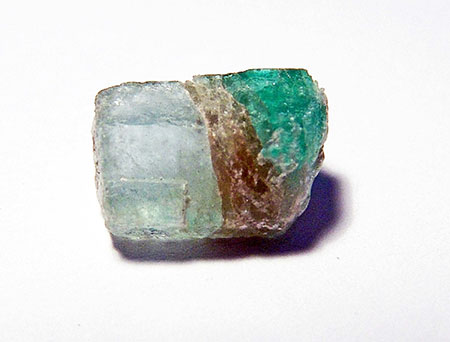 |
| Figure 8a. Bi-coloured Habachtal beryl specimen, consisting of an emerald top and a milky base (due to inclusions), separated by a mica layer. Weight 4.99 ct. Donation G. Grundmann. |
Bill Larson replied, “I have seen some of these new Austrian emeralds; some with aquamarine. They are quite unique.” We immediately followed up with Bosshart, asking whether we might publish his remarks. He replied:
Palagems people have never been asleep, just like their big boss. This time, however, I have to pull the brakes. I do not see the urgency for publication or pre-publication of the subject, especially since I have no decent specimens and analytical data. … I will consider sending you a write-up as soon as I have made substantial progress on the topic.
Before George Bosshart’s death, we received an elaboration of his poster session on the subject, which he presented to the 32nd International Gemmological Conference, July 2011, in Interlaken, Switzerland. While we feel the loss of the man, his work endures. In celebration of the life and loves of George Bosshart we are pleased to publish “Do bi-coloured, green and blue beryls exist, which are composed of emerald and aquamarine zones?” [back to top]
Industry News
AGTA in Times Square
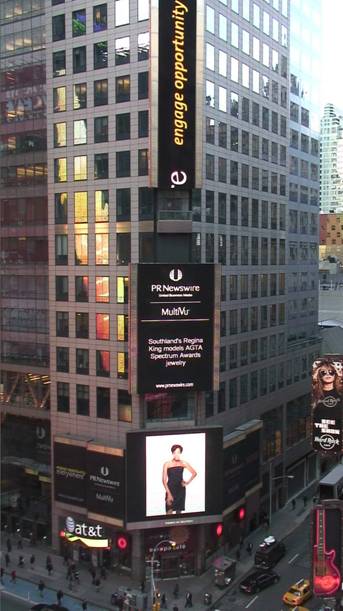
Regina King, Illeana Douglas model award-winning designs
American Gem Trade Association’s annual Spectrum Awards for jewelry design took its companion photo shoot to new heights last month—literally. The session, styled by Tod Hallman and shot by Ben Cope, featured Regina King (of TV’s Southland) and Illeana Douglas (Goodfellas, Cape Fear). King eventually landing on the Reuters boards in New York’s Times Square and Las Vegas.
As AGTA marketing manager Adam Graham told us, “We got a lot of play around the country – just Google ‘AGTA Regina King’ to see all the placements.” For more, including a close-up of the photo, visit AGTA.
 |
[back to top]
Burma Bits
Refugees in Utopia: Jade Mining Behind the Front Lines
If we recall correctly, Myanmar Times (MT) online newsweekly was taken offline at least once or twice in the past few years for lack of adequate self-censorship. That was then. Nowadays its pages are peppered with discussions of whether the upcoming April 1 by-elections will be run fairly, and the positioning of Aung San Suu Kyi’s National League for Democracy. A recent opinion piece by former MTer Aung Tun rehashes the pros and cons of sanctions, but does so in a candid way that we likely wouldn’t have seen a year ago.
And exiles are returning home to Burma—among them, Mizzima News Agency, a source to which we often have pointed. The editors, brothers U Soe Myint and U Sein Win, have not been back to Burma since 1998, when they founded Mizzima, according to a February 6 MT story.
It should be noted that all the buzz in MT about foreign-firm tax breaks, a previously unexpected 30% trade boom, shortage of higher-end housing and more (and more) has overshadowed a dire situation in Jade Land.
Jade and amber occur in the northernmost part of Upper Burma, reached by a weekly flight from Rangoon to Myitkyina. This village is in the eastern part of the so-called jade and amber belt and is very near the border of Yunan Province of China. —Martin Ehrmann, “Burma, The Mineral Utopia,” October 1957
A spokesperson from one of 24 camps established in Myitkyina township said the increase in refugee numbers was stretching the resources of the camp management bodies. —Myanmar Times, January 16, 2012
Because of the conflict, Kachin News Group reported on January 25, the Kachin Independence Organization “officially” and ceremoniously opened a jade field in Hpakant for mining. The field was to be open to “the general public” and to local artisanal miners, but not to large operators. The jade field provides an alternative to miners who have been denied access to usual sites.
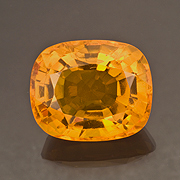 |
| Golden amber from the Hukawng Valley, in Kachin’s Myitkyina District. This stone weighs 19.48 carats, Inv. #19524 no longer available. (Photo: Mia Dixon) |
[back to top]
Books
The Book of Ruby & Sapphire, From an Unpublished Manuscript by J. F. Halford-Watkins, 1936
Edited by Richard W. Hughes
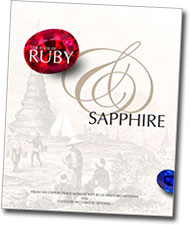 |
If you went to Tucson you likely got a peek at a project dear to the heart of Richard Hughes: The Book of Ruby & Sapphire, From an Unpublished Manuscript by J. F. Halford-Watkins. Such a manuscript, from the pen of Halford-Watkins (?–1937), who died before it could be printed, is remarkable because the writing springs from his more than twenty years of residence in Mogok. The scope is what you’d hope for: history, chemistry and crystallography, physical properties, “enclosures,” sources (Burma and elsewhere), mining—and that’s but half of the book’s pages.
The present volume is the result of more than a decade’s effort by Hughes and his confederates (including Pala’s Bill Larson), and the presentation is a reflection of the singular scholarship exhibited in Halford-Watkins’s text. The book is handsomely augmented by the inclusion of dozens of photographs and illustrations from an array of sources, contemporary, current and in-between. A sweet surprise is the addition of “The Streeter Diaries,” by way of Patrick Streeter, grandson and biographer of George Skelton Streeter, who traveled in 1887 with the first British expedition to Mogok. It was in Patrick’s book that Richard Hughes first learned of Halford-Watkins’s manuscript.
Dr. John Emmett, who urged Hughes to take on the project, apparently found his confidence well-placed, saying that the book “is a rare find—as exquisite as any fine ruby” and that every lover of fine gems will want a copy. Preview it and purchase it at Blurb.com.
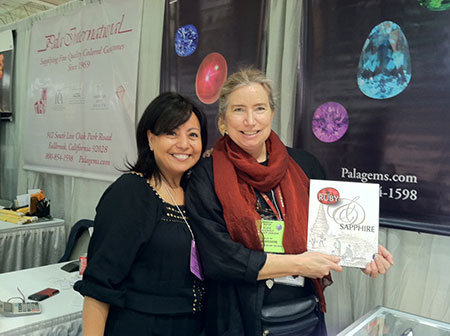 |
| At Tucson. Pala’s Gabrièl Mattice and The Journal of Gemmology editor Elise Skalwold, at Pala’s AGTA GemFair booth, with an advance copy of Halford-Watkins’s The Book of Ruby & Sapphire. (Photo courtesy Elise Skalwold) |
[back to top]
Pala Presents
|
With Pala Presents, we offer selections from the library of Pala International’s Bill Larson, who will share with us some of the wealth of information in the realm of gems and gemology.
Burma, The Mineral Utopia – Part Three
A reprint by Martin Ehrmann
Last year we treated readers to Martin Ehrmann’s unpublished (and unfinished) manuscript, Ruby Mines of Mogok. We followed up with his 1957 Gems & Gemology article, Gem Mining in Burma, which contains substantial overlap. This month we offer Part Three of another 1957 three-part article with material that will be somewhat familiar to readers of the other pieces. We offer it, however, so that people interested in the subject will have multiple resources as well as mid-century images of the mines, methods, miners and dealers of Mogok and elsewhere.
In Part Three of Burma, The Mineral Utopia, Ehrmann begins with an overview of amber mining in the Hukawng Valley in northern Burma. He then describes the gem trade procedure “used in all Oriental countries except Burma,” before looking at the exception to the rule, noting, for instance, the important role of women in the trade in Burma.
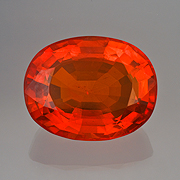 |
| Amber deposits in the Hukawng Valley can yield stones with hefty carat weights. This orange oval, Inv. #19521 (no longer available), is nearly 25 carats and measures 29 x 22.83 x 15 mm. (Photo: Mia Dixon) |
[back to top]
— End February Newsletter • Published 2/15/12 —
January 2012 Newsletter
In this edition of our newsletter we mark the passing of George Bosshart, who loved the gem mines of Burma. We mark the passing in Burma of one era to the next.
Shows and Events
Pala International News
Gems and Gemology News
Industry
- Emerald Aisle
- Green to Amber: Ural Emerald Mine Resumes Production
- “The 400 Million Dollar Emerald” Premieres Sunday, Jan. 29
- AGL IDs Irradiated Colombian Emeralds
- Green Giant Up for Grabs
- Diamond Doings
- Dramatic Price Increases Already Seen
- U.S. Blacklists Zimbabwean Diamond Companies Despite Kimberley Green Light
- Burma Bits
Pala Presents
- Burma, The Mineral Utopia – Part Two
by Martin Ehrmann - A Visit to the Gem Emporium
by Emily Jane Chang
Shows and Events
Tucson Time: January 31 – February 12, 2012
We’re looking forward to the world’s greatest gem and mineral show in February. One-stop general information about individual shows can be obtained from the Tucson EZ-Guide.
Pala International will be represented in Tucson as follows. We look forward to seeing our many friends there. Visit the Pala International Show Schedule for future events.
Tucson Tasting
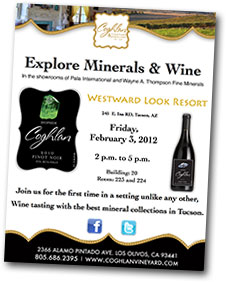 |
The Westward Look Show this year begins with a bang—or, rather, the pop of a cork—as the wines of Coghlan Vineyard & Jewelers will be breathing in the showrooms of Pala International and Wayne A. Thompson Fine Minerals.
During the Denver show last fall, we had the pleasure of sampling the 2009 “Diopside” Pinot Noir, which impressed some judges at last year’s Pinot Noir Summit and Pinot Shootout.
Click the invitation at right for details.
For more on Coghlan, see our write-up from August 2011.
AGTA Add-on: Andesine Panel
We just received word of an addition to the AGTA GemFair seminar lineup…
Andesine and Labradorite from Tibet, Inner Mongolia, Mexico & Oregon: A Panel Discussion
Moderator: Dana Schorr
Panelists: Richard Hughes, Ahmadjan Abduriyim, George Rossman & Adolf Peretti, with Shane McClure & John Emmett
The mining of natural red and green andesine in Tibet and near-colorless andesine in Inner Mongolia has been a subject of controversy. Large quantities of diffusion-treated andesine from Inner Mongolia entered the world markets without proper disclosure starting about 2000; however the idea that there might also be a source of natural red andesine in Tibet has been met with extreme skepticism from some quarters. This has not only polarized the gemological community, but has also created a lack of confidence in natural Oregon sunstone.
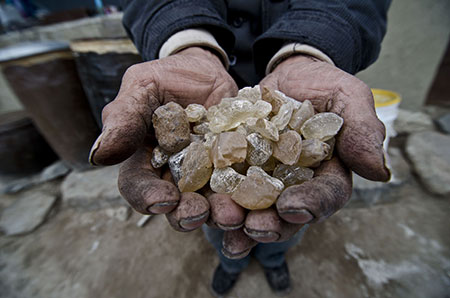 |
| Andesine offered for sale at Hai Bou Zi village in Guyang County, Inner Mongolia on October 22, 2011. (Photo: Richard W. Hughes) |
This program will present the latest results from field visits to both Tibet and Inner Mongolia, along with advanced testing of stones from each of those deposits. Simple tests will be described to separate both Tibetan and Inner Mongolian andesines from Oregon sunstones. The purpose is to finally lay to rest the controversy surrounding these stones. Free samples will be handed out to all attendees.
When: February 1, 2012, 9:00–10:00 a.m.
Where: Tucson Convention Center
Room: Maricopa Room
 |
AGTA GemFair
Pala joins nearly 100 exhibitors for this annual extravaganza.
Event: AGTA GemFair
When: January 31 – February 5, 2012
Where: Tucson Convention Center
Booth: 1016
The event website now features an interactive floorplan allowing you to see who is exhibiting by area of the convention center.
More than forty free seminars are offered by notables in the world of gemstones and pearls.
11th Annual Westward Look Mineral Show
Pala International and two dozen other world-class mineral dealers shack up at a Sonoran Desert resort.
 |
- Collector Day (Sat) features Ron Gladnick and selections from his private collection
- Edward Swoboda: “A Life of Gems & Minerals” (Sun) is a rare opportunity to take in a presentation by this 94-year-old legend of the mineral collecting world. Also on hand will be special guests Wendell Wilson, Bill Larson and Gene Meieran
Event: 11th Annual Westward Look Mineral Show
When: February 3–6, 2012
Where: Westward Look Resort
Suite: 224
See Pala International’s page on the Westward Look Show site.
 |
58th Annual Tucson Gem and Mineral Show
The symposium and guest speaker schedule is now available here.
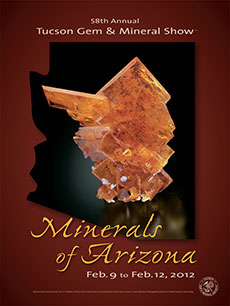
TGMS is the largest gem and mineral show in the country. This year’s theme is “Minerals of Arizona.”
Event: 58th Annual Tucson Gem and Mineral Show
When: February 9–12, 2012
Where: Tucson Convention Center
Booth: Aisle 5 East
Tucson Transit Tips
Many shows will offer their own shuttles. View your transit and parking options here. [back to top]
Sainte-Marie Scission
Early move to Colmar for Euro-Mineral & Euro-Gem
A planned 2014 move of Euro-Mineral & Euro-Gem from Sainte-Marie-aux-Mines to nearby Colmar will take place two years early due to a breakdown in negotiations, according to a statement by Michel Schwab, who has directed the show for thirty years. In 2010, two studies convinced Schwab and some other organizers that the move was needed; now it’s happening ahead of schedule.
Colmar is the capital of the Haut-Rhin department in which Sainte-Marie is situated, and the city lies on the eastern edge of the Parc naturel régional des Ballons des Vosges (named for the round, balloon-like mountains) that is home to Sainte-Marie. Colmar, with an urban-area population in 2008 of 126,000, is nearly 17 times larger than tiny Sainte-Marie. The show is taking advantage of the city’s Parc des Expositions de Colmar, with five halls totaling nearly 14,000 square meters (500,000 sq. ft.) of space.
On November 10, Sainte-Marie mayor Claude Abel and manager (and former Euro-Gem organizer) Raymonde Kistler announced that the town would host its own, competing event, which will take place the same days as the Colmar show, June 21–24, 2012. The “new” group, which stems from Sainte-Marie’s town council, goes by the name of Mineral & Gem à Sainte-Marie-aux-Mines and has a new website. A letter of explanation to prospective exhibitors was issued December 1.
Fortunately the two venues are 35 km apart. Pala International plans to attend both next June.
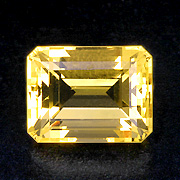 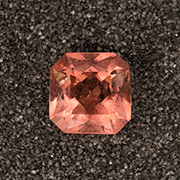 |
| Bon choix. Two emerald-cut fluorites from francophone countries. Left, a 14.22-carat, yellow fluorite from France, Inv. #13041 no longer available. Right, a 5.3-carat reddish-orange fluorite from Switzerland, Inv. #14245. (Photos: Wimon Manorotkul, left, and Mia Dixon) |
[back to top]
Pala International News
Pala’s Featured Stones: Brazilian Paraiba
This month we feature a set of tourmalines from the original mining area in Brazil. The pegmatite that produced these copper-bearing beauties spans the states of Paraîba and Rio Grande do Norte. Distinguishing which side of the border an individual stone was mined from has been trying, even for the most highly equipped laboratories around the world.
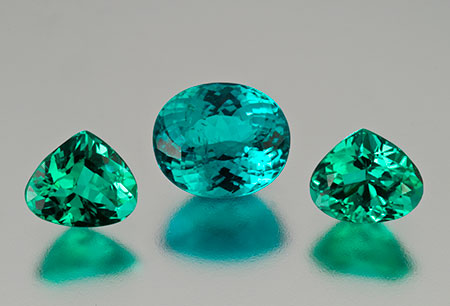 |
| Brazilian Paraiba. Blue green center oval, 2.8 carats, 9.22 x 7.8 x 5.57 mm, and the green teardrop pair, 2.51 carats, 7.5 x 6.3 x 4 mm. (Photo: Mia Dixon) |
Whichever state these paraibas were actually mined from seems irrelevant as you take in the light and color that is unlike any other gem on the planet. Dazzling neon hues of blue and green in a perfect medium tone, with saturation tilting the scales of what’s possible for a natural gemstone.
Throughout the year Pala is fortunate enough to have a handful of true Brazilian paraibas pass through our doors even though the mines have been exhausted for several years now. We also have a good supply of the now depleted Mozambique deposit. Contact us or check our inventory to see what’s available.
Gems and Gemology News
George Bosshart 1943–2012
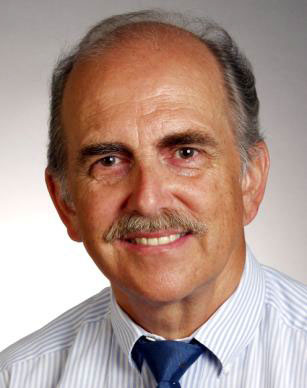 |
We received word on Monday from Anne Bosshart that her husband George passed away last Saturday. “Over many years he was fighting cancer and lost in the end. Throughout all his days, his work kept him going and he loved to be with people, all the precious stones and their sources.” Our hearts go out to Anne, whose devoted care of George made it possible for him to remain out of hospital until just a few days before his death. It was such care that allowed George to prepare a study on color stability in spodumene, which he presented at last July’s International Gemmological Conference in Interlaken, Switzerland.
George Bosshart had been chief gemologist, Research and Development, at the Gübelin Gem Lab in Lucerne. He made many contributions to gemological science and literature. After his university education in Switzerland, he did some geological fieldwork in Canada. His career in gemology followed, and he became director of SSEF (Swiss Gemmological Institute) for many years, when the lab was located in Zurich. During this time he worked closely with Prof. H. A. Hänni.
George was a close friend of Dr. Karl Schmetzer for nearly forty years. “To his last days he was interested in gems and gemmology,” Dr. Schmetzer told us, “and continued his major research project about green diamonds and the origins of colour, working with his own collection and samples from museums.” He conducted irradiation experiments and compared spectroscopic properties of natural samples with irradiated stones.
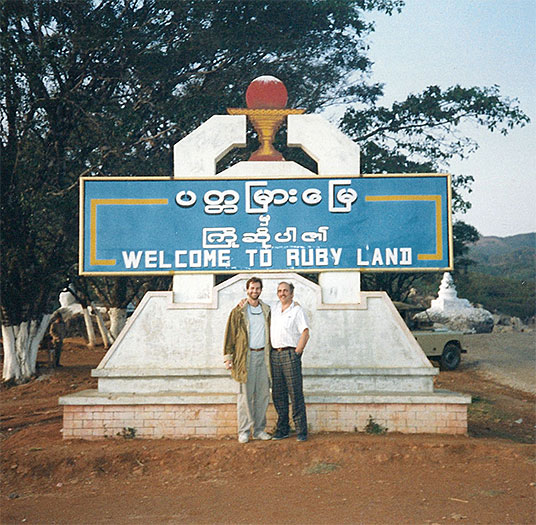 |
| Palling around. George Bosshart, right, with Edward Boehm, at the entrance to Ruby Land. (Photo: Dr. Eduard Gübelin and Edward Boehm) |
Richard W. Hughes shared with George “a love for travel to remote localities, particularly in Burma, and we often found ourselves exploring the same places, albeit at different times.” Anne Bosshart was George’s constant traveling companion, and they loved the jade mines of Upper Burma. “But it wasn't just the jade,” Hughes said. “I think, like myself, that was just a convenient excuse to travel, meet new people and explore new cultures. While certainly a Swiss at heart, he was simultaneously a citizen of the world.” George Bosshart contributed to “Burmese Jade: The Inscrutable Gem” by Hughes and others, archived on Palagems.com.
Pala’s Bill Larson recalled getting to know George personally on their first trip to Mogok, Burma, in 1993 with Dr. Eduard Gübelin. They rode together in the “pain-mobile,” named not after the famous mineralogist and gem dealer, but “so named because we all hit our heads on the metal roof (as we rode in the back of the four wheel drive vehicle—sans shock absorbers—the Burmese assigned us to) on every bump on the eight hour journey from Mandalay.” Out of all in that party, George got the worst gashes, but never complained even though they required medical attention. “He was just so excited to see the Valley of Rubies! He made the trip even more special; we all had the best time with him.”
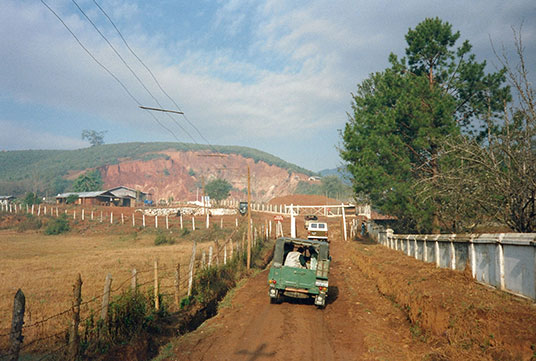 |
| Pain-mobile. Hold onto your hat, if you’re lucky enough to have one. Otherwise your pate will be at the mercy of jeep’s metal roof. (Photo: Dr. Eduard Gübelin and Edward Boehm) |
Friends and family will say goodbye on January 24 at 2:00 p.m. at the Protestant Church of Wädenswil. Consider donating to a charity in George Bosshart’s name: Schweizer Berghilfe (Swiss mountain assistance) or Schweizerischer Verein für das Blindenwesen (Swiss National Association of and for the Blind).
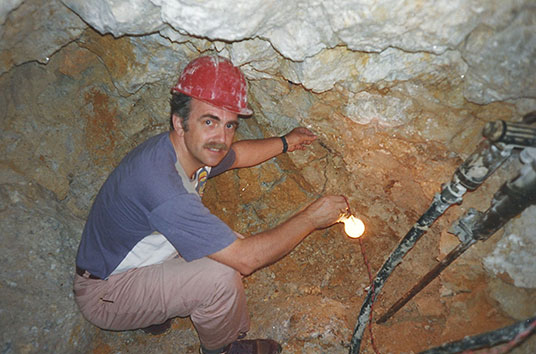 |
| In situ. George Bosshart is in his element here, in Lin Yuang Chi Primary Ruby Mine, Mogok, Burma. (Photo: Dr. Eduard Gübelin and Edward Boehm) |
[back to top]
Industry News
Emerald Aisle
Green to Amber: Ural Emerald Mine Resumes Production
Emerald production in the Urals has been, er, rocky for some time. In 2000, what was described as Russia’s only emerald mine, in the Malyshevo area of Sverdlovsk Region, was slated to reopen after five years of closure due to financial challenges, according to Associated Press. An Irish-Russian joint venture, Zelen-Kamen, was to take over the mine from the Russian company Ural Emerald Mines, which operated it following the mine’s privatization in 1993. RusBusinessNews, in its historical overview of the mining, stated that Ural Emerald Mines never was able to actually sell the emeralds due to lack of a “special license.” This led to the company’s bankruptcy; Zelen-Kamen assumed the company’s debt in exchange for the mine development license.
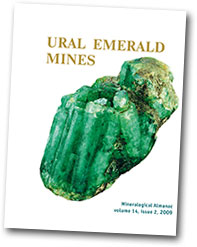 |
| Mineralogical Almanac issued this monograph in 2009 (Vol. 14, No. 2). |
As late as November 2007, however, the Russian daily Kommersant reported that Zelen-Kamen had been unable to begin production. Contrarily, Ronald Ringsrud, quoting dealer Warren Boyd in Ron’s Emeralds, A Passionate Guide, p. 292, mentions the mine’s “numerous contracts” for rough emerald and even alexandrite in 2006, but environmental regulations caused delays that suspended operations in 2007. In early 2008, the country’s Federal Natural Resources Usage Supervisory Service revoked the Zelen-Kamen’s license for the Malyshevo deposit. RusBusinessNews details subsequent developments through March 2011 when the Russian Federal Agency on Mineral Resources was to announce who would assume development of the deposit—either the Malyeshevo Mining Company or the Kaliningrad Amber Factory.
Prospects of the latter company’s success in obtaining the licence led RusBusinessNews to title its article, pessimistically, “Amber shadow on Ural emeralds,” since the company, according to experts, had “no money, no experience, no market prospects.” (Darkly, RusBusinessNews’s unnamed experts claimed that a turnover in ownership—without actual sales of stones—served the interests of what they inferred was a black market and that police believed that such emeralds, seized regularly during what it called 16 years of idleness, actually were coming from the mine.) Nevertheless, Kaliningrad Amber obtained the license and has resumed production, per the Sverdlovsk governor’s press office, as reported December 2 by RIA Novosti. Ringsrud, in his book, writes that Malyshevo, has the capacity to be one of the largest colored gemstone mining operations in the world.
The Malyshevo emerald deposit also was the primary source for industrial-use beryllium in the Soviet Union era. In November 2010, when prime minister Vladimir Putin ordered the license to be sold (it wasn’t sold until March 2011), the emerald deposit’s C1 (probable) reserves were pegged at 32.614 tons and C2 (inferred) reserves at 23.803 tons, according to Russia’s PRIME.
“The 400 Million Dollar Emerald” Premieres Sunday, Jan. 29
 |
The “Bahia” Emerald, which we’ve kept tabs on over the years, is now the subject of a National Geographic Explorer series segment. Here’s the description:
Some say it’s the largest emerald ever found, weighing in at 840 pounds and containing roughly 180,000 carats. Unearthed in Brazil in 2001, the Bahia emerald has an incredible history that fits its massive size: It spent months in a submerged bank vault in New Orleans after Hurricane Katrina and was even posted on eBay with a buy it now price of $75 million.
Emerald dealer and author Ron Ringsrud will be featured in the one-hour segment, as well as Anthony Thomas, who had claimed he had a sales receipt for the 840-pound specimen, only to have it burn in a 2006 fire. Check for the broadcast hour in your time zone on Sunday, January 29—when many of us will be in Tucson. The program is preceded by “Secret History of Diamonds.”
A reenactment of the emerald’s discovery in Brazil actually was done in Colombia, when the National Geographic crew was filming Ringsrud. See this four-minute National Geographic Channel streaming video, “Emerald Fever,” in which Ringsrud takes you through some of the bargaining and buying in the Plaza Central of Muzo, Colombia.
Two other litigants in the emerald case, Jerry J. Ferrara and Kit Morrison, feature the National Geographic logo on their website, perhaps in anticipation of their own roles in the Explorer segment. The website (as of August 8, 2011) touts a forthcoming book, Shades of Green: The Bahia Emerald Story, written by the pair, in which a sensational story is made even more gawdy by the appearance of Bernard Madoff, who was to have involved the emerald in a $197 million banking transaction, according to the website’s history page.
AGL IDs Irradiated Colombian Emeralds
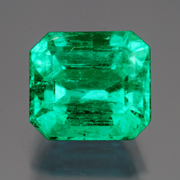 |
| Oiled, but never irradiated. This bright green Colombian emerald has a weight of just under two carats. Inv. #15527 no longer available. (Photo: Mia Dixon) |
American Gemological Laboratories (AGL) rang in the new year with a press release regarding the identification of Colombian emeralds that have had irradiation treatment. AGL had heard from wholesalers that such treatment improved the color of some Colombian emeralds. AGL president Christopher P. Smith noted that this method had been shown to modify the color of natural and synthetic emeralds nearly twenty years ago.
On his own website, Ronald Ringsrud writes that in 1985 he sent some emeralds for gamma ray treatment. The results were underwhelming: “they looked like dull peridots!” With the recent news, Ringsrud contacted gemologist Rodrigo Giraldo of the CDTEC Emerald Laboratory in Bogotá, who said irradiation could result in a “greyish brown undertone.” You’ll want to use the link above to see what several prominent gemologists had to say about this development.
Green Giant Up for Grabs
A 57,500-carat emerald, billed as the world’s largest faceted emerald, heads to auction on January 28 in Kelowna, British Columbia. According to the Calgary Sun, the 11-kg stone was in town on Monday for an appraisal at $1.15 million by Calgary’s Premier Gems after being flown in from—we’re not making this up—Brazil, according to Premier’s blog. The emerald’s owner, Calgary’s Regan Reaney, told the Sun that the stone was mined in Brazil and sent to India for cutting before being delivered to Canada. The stone will be displayed by Western Star Auctions in Kelowna until the sale.
 |
[back to top]
Diamond Doings
Dramatic Price Increases Already Seen
Last month we pointed to a December 8 Bain & Company report that projected a doubling of demand for diamonds by 2020, with price hikes in the offing due to international demand. (Note that a mine in China’s Liaoning province was announced on January 13, having been discovered in 2010, with a projected 30-year lifespan and output of one million carats.)
This month we look at a CBS report from Minneapolis featuring local dealer John Sorich, who in thirty years of business could not believe the 2011 market. The latest price increases are among the most significant that he’s ever seen. And, just as Bain predicted that the higher-end stones would be affected the most, Sorich already is seeing that trend, offering the example of a 3.5-carat ring that would have cost $16K last year, but now will cost $3K more, “thanks to that emerging international market.” In the face of higher prices, the report offers a “hot new trend” for engagement rings: surround a colored stone with several smaller diamonds.
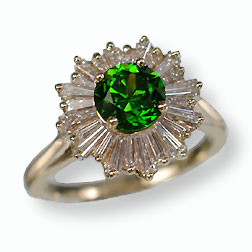 |
| A more modest proposal. As the CBS report suggested, a center stone surrounded by smaller diamonds can engage the emotions and the eye. Above, a demantoid garnet stands in for a 1-carat colorless diamond, ringed by 0.9 ctw of baguette diamonds. Below, a 5.51-carat tourmaline flanked by 0.60 ctw of round diamonds—large yet affordable. (Rings: The Collector Fine Jewelry; Photos: Wimon Manorotkul) |
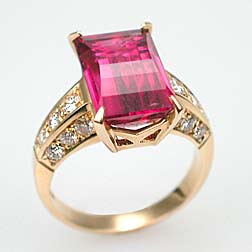 |
U.S. Blacklists Zimbabwean Diamond Companies
Despite Kimberley Green Light
In what one analysis termed a move for leverage in Zimbabwean politics, the U.S. Office of Foreign Assets Control added two of the country’s diamond mining companies to a sanctions list on December 9. The companies are Marange Resources Ltd. and Mbada Diamonds Ltd. This flies in the face of the decision in November by the Kimberley process to allow exports from these two mines. The parent company, Zimbabwe Mining Development Corp., already was on the blacklist. Thus a Stratfor analysis, December 15, opined that the U.S. move probably had less to do with alleged human rights violations in the Marenge region and more to do with exerting influence in the possible presidential appointment of current defense minister Emmerson Mnangagwa, whom the U.S. opposes. On Monday, Zimbabwe’s finance minister, Tendai Biti, challenged the sanctions.
[back to top]
Burma Bits
“Mid-Year” Emporium Shows Sluggish Sales
Well, the annual “mid-year” gems emporium, which historically has taken place in October, was held in 2011 even later than 2010’s November sale. This year’s event had been announced by Mizzima News as having been cancelled. The most recent sale began December 24, ending January 3, 2012, according to Myanmar Times (MT). The total earned was €700 million, or $903 million. The sale featured almost 12,000 jade lots (8300 sold), 230 gem lots (39 sold) and 270 pearl lots (212 sold). The top lot sold for about $9.3 million, and 55 jade lots sold for more than €1 million each. Chinese dealers picked up the most expensive lots.
The MT story claimed a December 2010 sale brought in $2.9 billion, but that appears to have been confused with the March 2011 sale, which garnered $2.8 billion. The November 2010 mid-year emporium brought in $1.44 billion, according to our statistics. (See also this story, below, on that sale.) Non-paying bidders previously had caused problems, so deposits on all bids were required at this latest emporium, which appear to have slowed sales. The New Light of Myanmar stated that the next annual emporium would be held “soon.”
Cease-fires, Cease-sanctions
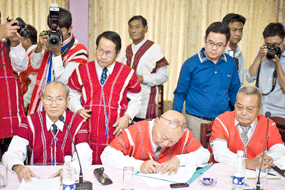 |
| General Saw Mutu Sai Pho, commander-in-chief of Karen National Union, signs the cease-fire in Hpa-an, January 12. (Photo: Kaung Htet) |
Even as encouraging political developments continue in Burma, reports from the Kachin jade region indicate a status quo of conflict. The Irrawaddy reported a week ago that fear of new fighting between Burma troops and the Kachin Independence Army caused refugees to flee the Hpakant jade area, just days before Burma signed a groundbreaking cease-fire with rebels in another ethnic region—Karen. The Karen conflict—like other such conflicts—involves ethnic autonomy and predates Burma’s independence from Britain. Burma had signed agreements with all other major ethnic groups, and so the signing of a Karen cease-fire, as noted by Reuters last Thursday, was seen as a possible “small step” towards the end of twenty years of sanctions against Burma.
Small step or big step, a day later the U.S. restored full diplomatic relations with Burma, after the government freed more than six hundred political prisoners, one of the largest in Asia’s history, according to an unnamed senior state department official.
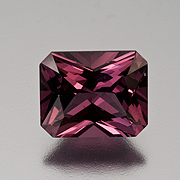 |
| Root beer and olives. From our Old Stock… New Pix section: Above, a 2.8-carat root beer-colored, emerald-cut spinel from Burma, Inv. #19017 no longer available. Below, a hefty 26.54 carats of olive green enstatite, Inv. #17734 no longer available. (Photos: Mia Dixon) |
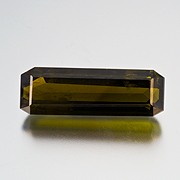 |
Rob Bates, senior editor of JCK Magazine, wasted little time in examining the issue of U.S. gemstone sanctions against Burma, yesterday. Bates wrote that Jewelers Vigilance Committee president/CEO Ceclia Gardner stated that lawmakers are looking at the lifting of sanctions even if no legislation is in the works. And Jewelers of America supported the ban, but CEO Matt Runci, who retires from JA at the end of 2012, said the group looks forward to easing the ban. JCK pointed to Australia already moving in that direction. ASEAN (Association of Southeast Asian Nations), at the request of Burma’s foreign minister, says it agrees with a call for the lifting of economic sanctions. According to Agence France-Presse (AFP), ASEAN took the same stance a year ago. (Burma declined to chair ASEAN, in rotating fashion, five years ago due to international pressure.) Yesterday, the Philippines called for sanctions to end, as reported by Associated Press. Even U.S. Senate Minority Leader Mitch McConnell had a photo op with President Thein Sein yesterday, calling him a “genuine reformer,” holding out the possibility of lifting U.S. sanctions in April after elections in Burma.
And the Brits?
Just a few days ago, when outlining this edition of our newsletter, we had planned to lead with news of British foreign secretary William Hague’s offer to lift sanctions in return for further “bold steps” by Burma. Sound promising? Not to Myanmar Times, which called this ploy by Hague “moving the goalposts” and inventing “new rules of the game.” MT actually claimed that the need for such a shift is because “the changes that have occurred owe little or nothing to Western pressures, but are essentially home-grown.” Oh, and: “To acknowledge this too openly could lead to a loss of face.”
In some encouraging news, The Irrawaddy today reported on peace talks in China between Kachin rebels and the Burma government, which has ordered the country’s troops to hold its fire, according to AFP. Jade roads that had been closed due to security concerns have been reopened, as reported by Kachin News Group. [back to top]
Pala Presents
|
With Pala Presents, we offer selections from the library of Pala International’s Bill Larson, who will share with us some of the wealth of information in the realm of gems and gemology.
Burma, The Mineral Utopia – Part Two
A reprint by Martin Ehrmann
Last year we treated readers to Martin Ehrmann’s unpublished (and unfinished) manuscript, Ruby Mines of Mogok. We followed up with his 1957 Gems & Gemology article, Gem Mining in Burma, which contains substantial overlap. This month we offer Part Two of another 1957 three-part article with material that will be somewhat familiar to readers of the other pieces. We offer it, however, so that people interested in the subject will have multiple resources as well as mid-century images of the mines, methods, miners and dealers of Mogok and elsewhere.
In Part Two of Burma, The Mineral Utopia, Ehrmann looks at some of the gemstones (and other minerals) apart from ruby, sapphire and spinel, for which Burma is less recognized. He credits Arthur C. D. Pain for bringing some of these to the fore. Pain lived in Mogok, and Ehrmann rattles off a list of a dozen different stones from the area, including a then-unnamed mineral that surely was the rare borate mineral that now bears Pain’s name. Ehrmann then rounds out this installment with a history of mining in Burma, including jadeite.
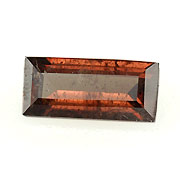 |
| Painite, such as this .46-carat baguette, was once considered the rarest gemstone in the world. Inv. #13016 no longer available. (Photo: Wimon Manorotkul) |
[back to top]
A Visit to the Gem Emporium
An article by Emily Jane Chang
 |
This article, from Lotus, the inflight magazine of Air Bagan, looks at Burma’s jade, gem and pearl emporium from the point of view of a novice. Emily Jane Chang, who grew up in Hong Kong, was no stranger to Burma, having visited there years before. But it wasn’t until November 2010 that she was introduced to the “mid-year” emporium by an old high school friend who had attended these sales since they began in 1964. The November 2010 sale—the first to be held in the country’s political capital of Naypyidaw—nearly tripled the proceeds over the March 2010 sale. And it brought in ten times the 2009 mid-year total.
Read the article here. [back to top]
— End January Newsletter • Published 1/18/12 —
Note: Palagems.com selects much of its material in the interest of fostering a stimulating discourse on the topics of gems, gemology, and the gemstone industry. Therefore the opinions expressed here are not necessarily those held by the proprietors of Palagems.com. We welcome your feedback.