gem-news-2010-v1
January – April 2010
- April 2010 Newsletter – April 13
- March 2010 Newsletter – March 16
- Recent Gem News – March 2, 4, and 8
- February 2010 Newsletter – February 21
- January 2010 Newsletter – January 18
April 2010 Newsletter
Shows and Events
Pala International News
- Pala’s Featured Stone
- The Sinkankas Symposium 2010: April 17
- Larson to Give San Diego Talk: April 14
- Natural History Museum of Los Angeles County
Council’s 25th Anniversary Gala to Feature Bill Larson
Gem and Gemology News
Industry News
Shows and Events
Pala at Las Vegas – June 3–7, 2010
 |
It’s time to plan for the JCK Las Vegas show. Pala International will be there in force, with one of America’s largest selections of fine colored gems.
Note: The JCK Show this year runs Friday through Monday. The AGTA Pavilion still opens one day early—Thursday, June 3—before the main JCK Show.
When: June 3–7, 2010
Where: Venetian Hotel Grand Ballroom adjacent to the Sands Expo & Convention Center, Las Vegas, NV
Hours: AGTA Gemstone Section
Thursday, June 3: 10:00 AM – 6:00 PM
Friday, June 4 to Sunday, June 6:
9:30 AM – 6:00 PM
Monday, June 7: 9:30 AM – 4:00 PM
Booth: AGTA Pavilion, booth 34308
See also this notice from AGTA about the GemFair. We look forward to seeing our many friends there. Visit the Pala International Show Schedule for future events. [back to top]
Pala International News
Pala’s Featured Stones: Made in America
This month we visit some homegrown stones that remind us of the rare treasures the U.S. has spawned.
Oregon has continuously produced beautiful and natural feldspar sunstones. Intense, orangey-red gems such as the 5.30-carat pictured below are some of the rarer hues found at the Dust Devil Mine outside of Plush, Oregon.
California’s state gem has taken a hiatus for the time being, as far as new production, but we still see a few jewels circulating in the trade. The Benitoite Gem Mine in San Benito County has blessed us with truly rare and beautiful gems over the years, including the 2.63-carat round shown below.
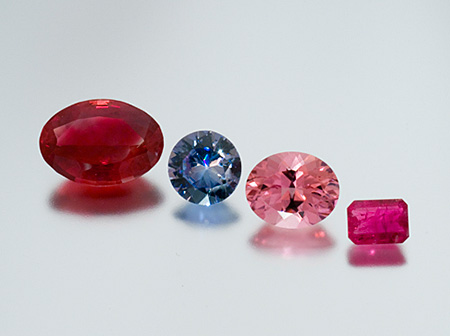 |
| American Neighbors: 5.30-carat oval sunstone, 14.80 x 10.69 x 5.86 mm.; 2.63‑carat round benitoite, 8.79 x 4.68 mm.; 3.44-carat oval pink tourmaline, 11 x 9.1 x 5.8 mm., and 0.75-carat red beryl 7.12 x 5.26 x 2.62 mm. (Photo: Jason Stephenson) |
In Southern California, the Himalaya Mine tourmaline still has a presence, with all the stockpiles left in our safes here at Pala. Occasionally, pink tourmalines are still found in the surrounding mines, but the quality and quantity seem to be limited. The 3.44-carat pictured above is one of the cleanest and most pure pinks we have left.
Red beryl is another gem that seems to be out of production for now, but luckily we still see a few of these intense red jewels bubble up now and again. The Violet claim, in the Wah Wah Mountains of Utah, produced the most red beryl, including this little 0.75-carat beauty.
And speaking of red beryl, loyal readers may recall our featured stone from May 2008. It’s back in stock.
The Sinkankas Symposium 2010
Bill Larson to present on Gem Feldspar theme
The annual Sinkankas Symposium has been described by John Koivula as the “best gem mineral symposium in North America” and never fails to achieve sold-out enrollment. This year’s topic is Gem Feldspar, a subject made a bit more compelling by the unraveling of red feldspar issues that we looked at last October, in “A Mystery of the Orient.”
The Symposium, which will be held on Saturday, April 17, will feature Pala’s Bill Larson presenting on “World Class Collectable Gem Feldspars.”
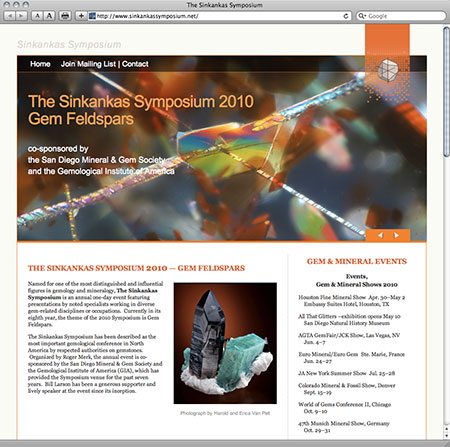 |
| The Sinkankas Symposium now has a handsome website of its own. |
The Symposium is organized by Roger Merk, and co-sponsored by the San Diego Mineral & Gem Society and the Gemological Institute of America. For more information see the new Sinkankas Symposium website. [back to top]
Larson to Give San Diego Talk
April 14 presentation in Carlsbad on Burma Gem Crystals
Can’t make the Sinkankas Symposium? The San Diego Chapters of the Women’s Jewelry Association and GIA Alumni Association are cosponsoring an event the prior Wednesday, for which they sent the following…
“Gem Crystals of Burma – The Source and Experience” will be presented by Bill Larson, President, Pala International.
Pack your passport….“Burma Bill” will take you on the experience he has traveled nearly two dozen times—into the valley of gems to one of the most historical resources for fine gems—Burma (now called Myanmar). Your journey will begin with history, and include the profound experience of visiting this land. You will also hear first hand, about the abundance of gems and minerals found, some of Bill’s guests/travel partners’ experiences to Burma, and the current trading issues that have resulted from the US embargo against Myanmar.
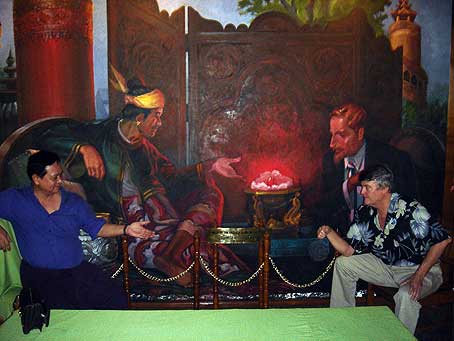 |
| “Awed by the Fabulous Ruby Ngamauk.” Han Htun, FGA, and Pala’s Bill Larson, under the image of King Tibaw showing the royal ruby to author and gem merchant extraordinaire Edwin Streeter. Read the story of this ruby in our reprint of C. M. Enriquez’s “Fire-Hearted Pebbles from Burma.” (Photo: Bill Larson) |
The event is open to the public, and there is an admission charge (see below).
Event: Cosponsored by WJA/GIA Alumni
When: Wednesday, April 14, 2010
Where: La Costa Resort & Spa, Carnation Room
2100 Costa Del Mar Road, Carlsbad, CA 92009
800.854.5000
Program:
- 5:00–6:30 pm: Mix/mingle, no-host happy hour, at resort’s Blue Fire Grill
- 6:30–6:45 pm: Check-in and seating
- 7:00 pm: Bill Larson lecture begins promptly
PayPal payment may be made here. Reservation emails or questions to info@giasd.org or call Blaire Beavers at 619.279.3190. [back to top]
Natural History Museum of Los Angeles County
Council’s 25th Anniversary Gala to Feature Bill Larson
Museum Group’s May 2nd Event Is Open to the Public
We received the following notice recently. Congratulations to the Gem and Mineral Council on its first 25 years!
The Gem and Mineral Council of the Natural History Museum of Los Angeles County is celebrating its 25th anniversary with a gala event on Sunday, May 2nd, 2010. Billed as “An Evening to Remember,” the event will include dinner and drinks, silent and live auctions, historical photo essays, special museum tours—all in the beautiful setting of the museum and its world renowned Hall of Gems and Minerals.
The evening will culminate with a fascinating retrospective of the past 25 years in the world of gems and minerals by one of its most dynamic “players,” the inimitable Bill Larson.
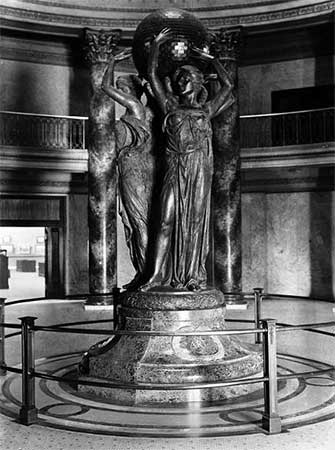 |
| The Natural History Museum has nearly 100 years of its own history. See this 95-year overview of gems and minerals at the museum. (Photo courtesy Natural History Museum of Los Angeles County) |
The public is invited, with a special invitation to past members. Tickets are $50 for members and $75 for non-members. RSVP required; contact Jean Brandt, 213.763.3326 by April 24th.
The Gem & Mineral Council, a members' group at the Natural History Museum of Los Angeles County, offers its members opportunities to advance their knowledge and enjoyment of gems and minerals within the unique context of the museum, including a varied schedule of activities including exciting field trips, educational lectures, and exclusive social events. More information on membership is available at the Council website. [back to top]
Gem and Gemology News
Lawrence Stoller’s “Eye”
A damaged phenacite as artist’s muse
Two weeks ago, Pala’s Bill Larson received an intriguing note from award-winning artist Lawrence Stoller, who included photographs of “a phenacite that I was asked to ‘do something with.’” We found ourselves entranced by what we saw, and wanted to learn more. “So much to occupy the eye,” we told Stoller, before learning the name given to the piece.
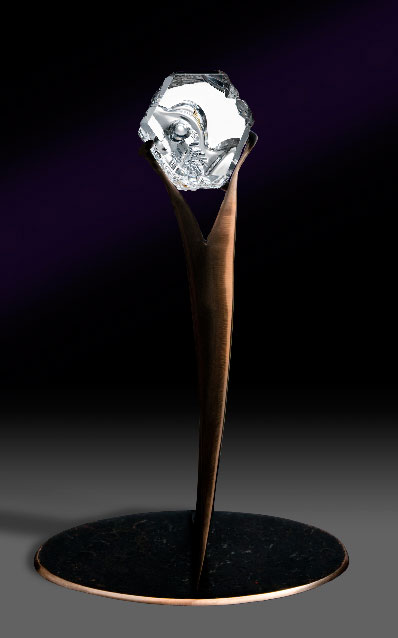 |
| “Eye of Matter,” carved by Lawrence Stoller. “The base is made of bronze,” said Stoller, “and has a whimsical quality that seemed to draw from the character of the stone,” (Photo: Gary Alvis) |
The story begins with a damaged 98-gram phenacite specimen obtained this year at the Tucson show by John Van Rees, of Exquisite Crystals. “He showed it to me,” Stoller told us, “and said he was considering having it cut into a traditional faceted stone. John and I are friends, so he didn’t take it personally when I told him I thought that was a crazy idea.” Phenacite isn’t common, and this crystal had both size and character. “My thinking was that by faceting it, this rare phenacite would look like a piece of faceted quartz or any other colorless crystal.” Indeed, the mineral was named from the Greek word for “imposter” by Finnish mineralogist N. G. Nordenskiöld, due to the ease with which it often is mistaken for quartz. (Nordenskiöld was responsible for another, famous, appellation—demantoid—for the rare variety of garnet.)
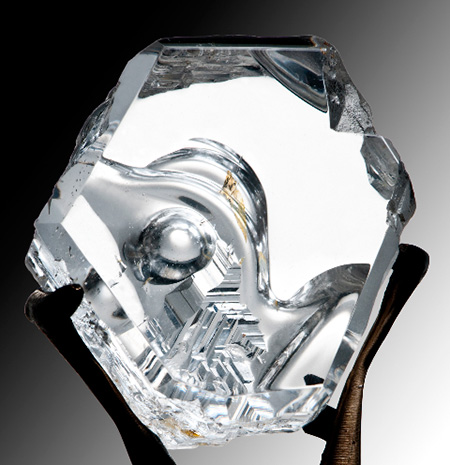 |
| What’s the matter? Nothing, as far as we can see. In in this carving of what was a damaged phenacite specimen, we can see afar… (Photo: Gary Alvis) |
“So John asked me what I would do with it, and I really didn’t have a good answer on the spot,” but Stoller said he’d preserve the specimen’s size and distinctive etched surfaces. One wrinkle: Stoller had never cut phenacite before. While the cutting and caving were “relatively straightforward,” as he told us, “getting a good polish on the large surfaces was another matter entirely. The crystal acted much like a large topaz behaving badly. After the 1200 [grit] stage it wanted to scratch itself.” Stoller’s assistant Ingrid Mrencso spent many hours polishing out the large, flat surfaces—roughly 15 times longer than a comparable piece of quartz—to bring out the brilliant finish captured in the photograph by Gary Alvis.
Remodeled without being remade, and surrendering but eighteen of its original ninety grams, the finished piece was given the name, “Eye of Matter.” The specimen, appropriately, hails from the “Shining Stone” Mine (Okuta-didan in the Yoruba language), an alluvial deposit at the Jos Plateau in central Nigeria. The finished size is 43 x 35 x 24 mm.; the stand measures 7 x 4 inches.
For more about Lawrence Stoller and the breadth of his artistry, see his CrystalWorks website. See also this blog entry by metalsmith Carla M. Fox for the description of a photo shoot by Gary Alvis. [back to top]
Research Roundup
Some research reports of note from recent weeks…
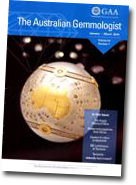 |
The Australian Gemmologist received a makeover with its current issue, January–March 2010. The new format is larger (A4, roughly 8.27 x 11.7 in.) and the cover allows for up-front imagery. See the abstracts here.
Highlights from this edition of the journal, which is 51 years young:
- “Differing causes of colour in diamonds” looks at different agents behind two African diamonds of similar hue
- “Rubies and sapphires from Winza, Tanzania - summary of characteristic properties and short update of the mining situation” looks at the post-alluvial overburden exploitation as mining moves to hard rock. The material shows “a large variability in morphology”
And perhaps the most intriguing article involves a different sort of heat-treatment, picking up on a passage early on in Mineralogical Record’s comprehensive study of tanzanite (Sep–Oct 2009), regarding the “legend” that brown zoisite crystals, when exposed to the surface—and to brush fire—might be caused to turn blue. “Tanzanite – naturally heat treated?” explores the possibility with experimentation.
Gemlab Gemological Laboratory, now in its fourteenth year, introduced an online journal, Gemnotes, in February. Vol. 1, No. 1 features twelve pages of “Short Papers.” Included are:
 |
- “A Very Fine Transparent Gem Quality Pink Zoisite” pays attention to manganese content, concluding that “the manganese content of tanzanite may often have a (sometimes pronounced) influence on the colour”
- “An Uncommon Yellow Sapphire” looks at a fine 32-carat stone that at first glance had the hallmarks of heat treatment
- “A Mogok Ruby with Large Two-Phase Inclusion” also does a double-take on a large, natural oval cabochon
- “Beautiful Inclusion Scenario in a Verneuil Synthetic Ruby”—and are they beautiful!
Gemnotes may not be archived online, so you’ll want to subscribe here.
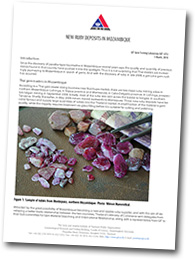
GIT Gem Testing Laboratory (GIT-GTL) issues “New Ruby Deposits in Mozambique,” in which Thai government reps meet officials from the African rubyland.
 |
Last December, we journeyed with the intrepid Vincent Pardieu, via FieldGemology.org, to new ruby localities in northern Mozambique: the provinces of Niassa and Cabo Delgado. Pardieu actually compared the the quality from Cabo Delgado’s Montepuez with Burma’s famed Mong Hsu. “All the material can find a market,” he told us.
Pardieu and his fellow travelers, who began gemological forays in early September, weren’t the only folks from Thailand interested in new ruby. Later that month, delegates from Thailand’s Ministry of Commerce visited Montepuez and nearby Pemba along with a rep from The Gem and Jewelry Institute of Thailand (GIT). Their mission was to facilitate the legal acquisition of ruby from the area, which had turned up in Thai markets via underground means.
According to the report published last month by GIT-GTL, much of the material appearing in the markets of Nanhupo (Montepuez) and Pemba require “some kind of enhancement.” But the Thai delegation was shown two specimens that were similar to what GIT-GTL had acquired in March 2009, purportedly from Mozambique: a 15-cm. aggregate ruby with embedded green amphibole and a 7-cm. fragment of a hexagonal single crystal. See the report for photos, chemical fingerprint data, and more.
SSEF’s annual Facette e-journal—No. 17—contains both entry-level and advanced reporting.
 |
- “What does it take to issue a certificate at SSEF?” walks you through the lab’s certification process, step-by-step
- “New rubies from Montepuez, Mozambique” provides a stellar example of the locality at its best: an 8‑carat unheated beauty
- “Damage to cut gemstones”: The usual suspects, and some others, including “the expansion of uranium-containing zircon inclusions and uraninite inclusions in sapphire”
- “Age dating of pearls”: Radiocarbon dating applied in the gemological laboratory
- “How to get the ‘Blues’ out of the Pink—Detection of low-temperature heating of pink sapphires”: SSEF employs a unique method
[back to top]
Industry News
Diamond Demand Reflects Rebound
Executives at Canada’s Harry Winston Corp. told analysts on April 1 that short-term prices likely would rise due to demand in China and India outpacing production. The Canadian Press reported on a conference call with Harry Winston chair and co-CEO Robert Gannicott, who said that prices had “rebounded to almost the previous highs,” but production could not return to previous levels quickly. Production in Q4 2009 was down significantly from a year before due to planned reduction—a reaction to a soft market. The firm saw higher holiday sales and believes that rebound in equity markets and Asia’s strength have led to a rise in luxury product demand. The conference call is archived here.
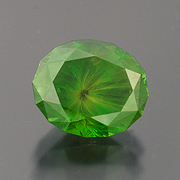 |
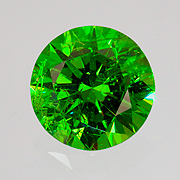
| Diamond-like. Of course, we’re not in the diamond trade, but we have some luxurious Russian demantoids ready for a tax-time splurge. Just choose your mood. Above, 4.24-ct oval with a distinctive horsetail inclusion, Inv. #17894 no longer available. Below, 2.67-ct round with multiple horsetails, Inv. #18051 no longer available. (Photos: Mia Dixon) |
 |
[back to top]
— End April Newsletter • Published 4/13/10 —
March 2010 Newsletter
Shows and Events
Pala International News
Gem and Gemology News
- “It’s all about the people…”
Cornell collaboration will involve Pala’s Bill Larson
Industry News
Shows and Events
World of Gems Conference II: October 9–10, 2010
Registration fee to increase after June 15
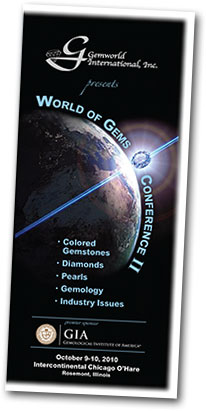 |
| Conference brochure available here. |
In 2008, the World of Gems Conference called together a who’s who of the domestic gemstone galaxy, drawing attendees from six countries. Conference II is now taking shape, with several presenters already named. Topics will include industry controversies, cutting-edge gemstone treatments, pricing, and legal issues.
The October 9–10 conference is hosted by Gemworld International, publisher of the diamond and colored gemstone pricing reference, GemGuide. It will be held in the Chicago area at the Interncontinental O’Hare in Rosemont.
Early-bird registrants can save $50 before June 15. GemGuide subscribers receive a further discount.
Exhibits by industry firms, institutions, and product vendors also will be included in the conference. Plenty of time for networking will be allowed in the program schedule.
For a look at the 2008 conference, with more than a dozen photographs, see the website of Elise Skalwold, who assisted with the AGTA GTC corundum treatments seminar, and whose work on a special project we highlight in this issue of Pala’s Gem News. [back to top]
Pala International News
Pala’s Featured Stone: Spinel from Tajikistan
We have been reporting on the new electric pink spinels coming out of Tanzania, and the superb reds still trickling out of Burma, but the most historical spinel deposit in the Pamir mountains of Tajikastan has been producing some beautiful large stones recently as well. Originally coined the Balas Ruby, which was later tested to be spinel, this was the material that has adorned some states’ royal crown jewels. Even recently we have seen rosy reds and pastel pinks still being mined from this region. This month’s monster 22.76-carat spinel is quite unusual for its size and rich, rosy red color. A wonderful collector’s piece to complete a worldwide spinel locality assemblage.
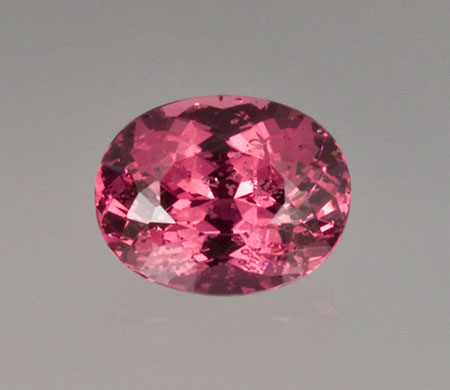 |
| Big Rosy Red: A 22.76-carat spinel from Tajikistan, 18.54 x 14.55 x 11.47 mm. Inventory #11669 no longer available. (Photo: Jason Stephenson) |
This beautiful and gemological gem would probably be a pick of the late Dr. Eduard J. Gübelin. He loved to collect gems that were not only attractive on the outside, but also intriguing on the inside. A photomicrograph of this extraordinary spinel from Tajikistan reveals a beautiful suite of natural inclusions. Taking a tour of this inner world, we note the well-formed octahedron just left of center; probably a negative crystal formed as a result of exsolution during the spinel’s growth. The large crystal seen just right of center appears to be an apatite crystal, while many of the smaller rounded nodules scattered to the left and lower left are probably more sub-euhedral apatites. The intriguing guest mineral emerging into the light at lower left, hints at being quartz, another fascinating inclusion to be found in spinel.
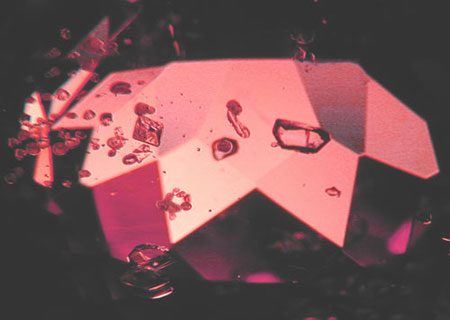 |
| In bloom. The internal world of this month’s featured gemstone. (Photo: Jason Stephenson) |
Search the entire inventory of spinels on Palagems.com.
Interested? Select the inventory number above, call, or email us to inquire. [back to top]
Gem and Gemology News
“It’s all about the people…”
Cornell collaboration will involve Pala’s Bill Larson
We recently caught up with Elise Skalwold, gemological curator at Cornell University. Pala Gem News readers surely will recall “Viking Compass and the Usambara Effect,” which we cherry-picked from her website last June. Well, when she’s not festooning that website with streaming video of growing hydrothermal sapphire in a diamond anvil cell, for the past year she’s been working on a gem and mineral project that remains under wraps. When the curtain is pulled back, however, it will involve among other things a publication featuring photographs by Jeff Scovil, and will include a foreword by Pala’s Bill Larson, who also has kindly provided ad hoc advice along the way.
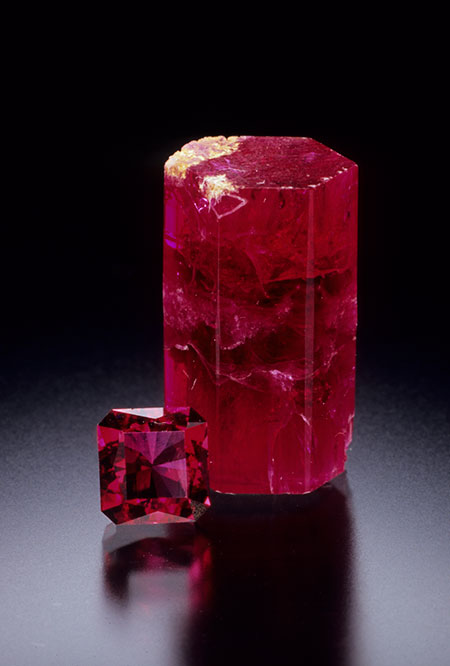 |
| Classic Jeff Scovil “rough & cut” portrait. A 1.19-carat cut gem alongside its natural sister, a 1.70-cm. double-terminated crystal. Both originate from the Wah Wah Mountains, Beaver County, Utah (Cornell University gem and mineral collection). This appears in John S. White’s “U.S. Gemstones: An Overview” in the January/February issue of Rocks & Minerals. (Photo: Jeff Scovil) |
Leaving the mystery aside, we were taken by Elise’s description of the work involved in the ongoing project—a series of collaborative connections. “The context is gems and minerals,” she tells us, “but it is all about the people and the process.” She is honored to collaborate and be co-author with her dear friend and leader of the project, Cornell’s William Bassett, professor emeritus of geological sciences, and recipient of the Mineralogical Society of America’s highest award, the Roebling Medal. Oh, and “one of the pioneers of diamond anvil cell high pressure research,” she reminds us. But then you would have gathered that when you visited the link above.
The collaboration brings together this gemologist with a world-class mineralogist, working to quantify and write about gem materials. Master gem and mineral photographer Jeff Scovil was brought on board, and because time was limited, Mark Mauthner (himself an accomplished photographer, author, and curator) was brought in to do on-the-spot production work. “Working together with Jeff and Mark was for me an amazing synergy of purpose where each day was exhausting, but completely satisfying,” says Elise. “I am so happy to have had Jeff involved in this project, as well as to have experienced working closely with him while he plied his art.” Although the photography is completed, Elise and Bill hope to have Mark return periodically as an advisor on the project as it moves forward. “He brings a holistic approach to all that he does, which especially appeals to me; Jeff being also of that mind makes for a perfect team.”
Teamwork, yes, but there are silent partners as well, who speak volumes—through their volumes. “This [project] has coincided,” Elise says, “with my acquisition almost one year ago now of John Koivula’s library and assorted gemological tools which have been instrumental and priceless to Bill’s and my work together.” John Koivula’s library? “This is a ‘working library,’” she explains, “not some collection of material wealth.” Nevertheless, all were “breathless” at what 1600 lbs. of packing cartons contained, and not from their heft. “Maybe not all of interest to lay gemologists, but certainly to a mineralogist and gemologist working in tandem. Sets of the best mineralogy texts, books on diamond morphology, works of Bill’s friend and colleague Edwin Roedder [a fellow Roebling medallist]; and for me books signed by Dr. Gübelin, Dr. Jobbins and many other giants of the gemology world.”
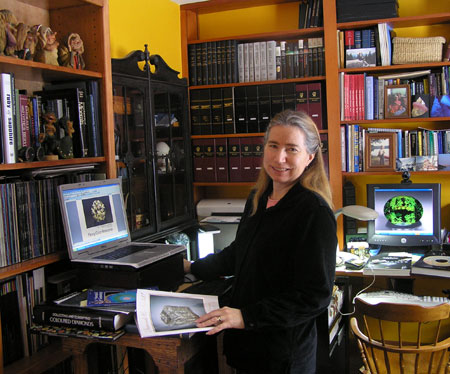 |
| Elise Skalwold at work... |
Elise continues:
The books are not only an extensive gemological reference base probably unmatched within 200 miles of where I now sit, but are also of historical significance. I am awed whenever I open a book to reference something for our work and brush my hand over penned inscriptions by all of the great gemologists: John himself, Dr. Gübelin, Dr. Jobbins (whom I had the great honor of sitting beside at the Gem-A Centenary Conference along with the Koivulas), and many others.
Something like coming across the notations of patriarchs in the holdings of a desert monastery…
Whatever elaboration on a topic I am seeking to share with Bill is usually accompanied by an excited reference to what that author has contributed to the field of gemological science. Bill is always keen to take this aspect of gemology and relate it to work in the larger field of mineralogy and geology, throughout history and present day. We both gain from the experience.
Bill has become a great fan of John Koivula’s work on inclusions and the PhotoAtlas series and has found tremendous value in its applications to the study of minerals. I, on the other hand, have been able to make better use of the PhotoAtlas books under Bill’s tutelage. Between us, we have three sets of the complete series; they are never far from reach (nor should they be for any practicing gemologist).
“Along with the library,” Elise says, “working with Bill is such a great honor.” She recalls contemplating the quote posted in GIA’s Richard T. Liddicoat Gemological Library in Carlsbad.
A good library is like a fine banquet – both are full and complex – while the lesser collections may nourish your intellectual needs on a narrow subject, they cannot match the gratification provided by a profoundly contextual experience.
— John Sinkankas, 1994
“This can not be more true than for me,” she tells us, “especially when shared with others such as Dr. Bassett.”
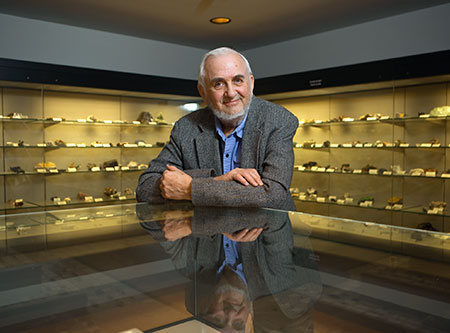 |
| Dr. William A. Bassett in the Timothy N. Heasley Mineralogy Museum, housed in Cornell University’s Snee Hall. (Photo: Jason Koski, University Photography) |
As the project unfolds, we’ll keep our readers informed… [back to top]
Industry News
Tourmaline from Nuristan, Gemstones from Pakistan
Response to last month’s Pala Mineralis report, and more
Last month, in our newly re-named sister e-newsletter, Pala Mineralis, we featured a photo essay, “Tourmaline Mining in Afghanistan,” contributed by a correspondent in southwestern Asia.
Coincidentally, via a mutual friend, we received the following reply on that story from another correspondent, in Pakistan, who we hadn’t heard from in some time. (He had last notified us about a December 2005 avalanche in a peridot-mining region of Kohistan, in the North West Frontier Province border region and had commented on the state of the gemstone industry in Pakistan at the time.)
Here are his remarks on the tourmaline mining in the general area of the Mawi pegmatites in Nuristan Province. (Nuristan also is the traditional name for an area that straddles the current provincial boundaries of Nuristan, Laghman, and Kunar, aka Konar.)
My closest friends actually worked that [Gaamata, aka Gamatha] mine many years ago but were unsuccessful because of the sheer difficulty of the terrain and small yield. Please tell Bill that Gamatha is NOT the only mine producing the neon/Paraiba colors. There are 4–5 mines in Nuristan, [and] I know them all. One of those mines (in Kunar actually) produces the incredible electric green tourmaline that is equal if not better than Mozambique’s finest.
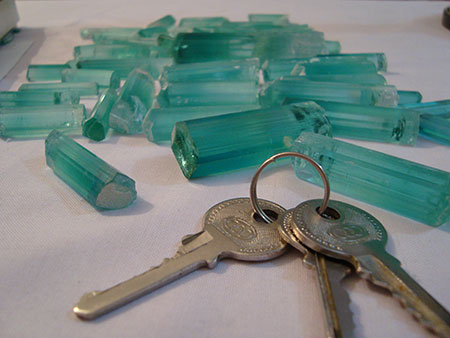 |
| Mawi tourmaline. This was one of the fine lots of tourmaline found in Mawi recently. From last month’s article in our Pala Mineralis. |
The correspondent forwarded to our mutual friend an explanation he’d made to a third party upon hearing of the Pala Mineralis story. The Gaamata mine is quite remote, and while production had been low in his experience, “when something would be found [it] was magnificent.”
One of the finest roughs ever recovered from this mine was a 68-gm piece (yes, 68 grams!!) some years ago. My friend sold that stone to a Peshawar dealer who then sold it to Jeff Graham at the Tucson shows. Graham later said it was one of the finest tourmalines he ever saw and bought. … I saw the 68-gm with the Peshawar dealer. I missed by just a couple of days. … This was a year or so before cell phones became popular here—I think it was 2000 or 2001…
Jeff Graham, who died unexpectedly in June 2009, did extensive writing on the art and craft of gemstone faceting, some of which still is available on Cabbers.com.
God only knows what hidden treasures are in that mountain. There’s an emerald deposit near Gamatha, too. Again, some close friends were the first to work that emerald mine, which has produced the occasional fine piece. … Just walking up the 3000-ft trail alone will put you down...
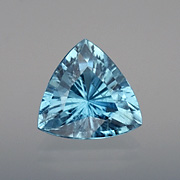 |
| Cool blue. This unenhanced blue trillion-cut tourmaline from Afghanistan is a cool 9.93 carats, and affordable. Inventory #16191 no longer available. (Photo: Wimon Manorotkul) |
He goes on to discuss other material being produced in the area.
The latest mine to yield top neon IS near Mawi but that produces emerald green material. That too is amazing material, and I’m surprised that there has been no mention about it in GIA or AGTA during the past few years because the material is mind-blowing. This started coming out about 4–5 years ago. … I’ve been a little out of touch with the mines during the past year or so [being involved in another sector of the market], but last time I heard about this material it was selling for very high prices in Mawi, even tiny crystal fragments. The exceptional quality and big roughs would sell by the piece, but again, production started to get very sporadic after a couple of big finds, and rare to find.
(Indeed, we’ve been able to find very few if any references to this material.)
We followed up with this correspondent and received more information. He again mentioned the emerald green tourmalines:
There was a lot of talk about the pockets near Mawi producing the material. This was about 4–5 years ago. Much of the initial findings were sold to the major Peshawar dealers the first year, but thereafter just a trickle of material would find its way [out]. Primary color was a beautiful intense spectral green, some with a yellowish-brown modifier, others with a touch of blue. I would see the occasional rough lot in Peshawar, but was told some superb one-of-a-kind pieces weighing over 50 grams were found and sold almost instantaneously at the mines for very high prices.
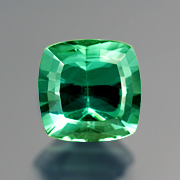 |
| Avoid the pinch—on St. Pat’s and on the wallet. This blue-green tourmaline from Afghanistan is 4.15 carats and available. Inventory #15654 no longer available. (Photo: Wimon Manorotkul) |
And other mines in the borderlands of the three provinces can sporadically produce neon colors. The mining area is relatively high in elevation, with the nearby Koh-e-Sagoli mountain range nearly 10,000 feet in altitude. Thus, our correspondent told us that “the mines of Kunar, Laghman, and Nuristan are known very little about, even in this age of satellite TV and the Internet.”
We asked him about the geology of the pegmatite veins pictured in the February Pala Mineralis news item. He related what he’d been told when the mining was attempted a decade ago.
I was told by friends that many times the pegmatite veins seem to travel in more vertical and other difficult angles; the deeper you’d penetrate the more complex the pegmatite route. The deeper the pegmatite the better the material, as the old saying there goes, but then what does one do when the vein suddenly goes off in different directions 50 meters or so within the surface, or even further in than that? This is what made the recovery of material at Gamatha so difficult, according to my friends.
One of the beauties of the kunzite mines at Mawi was that a miner could walk into a refrigerator sized pocket containing many kilograms of kunzite just a few meters within the surface. (It’s not uncommon to come across pockets within major pegmatite veins that could contain up to a 100 kilos of Kunzite, even more, just within a few meters beneath the surface!) Unfortunately, that doesn’t apply to Gamatha. The gold and glory is there, but the mining is going to be a challenge surely. Much more challenging than the normal mining conditions in Laghman, Kunar, and Nuristan. Again, your [other] correspondent is working there now and I assume a lot has changed in the past ten years.
He wishes the current miners well: “It’s not easy working that mountain…”
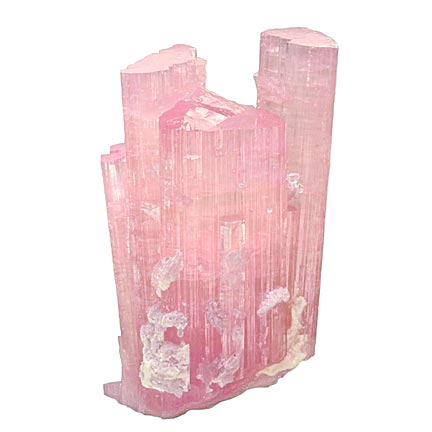 |
| From Paprok, Nuristan. This specimen was just posted to our online inventory on Friday. This tourmaline from Afghanistan consists of four prominent attached crystals. Good luster with glassy terminations. It measures 6.6 x 4 x 2.4 cm. Inventory #18086 no longer available. (Photo: John McLean) |
And Pakistan?
Turning to another subject, and another country, we asked him for a new assessment of Pakistan’s gem and jewelry industry. Four years ago, he’d admitted to being an optimist, but in the face of a reality that called for skepticism. Now, things are
still a little “rough” but improving. I give much credit to the few gemologists here who are working hard to apprise better the gem trade in colored stones and diamonds. There are gemologists who offer week-long programs in diamond grading, for example; you couldn’t see that a few years ago. The Export Promotion Bureau, though helping the local dealers in local promotions, still are lacking in the international avenue. Jewelry manufacturing, especially in the casting and stone setting sectors, is much better than before.
Mining conditions, however, still are pretty much the same, with the same risks and hurdles of the past 30 years. Again, sadly, the political [situation] and stability of peace in the (now) volatile North-West Frontier Province and Pakistan itself will be a major factor in developing the mines as well as prospecting for new mining areas. Northern Pakistan regions like Skardu, Hunza, Gilgit, etc., still are happy and peaceful regions, though.
A follow-up message included information about women’s role in the industry.
I forgot to mention that another interesting aspect I’ve observed in the jewelry sector here is the greater involvement of women entrepreneurs in the jewelry field nowadays—especially colored stone jewelry in silver and gold. Whereas you would find just a couple of women working in jewelry a few years ago, nowadays there are many ladies doing business and doing extremely well. Much of their work and promotion is localized in the form of private exhibitions in homes and hotels, but a few are venturing to places like England and the U.S. and doing well there also.
Thank you to both our contributors for their informative reports…
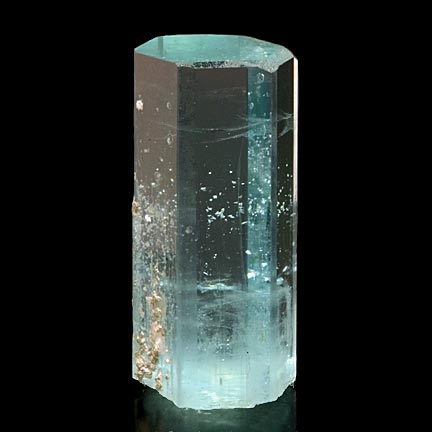 |
| From Shigar Valley, Baltistan. Another new specimen posted to our online inventory on Friday. It features a gemmy upper half and measures 11.4 x 2.6 x 2.3 cm. Inventory #18087. (Photo: John McLean) |
[back to top]
De Beers Blue Diamond Should Fetch Millions
A blue pear-shaped diamond, estimated to be worth $4.6–5.9 million, is expected to be highlighted at an upcoming Sotheby’s auction in Hong Kong on April 7. This exceptional diamond is the first from the De Beers Millennium collection to be put up for sale at auction. It is one of eleven rare diamonds that were in this esteemed collection that took De Beers decades to assemble.
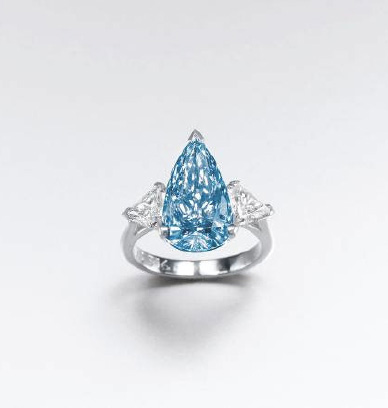 |
| Once in a thousand years. This diamond bears the inscription, “De Beers Millennium Jewel 11,” signifying its place in the collection that De Beers presented in 2000 to celebrate the new millennium. (Photo courtesy Sotheby’s Hong Kong) |
Weighing in at 5.16 carats, with an even fancy vivid blue hue, and an internally flawless clarity grade, this rare natural diamond is the star lot of Sotheby’s Hong Kong. Last May, a 7.03-carat cushion-cut, internally flawless, vivid blue diamond set a world record per-carat price, of almost $1.34 million/carat.
This Magnificent Jewels and Jadeite Sale also will include: a jadeite bead necklace, a necklace with 50 D-color and IF-clarity diamonds, and an assortment of gemstones, diamonds, and natural pearls. See the press release and more photos. [back to top]
“Elephant” Emerald Unearthed in Zambia
The “elephant” has entered the room. A massive 6,225-carat rough emerald crystal has been pulled out of the Kagem mine in Zambia. The local Bemba people named the oversized green jewel “Insofu,” which translates as “elephant.” This remarkable specimen was found on February 5 and announced by the gemstone producer Gemfields. Evaluation of the true quality of this piece has not been released, but even from the simple picture below, one can see the strong color and high clarity. No doubt we will be seeing some mammoth faceted emeralds out of this very gemmy-looking piece of rough.
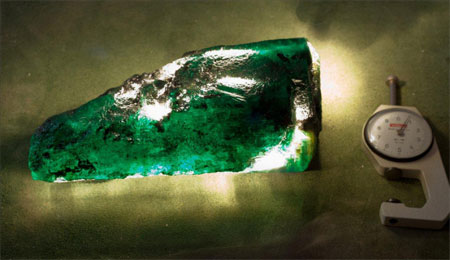 |
| The “elephant” was named for its size, but also in honor of the World Land Trust’s “Wild Lands Elephant Corridor Project.” Promotion of the project will include the creation of “a bespoke collection of emerald jewellery, designed and created by the very best jewellers from around the world,” according to this International Colored Gemstone Association news item. See also this compelling preview of a forthcoming documentary on Asian elephants. (Photo courtesy Gemfields) |
Zambia has become an important source for emeralds as the world’s thirst for these green jewels grows. Other major producers include Colombia and Brazil, which have produced some record-settling emeralds as well. Colombia unearthed a 7,025-carat emerald crystal that actually held the record, but Brazil supposedly found the largest uncut emerald in 1974 that weighed 86,136 carats, according to The Daily Telegraph (UK) and Mindat.
For an overview of gemstone mining in Zambia, see this 2007 briefing paper prepared by the NGO groundWork.
Ron Ringsrud on the Elephant and El Itoco
Our friend Ron Ringsrud, author of Emeralds, A Passionate Guide, had this reaction to the Zambian find: “I am so impressed with the transparency of the ‘Elephant Emerald.’ It is astounding. It reminds me of the gem-quality transparency of the Itoco emerald.”
Ron should know; he facilitated the Itoco’s display last year at Southern California museums, as we reported. He told us that the Itoco will be unveiled once more—at Baselworld. It will be displayed in Exhibition Hall 3, Hall of Elements 3.1. [back to top]
Burma Bits
Burma Gemstone Production Down
Nearly 50% for Calendar Year 2009
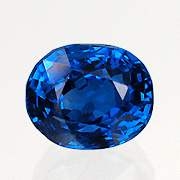 |
| How did this one get past us the first time? This 3.12-carat blue sapphire from Burma is listed on our Old Stock… New Pix feature. Inventory #12283 no longer available. (Photo: Mia Dixon) |
Vague mention was made last week of the annual general meeting of the Myanmar Gems Entrepreneurs Association, at the site of the 47th Gems Emporium now taking place. According to the official New Light of Myanmar daily, the meeting, held March 7, was attended by Minister of Mines Brigadier-General Ohn Myint and other department heads. No specifics from the meeting were reported.
What was reported on March 5, however, were industry statistics for December 2009, which round out another calendar year. (The fiscal year for Burma runs April–March.) The results are, as might be expected, dismal, with not a single production increase, except that of pearls.
Gemstone Production Figures – 2009
Gemstone, jade, and pearl production for calendar 2009 (Central Statistical Organization):
- Total gemstone production: Down 46% from 2008
- Ruby production: Down 10% over 2008
- Sapphire production: Down 30% over 2008
- Spinel production: Down 48% from 2008
- Peridot production: Down 66% from 2008
- Jade production: Down 18% from 2008
- Pearl production: Up 5% from 2008
Total trade with China, however increased by 10 percent, as reported by Xinhua last week.
Except for anecdotal information, we haven’t seen statistics on how gemstone sanctions have affected workers, but a kindred sector—the garment industry—has been decimated by sanctions that were imposed beginning in 2001. According to a March 10 Reuters story, the Burma garment industry is estimated to have shrunk by 75 percent, with 280 out of 400 factories closing, and 240,000 out of 300,000 jobs lost.
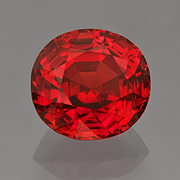 |
| And this one? Also from Old Stock… New Pix, this 3.56-carat spinel from Burma is a deep, orangey-red and very gemmy. Inventory #14315 no longer available. (Photo: Mia Dixon) |
[back to top]
— End March Newsletter • Published 3/16/10 —
Recent News
March 8: AGTA Spectrum Designs
Figure in Academy Awards
Jewelry designs created for the American Gem Trade Association’s annual Spectrum Awards were among those flying out the door prior to last night’s Oscar presentations. Celebrity stylist and jewelry guru Michael O’Connor took The Fashion Patrol website on a browse through some of the choices that were made available to red-carpet ramblers.
While “white” diamonds always deliver at the ceremony, color can command as well, from the understatement of Kate Winslet’s yellow diamond necklace, earring, and bracelet ensemble from Tiffany, to Sigourney Weaver’s massive ruby and diamond brooch. Zoom in on Amanda Seyfried’s brown, champagne and mint diamond geometric bracelets by Lorraine Schwartz. Or perhaps the turquoise and diamond earrings worn by Susan Geston.)
Before the ceremony, Michael O’Connor allowed a peek at a StyleLab suite of top designers’ luxury goods—hidden away in a Beverly Hills suite. Several made-for-Spectrum designs—including immense aquamarine earrings by Sam Getz—were highlighted in the Fashion Patrol video. Other designs from the StyleLab—including a lovely ruby and diamond rose-shaped brooch are pictured at the blog The Recessionista. [back to top]
March 4: More from Mozambique?
In 2007, we noted the visit to Tucson of gemstone entrepreneur Moussa Konate, who with his partners in Mozambique Gems dazzled us with paraiba-type tourmalines in substantial sizes. Between August 2006 and August 2008, Pala International chose tourmaline from Mozambique six times as the monthly featured gemstone. After the Tucson show in 2007, Pala’s Jason Stephenson traced the history of these stones in a full-length article, “The Path to Paraiba Winds Through Mozambique.”
Moussa returned to Tucson last month, but production of tourmaline from the region has ceased for the time being. We’ll keep you posted on further developments…
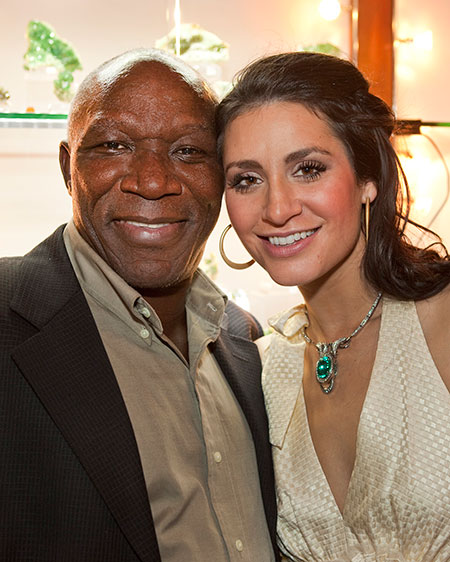 |
| Gemtone supplier Moussa Konate, pictured above with Rebecca Boyajian at a Tucson 2010 party. Rebecca wears a necklace featuring one of the paraiba-type tourmalines that were the talk of Tucson 2007. (Photo: James Elliott, Fine Minerals International) |
[back to top]
March 2: 507-Carat Cullinan Heritage Diamond Sells for $35.3 Million
Hong Kong’s Chow Tai Fook Jewellery Company on Friday purchased the 507.5-carat Cullinan Heritage for $35.3 million—the highest ever paid for a rough diamond. According to a news release from the seller, Petra Diamonds, the diamond was sold on tender in South Africa, where the 100-gram crystal was discovered last September (along with three other notable diamonds, as we reported). According to the jeweler’s website, “[t]he Company plans to handcraft the…diamond…into a finest [sic] round diamond of more than 120 carats.”
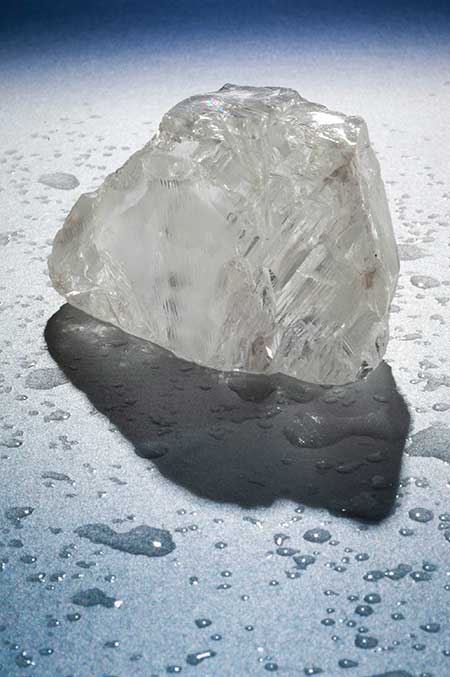 |
| The Cullinan Heritage, pictured above comes from the same mine as the world’s largest, the 3,106-carat Cullinan, discovered in 1905. (Photo courtesy Petra Diamonds/Buchanan Communications) |
[back to top]
February 2010 Newsletter
In this issue we take a breather from Tucson, which GIA and AGTA found mostly upbeat, and from which was acquired the rough for this month’s featured stones. While in Tucson, not only did we pay tribute to the late Campbell Bridges, but we learned of the capture of a key suspect in his death. Looking forward, we sneak a preview at Pala’s forthcoming website: Palaminerals.com. And two new CIBJO reference guides. We round it out with a research roundup and some Burma boulders.
Shows and Conferences
- Bridges Tribute at Tucson Followed by Suspect’s Apprehension
- CIBJO: Emerald Guide and Retailers’ Reference
Pala International News
Gem and Gemology News
Industry News
Shows and Conferences
Campbell Bridges Tribute at Tucson
Followed by Suspect’s Apprehension
Attendees of the Tucson shows on February 3 took time to reflect on the life and work of Campbell Bridges. GIA’s Robert Weldon, whose portrait of Bridges is included below, presented photographs of the pioneer who is known to students of gemology as the discoverer of tsavorite. The gathering was attended by Judith Bridges, Campbell’s wife, and their children Bruce and Laura, along with other family members and over 300 members of the international gemstone community. The tribute took place during the annual International Colored Gemstone Association (ICA) reception at the American Gem Trade Association (AGTA) GemFair and was arranged by ICA, AGTA, and the Gemological Institute of America (GIA). From a February 6 ICA release:
Bruce Bridges’ emotional remembrance of his father included the tragic details of the last moments of Campbell’s life. He thanked the ICA for its collective efforts to rally the support of the international gemstone community immediately following the murder of his father and the association’s commitment to the family and Campbell’s legacy. Bruce called on the international community to support the efforts to seek justice for Campbell and the prosecution of the known perpetrators.
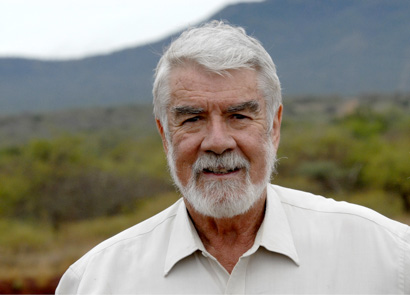 |
| During ICA’s East Africa gem tour in 2007, Campbell Bridges posed for cameras near his tsavorite garnet mine in Kenya. (Photo: Robert Weldon, © 2007 Gemological Institute of America) |
Five days following the tribute in Tucson, ICA announced the arrest in Nairobi of the alleged organizer of the attack on the Bridgeses and four colleagues. From the February 8 announcement:
Sources close to the Bridges family reported that a member of the Bridges' private security force apprehended Daniel M. Mnene, commonly known as Suleiman, and held him until police arrived to arrest him. Records indicate that Mnene was booked at 16:36 hrs under Occurrence Book number 99 at the Central Police Station in Nairobi.
Mnene is believed to be behind the illegal mining and attempted takeover of the Bridges’ mining concessions.
The security officer who notified police was a witness to the murder of Campbell Bridges and was brutally beaten and stabbed by the mob that murdered Bridges on August 11, 2009 in Taita Taveta District in Tsavo National Park. He reportedly accompanied police to the station to document the arrest of the alleged suspect.
Details on the charges filed against Mnene are not yet available.
A Reuters story on February 8 stated that the suspect would be moved to the town of Voi, not far from where the attack and murder took place. [back to top]
CIBJO to Approve Emerald Guide at Congress
AGTA Publishes CIBJO Retailers’ Guide
At its Congress yesterday, CIBJO’s Coloured Stone Commission planned to ratify its new Emerald Guide as an addition to other such guides for ruby and sapphire. The guides provide an illustrated, two-page aid covering the “Four Cs”: carat, cut, color, and clarity.
CIBJO, The World Jewellery Confederation, is holding its annual meeting in Munich.
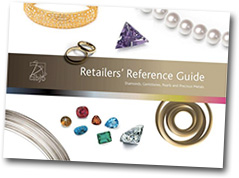 |
Just prior to the Congress, the American Gem Trade Association announced the publication of the CIBJO Retailers’ Reference Guide: Diamonds, Gemstones, Pearls and Precious Metals (see this link for more information on the guide). The guide’s development was launched at last year’s CIBJO Congress, in Istanbul. From the AGTA news release:
The book is spiral-bound and sections are divided out with easy-to-read tabs for quick navigation. Key Facts pages discuss the important quality factors for each category. The guide then focuses on specific gemstones, taking an in-depth look at the characteristics of each, lore, origin, treatments and care. Using this book, sales associates can quickly answer the majority of client's questions, instilling confidence and helping to close the sale.
According to a special report issued in January, the gemstone section of the guide was written by Robert Weldon of the Gemological Institute of America, aided by the CIBJO Coloured Gemstone Commission Steering Committee. Today, CIBJO announced the launch of a consumer reference guide to be crafted during the coming year. [back to top]
Pala International News
Pala’s Featured Stones: Prase Opal From Tanzania
This month we feature prase opal from some recently unearthed veins on Mount Iyobo in central Tanzania. Prase opal is a nickel-bearing variety of common opal, with nickel being the chromophore that illuminates the neon bluish-green hue. Chrysoprase and prase opal can be similar in appearance but can easily by separated by varying RI and SG. Both varieties range from low-quality opaque material to high-quality translucent jewels; however, the prase opal tends to be more translucent and gemmy. Pala International just recently purchased some of the fascinating prase opal rough while at this year’s Tucson show.
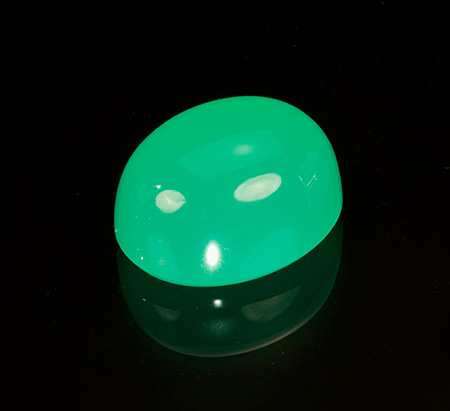 |
| Tanzanian treat. A glowing prase opal cabochon showing the most pure and intense color; 11.80 carats, 16 x 12.6 x 9 mm. Price available upon request. (Photo: Jason Stephenson) |
Chrysoprase and prase opal have been mined on Iyobo Mountain in central Tanzania for more than 20 years, with the first accounts being described by Gübelin in 1975. The most recent discovery revealed some of the most intense and beautiful bluish green material to be seen by the gem trade. The majority of the production is in the chrysoprase form, while the prase opal is the more rare find from this deposit. Chrysoprase and prase opal both form in discontinuous veins within metamorphosed ultramafic rocks with the most dominant host rock being altered serpentine.
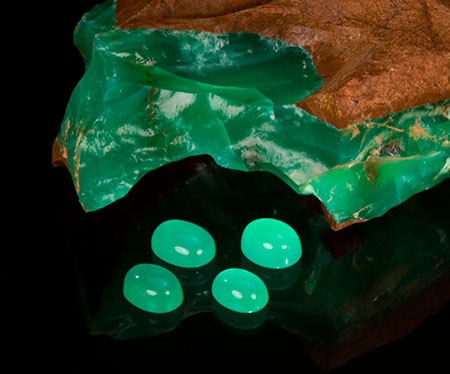 |
| Goody goody gum drops. An assortment of the prase opal cabs with a chunk of rough showing the gem vein and the surrounding matrix. (Photo: Jason Stephenson) |
See “Chrysoprase and Prase Opal from Haneti, Central Tanzania,” by James E. Shigley, Brendan M. Laurs, and Nathan D. Renfro, in the current issue of Gems & Gemology.
Palaminerals.com
Pala International to debut website devoted to mineral specimens
Pala International will soon debut a new website, for the mineral devotee: Palaminerals.com. The website aims to offer the existing catalog (currently available from CollectorFineJewelry.com) in an updated format and with enhanced search capability.
We’ll notify both groups of our subscribers—minerals and gems—just as soon as the website goes online.
 |
Will Larson, webmaster David Hughes, and Fallbrook IT pros Stephen Calia and Brent Dussia have guided the project through design and scripting phases. Features that users have come to rely on, via the sister site, Palagems.com, will be integrated into the site, including Mineral News from Pala International, which receives its new title and masthead, Pala Mineralis.
Why “Pala Mineralis”?
The literature of mineralogy predates the printing press of Johannes Gutenberg, himself a goldsmith and gem-cutter. Medieval mineralogical works, such as those by 13th century polymath Albertus Magnus, were some of the earliest to see the transition from manuscript to printed page, with his De Mineralibus Libri being published in 1476—only twenty years after the famous 42-line Bible. As stated in a bibliography by the late Curtis P. Schuh:
With Albertus Magnus' mineralogy, the study of minerals begins to emerge from its embryonic period into a full fledged science. The tradition of magical and curative powers in gems still permeates the text, but one feels the author fighting the superstitions of the ancient beliefs, and seeing the world in a new, more skeptical and practical view.
Although the coming renaissance would lead, as suggested above, to the Age of Reason, even Isaac Newton, as a scientist of his day, delved into alchemy and other esoteric investigations. And while the great age of the illuminated manuscript had since passed, illustrated manuscripts continued to be produced. One such work—perhaps at first glance more compelling for its arcane subject matter than its awkward imagery—is Cabala mineralis, a curious ~17th century alchemical treatise.
Alchemy was (is) concerned with investigation and, of course, transformation. And so it is both the curiosity-compelling and transformative power of nature’s creations, as we behold them, to which we pay homage in our echoing—rhyming, twinning—of a long forgotten alchemical text. Pala Mineralis. (Dulce et decorum est.) — David Hughes
[back to top]
Gem and Gemology News
Research Roundup
 |
Some research reports of note from recent weeks…
GIT-GTL’s lab alert, “An Update on Titanium-Diffused Sapphire”: As indicated by the title, this treatment is not new. (See one of Richard Hughes’s articles that discusses the history of surface diffusion.) What was new to the GIT researchers was that the evidence of treatment was reduced, “or even eliminated,” in faceted material.
Samples of rough and cut material were obtained by the lab in November. The report is well illustrated; penetration of the diffusion is easily observed alongside traditionally heated sapphire, under diiodomethane (methylene iodide) immersion. Photomicrographs by ex-Pala staffer Wimon Manorotkul reveal the telltale signs of heating at high temperatures: melted crystals, dotted lines of partially resorbed needles, and discoid fractures encircling melted crystals. Even normal photography displays strong color rims on the rough.
Seems simple enough, but the report’s conclusion stresses that because this faceted material contains so little evidence of enhancement, compared with what is typically seen, care must be taken by gemologists in order not to overlook the treatment.
GIA Laboratory–Bangkok’s Vincent Pardieu, Pantaree Lomthong, and Nick Sturman take on “Lead glass filled star rubies reportedly from Madagascar,” and compare this material with star rubies elsewhere.
When was the last time a Thai “burner”—gemstone enhancer—contacted a gem lab with news about a prospective treatment? Such a contact did take place in January between Mr. Mahithon Thongdeesuk, who has been developing lead glass treatment since 2002. He wanted an independent study for publication on treated star ruby purportedly from Madagascar. Marketing accuracy—transparency—was the goal. Refreshing.
Hmm. Remember the Bangkok Post story we pointed to a year ago on the decline of the Thai colored gemstone market? It included a call by a trade leader to redeem the reputation of the Thai market via government partnership with the private sector in order to develop a disclosure strategy that will satisfy the wary buyer. But we digress…
The GIA report recounts the history of glass filling, and then looks to the stones from Mr. Thongdeesuk’s office. While the provenance of Madagascar could not be confirmed, the gemological data pointed to East Africa. The treatment itself was not technically challenging, although swapping a loupe for a microscope probably is in order: flash effect was absent, the refractive index of the filling was very close to that of the ruby, and fissures were to some extent obscured by the stones’ dense silk. The copious photomicrographs demonstrate what can be seen using appropriate magnification and lighting.
The report notes that lead-glass-filled star rubies are not new, but have been relatively rare in the marketplace. The star effect of the examined stones was not affected due to the relatively low melting point of the lead-rich glass. “As a result the final product can exhibit a six (or twelve) rayed star very similar to that found in non-fractured, untreated star rubies.” It’s probably only a matter of time for the gemologist and jeweler to be confronted with this enhancement.
Dietmar Schwarz of Gübelin Gem Lab and Vincent Pardieu of GIA Laboratory–Bangkok provide an in-depth exploration of “Emeralds from the Silk Road Countries – A Comparison with Emeralds from Colombia,” in the Fall/Winter 2009 edition of International Colored Gemstone Association’s InColor. The article begins with a discussion of the geological conditions under which the elements of emerald are brought together. Next, identification of the host rock for individual localities, from two zones in Colombia to Pakistan’s Swat Valley and Afghanistan’s Panjshir Valley, and on to China’s Davdar deposit.
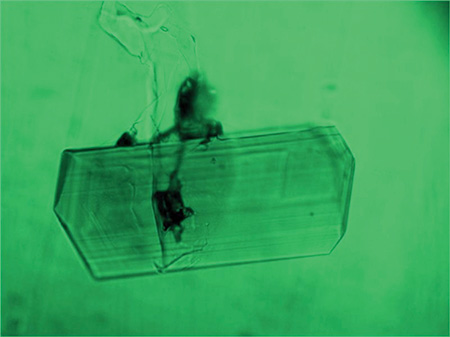 |
| From the article: A well-developed tourmaline crystal in Afghan emerald. “Tourmaline inclusions help to separate Panjshir and Colombian emeralds, but they are also known in Swat emeralds.” (Photo: Dr. Eric Erel, courtesy Gübelin Gem Lab and InColor) |
Gemological identities are then examined. Inclusions are often specific to a particular region—until they are found elsewhere—such as those from Chinese Davdar, which can include three-phase inclusions like their Colombian cousins or tube-like multiphase inclusions similar to those found in Panjshir. Locality-specific characteristics—mineral associations/combinations—also are listed.
The article, which is nicely illustrated by photomicrographs and charts, concludes with discussions of chemical and spectral fingerprinting. [back to top]
Industry News
Burma Bits
Gem Sales
Gems Emporium Scheduled for March
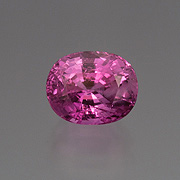 |
| Am I blue? This natural, 4.57-carat pink sapphire from Burma features a deep fuchsia color and beautiful cushion cut. Inventory #15668 no longer available. (Photo: Mia Dixon) |
The 47th Annual Myanma Gems Emporium is scheduled to be held March 8–20, according to a February 15 item in The Myanmar Times.
A Ministry of Mining spokesperson was quoted as saying that no “extraordinary items” would be offered at the sale. That doesn’t seem to have been the case at a sale in January, however…
January Sale Held
According to a pre-sale notice on the website of the Union of Myanmar Economic Holdings Limited, a January 11–15 sale featured
a magnificent rough sapphire from Mogok, weighing 326.55 carats, clear, flawless and transparent, and of a velvet blue colour…. The starting price will be Kyat 500 million.
The 28th Gems & Jade Sales 2010 was held at the Myanmar Gems Pavilion in Yangon. Figures for the sale were not made public.
Burma Jade Boulder —> Biggest Jade Buddha
Two weeks before last fall’s 18th Annual Mid-Year Myanma Gems Emporium, a 35-ton jade boulder was transported from Burma to Vietnam, where it is to be carved into what may be the largest image of Buddha ever sculpted in jade.
The story of the jade’s journey varies a bit from news account to news account, but, according to VietNamNet Bridge, it begins in 2006, at a mid-year auction in Burma. (Burma had at least two major sales during that summer, as well as the annual “Mid-Year” sale in October.) At the sale, the giant boulder was seen at the sale by entrepreneur Dao Trong Cuong, who is vice director of the Vietnam Gem and Jewelry Institute, when it was bought at the sale for $1.5 million by a Chinese businessman. (To our knowledge, the sale of the boulder went unreported in news of the three sales held that year between June and October.)
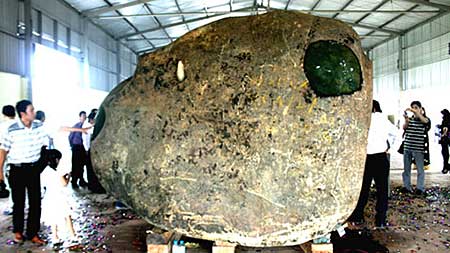 |
| SUV-sized: that’s the way one report put it. Owner Cuong also owns a Hummer. The boulder appears to be lying on its side, above. (Photo: VietNamNet Bridge) |
Haunted by the jade, which Cuong claims contains no cracks, he made Web searches for any mention of the boulder, but to no avail. During a later trip to China to buy jade sculpting equipment, Cuong found that the jade was on the market—by its original buyer, a fellow sculptor. After selling his Hanoi villa and borrowing cash, Cuong purchased the boulder for slightly less than its auction price: $1.45 million—plus 3 billion dong in taxes (about $160,400). According to news reports, the boulder may never have been transported to China; on October 10 it was shipped by Cuong from Burma to Vietnam following his purchase. A January 19 VietNamNet Bridge news item claimed that the boulder was purchased “from a gemstone fair in Myanmar.”
Later in October, the city of Hanoi marked its 999th birthday, as “former Party chief Le Kha Phieu, local authorities, and Dao Trong Cuong… opened the seal” of the 35-ton boulder at Cuong’s carving and “gem-made-painting” factory in neighboring Hai Duong Province. According to an October 20 report by VietNamNet Bridge, the boulder measured, in meters, 3 (h) x 2.3 (w) x 2.4 (d). Cuong and craftsmen colleagues were then slated to visit India and Nepal for inspiration.
The carving will cost $800,000, employ fifty Chinese artisans, and is estimated to be completed late next year, with a net weight of between 15 and 16 tons, retaining the uncarved height of 3 meters. The first day of carving, January 18, was marked by a ceremony attended by President Nguyen Minh Triet, over 400 senior Buddhist monks, and thousands of others.
- See photos of the ceremony and more background at VietNamNet Bridge and AP
Bite-Sized Bits
- Xinhua: 115-ton jade boulder discovered at Phakant
- Institute for Security & Development Policy: A report examines European sanctions against Burma. The report concludes that the sanctioning of gemstones from Burma, for example, is responsible for the reduction of economic development of the country’s middle class. Sample quotes: “[S]anctioning of products from Myanmar has created perverse effects….” “Sanctions are essentially an expression of helplessness” and sanctioning “has reduced to almost zero the possibility for the EU to influence the government in Myanmar…. By the same token, it has strengthened other actors to influence Myanmar.” [back to top]
— End February Newsletter • Published 2/21/10 —
January 2010 Newsletter
Shows and Conferences
- Tucson Time: Bill Larson to Address Museum Group
- All That Glitters: San Diego Museum Launches 2-Year Exhibition
- CIBJO Announces “Ruby Day”
- Wittelsbach-Graff Diamond to be Displayed at the Smithsonian
Pala International News
Gem and Gemology News
Industry News
Shows and Conferences
Tucson Time: Bill Larson to Address Museum Group
 |
Pala International president Bill Larson will address the 2010 Tucson Meeting of The Society of Mineral Museum Professionals on the subject of Gem Crystals – Mogok, Burma. The meeting will be held during the annual extravaganza of gem and mineral shows in Tucson in late January and early February. The public is welcome to attend.
The Society of Mineral Museum Professionals (SMMP) is an international organization of mineral museum curators and others with related interests. SMMP is a non-profit, tax-exempt corporation incorporated under the non-profit laws of the State of Arizona.
Event: SMMP 2010 Tucson Meeting
When: Thursday, February 11, 4–5 p.m.
Where: Tucson Convention Center
The Tucson Shows – February 2–14, 2010
Tucson hosts the world’s greatest gem and mineral show in February. One-stop general information about individual shows can be obtained from the Tucson EZ-Guide.
Pala International will be represented in Tucson as follows. We look forward to seeing our many friends there. Visit the Pala International Show Schedule for future events.
AGTA GemFair
 |
Pala joins nearly 100 exhibitors for this annual extravaganza. Some highlights from the schedule that may interest mineral lovers and dealers:
- Richard Drucker, of The Guide, gives tips on profitability in the colored gemstone trade (Wed)
- Gary Roskin, of Roskin Gem News Report, discusses color trends for 2010 and 2011, and availability (Wed)
- Jewelers Vigilance Committee invites reps from 5 U.S. agencies to answer questions (Thu)
- Books for Gem Lovers features three authors we’ve spotlighted in Pala’s Gem News in recent months: John Koivula, Ronald Ringsrud, and Richard Wise (Thu)
- Cindy Edelstein, of Jewelers Resource Bureau, explains how to use social networking tools (e.g., Facebook, Twitter) to promote your products (Thu)
- Robert Weldon, of Gemological Institute of America, documents the world of ametrine in easternmost Ángel Sandoval Province of Bolivia, with videography by GIA’s Pedro Padua (Thu)
- Alan Hodgkinson regales with “Intriguing Gem Stories” (Fri)
- Edward Boehm, of JOEB Enterprises, on “Spinel: A Royal Gem” (Fri)
- Antoinette Matlins, of Gemstone Press, teaches how to quickly identify colored gemstones and detect treatments, fakes, and synthetics (Fri)
- Leela Hutchison, of Leela’s Divine Play of Gemstones, explores those amazing selenite caves of Naica, Chihuahua, Mexico, which we covered in 2007 (Sat)
Event: AGTA GemFair
When: February 2–7
Where: Tucson Convention Center
Pala International Booth: 1016–1018
9th Annual Westward Look Mineral Show
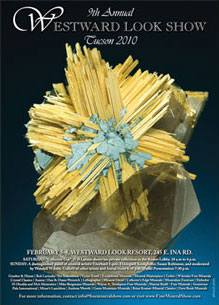 |
Pala International and two dozen other world-class mineral dealers shack up at a Sonoran Desert resort.
- Collector Day (Sat) features Pala’s Will Larson and selections from his Japan and worldwide collections (see this preview from our October edition)
- Mineral Artists (Sun) looks at the work of special guests Eberhard Equit, Hildegard Könighofer, Wendell Wilson, and Susan Robinson, as well as others whose paintings and illustrations will be displayed. Gamini Ratnavira, illustrator of our featured mineral specimen last month, will be included in the exhibition
Event: 9th Annual Westward Look Mineral Show
When: February 5–8
Where: Westward Look Resort
Pala International Suite: 236
See Pala International’s page on the Westward Look Show site.
55th Annual Tucson Gem and Mineral Show
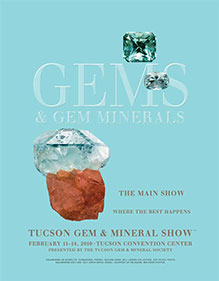 |
TGMS is the largest gem and mineral show in the country. This year’s theme is “Gems and Gem Minerals”—a Pala International specialty.
Event: 55th Annual Tucson Gem and Mineral Show
When: February 11–14
Where: Tucson Convention Center
Pala International Booth: Aisle 5 East
Ronald Ringsrud has informed us that the Geo-Literary Society will host a book signing (Emeralds, A Passionate Guide) and lecture by Ringsrud in the Crystal Ballroom at the Tucson Convention Center during the TGMS, Friday, February 12, at 3:30 p.m.
The next day, Saturday, February 13, Richard Wise will appear at TGMS at 11:00 a.m., with a signing (The French Blue) and talk on “The History and Mystery of the Hope Diamond.” [back to top]
Tucson Transit Tips
The I-10 Widening Project is complete; therefore the Gem Ride shuttle is discontinued. Many shows, however, will offer their own shuttles. View your transit and parking options here. [back to top]
All That Glitters: San Diego Museum Launches
Two-Year Exhibition
Pala International to provide 100 gems and minerals
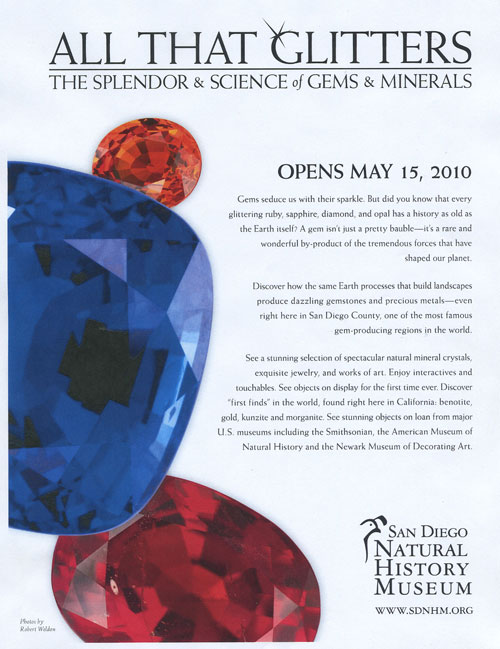 |
| Above, a promotional piece for the upcoming exhibition. Click on thumbnail to view full size. (Images courtesy San Diego Natural History Museum) |
The San Diego Natural History Museum is opening an exciting new exhibit for all those gem lovers out there. “All that Glitters: The Splendor & Science of Gems and Minerals” will include mineral specimens, faceted gemstones, and designer jewelry. It tells the story from the formation of gems within the Earth to Man’s creations employing all the wonderful gem materials. The exhibit will appropriately focus on the fascinating array of gems and minerals found in San Diego County, along with a wide variety from major gem producing regions around the Earth.
Over 100 gems and mineral specimens will be provided by Pala International. Prominent names in the industry like Tiffany & Co., Van Cleef & Arpels, and Cartier will provide a wide range of original jewelry pieces. Harvard University, the Smithsonian, the American Museum of Natural History, and the Museum of Fine Arts in Boston all will be adding to the extravaganza with more jewels and mineral specimens.
The exhibit opens May 15, 2010 and is scheduled to run through April 2012. “In addition to demonstrating the ‘splendor and science of gems and minerals,’ All That Glitters will have a playful side,” says Exhibition Curator and Graduate Gemologist Elise B. Misiorowski. “Jewels and carvings incorporating natural-history themes will give children as well as adults delightful surprises to hunt for. How many jeweled butterflies, birds, and flowers can you find? Which case contains the Faberge carved pig with diamond eyes?”
See the exhibition website for a look at the efforts underway to construct display installations as well as some of the pieces that will be included in the exhibition. The show’s inaugural week will culminate with the All That Glitters Gala. “The All That Glitters exhibition will seduce visitors with the beauty of these precious objects and fascinate them with the science of their formation, and the Gala will delight revelers with exquisite food, beautiful ambience and fantastic entertainment,” said Ellen Zinn, museum board member and Gala Chair, according to a press release containing more Gala details. [back to top]
CIBJO Announces “Ruby Day”
Congress 2010 to feature “mini conference”
 |
CIBJO, the World Jewellery Confederation, has added “Ruby Day” to a line-up of gemological mini conferences that the organization plans to feature at future congresses. “Ruby Day” at next month’s congress in Munich will focus on new and old deposits as well as new research findings associated with ruby treatments. The conference is to include such topics as:
- Mineralogy of ruby deposits connecting North-Vietnam and South China (Wolfgang Hofmeister)
- Low temperature treatment of Mong Hsu ruby (Pornsawat Wathanakul)
- Rubies from Mozambique before and after treatment (Kenneth Scarratt)
- Occurrence and identification of rubies from Winza, Tanzania (Adolf Peretti)
- Recent observations on synthetic rubies (Claudio Milisenda)
- Heating and diffusion processes on rubies: characteristics, detection and declaration (Michael S. Krzemnicki)
- Glass in rubies: various case, their detection and declaration (Elena Gambini)
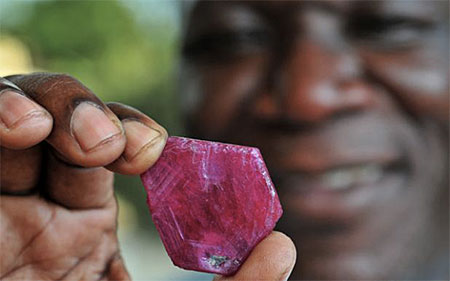 |
| Déjà vu. This photograph is included in the “Ruby Day” press release. Pala Gem News readers will have seen another view of this nearly 40-gram Montepuez, Mozambique ruby in our last edition. (Photo: Vincent Pardieu/GIA Laboratory, Bangkok, 2009) |
Subject matter and findings of presentations and articles will be added to the CIBJO Blue Book system, which aims to advance universal standards and terminology in the gem and jewelry industry. “CIBJO Blue Books are a definitive set of standards for the methodology, nomenclature and the trade practices of diamond, coloured stones, pearls and precious metals,” explains a recent press release.
- Friday, February 19th, 2010, from 1:00 - 4:00pm in Hall 5 of the International Congress Centre, at the Messe München, in Munich Germany
See the congress website for details. [back to top]
Speaking of ruby…
See how Vincent Pardieu and colleagues marked the New Year at the ruby mines and markets of Pailin, Cambodia, and the sapphire mines and markets of Chanthaburi, on Fieldgemology.org. [back to top]
Wittelsbach-Graff Diamond to be Displayed at the Smithsonian
 |
| Image courtesy Kunsthistorisches Museum Wien |
The Wittelsbach-Graff diamond will be coming out of a 50-year hibernation from the public eye and be unveiled in the Hall of Geology, Gems and Minerals in the Smithsonian. The stone will be on loan to the National Gem Collection, which includes the Hope Diamond. Rumor has it the Wittelsbach-Graff and the Hope diamond were both found in the Golconda mine in India; scientists will explore this possibility while the two are under one roof.
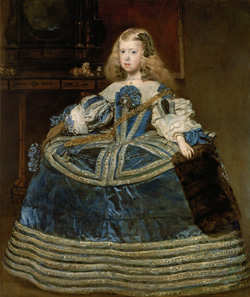
The Wittelsbach-Graff diamond weighs 31.06 carats and has a very rare, fancy deep blue color (Type IIb) and is internally flawless according to GIA. This remarkable diamond has a colored past, first being illustrated in 1664 when it was given by Philip IV of Spain at the time his daughter, the Infanta Margarita Teresa (portrayed here by Diego Velázquez), was engaged to Emperor Leopold I of Austria. Then in 1722 the diamond changed hands to the Wittelsbachs, members of the ruling House of Bavaria. In 1931 the crown jewels of the House of Wittelsbach were sold through a Christie’s auction. Laurence Graff eventually bought the 35.56-carat blue diamond at auction in London and recut the stone to its current weight of 31.06 carats to enhance the brilliance, clarity, and grade. Thus he was compelled to rename it the Wittelsbach-Graff.
- National Museum of Natural History January 28, 2010 through August 1, 2010
See the Smithsonian website for details. [back to top]
Pala International News
Pala’s Featured Stones: Burmese Red Spinel
This month we feature a Burmese red spinel with a single octahedral crystal, in conjunction with the theme of this year’s Tucson Gem and Mineral Show: gem crystals. As the world opens its eyes to new gem varieties, spinel is standing at the front of the line, intense and beautiful. Nothing better than a good ol’ fashioned flame-red spinel. This spinel exhibits the best Burma has to offer, with a slightly orangey red hue, high saturation, and a pleasing cushion cut.
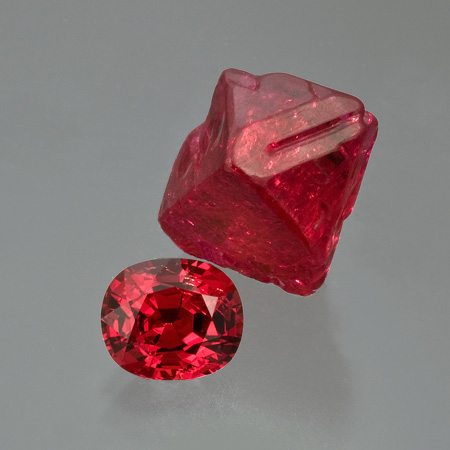 |
| Crystal & jewel: 2.24-carat Burmese faceted red spinel, 8.3 x 7 x 5.1 mm,, with 15-carat Burmese spinel crystal, 17 x 12 x 10.5 mm. Inventory #16655 no longer available. (Photo: Mia Dixon) |
As we see many deposits producing fine spinels these days, with Tanzania, Tajikistan, Vietnam, Madagascar, and Sri Lanka, to name a few, nothing quite compares to some of the rich reds that are produced in Burma.
Interested? Select the inventory number above, call, or email us to inquire. [back to top]
Mineralogical Almanac to Feature Bill Larson Article
Russian journal’s next edition planned for Tucson
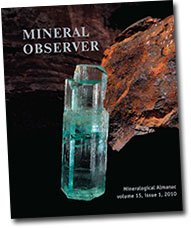 |
Last month, we featured Will The Younger’s report on the phenomenon of Mineralientage München. This month we look towards another world-class venue, Tucson and, among other things, the appearance of the elder Larson’s take on the Munich show, courtesy of the Russian journal, Mineralogical Almanac. If all goes as planned, the Almanac’s Ludmila Cheshko and Michael Leybov will have copies in tow, at the show.
We’ve seen a proof of the nicely illustrated article, which shines the spotlight on the Indian Exposition, the centerpiece of the 2009 Munich show. Munich this year featured some colossal mineral specimens. “It’s amazing to see the many tons of relatively perfect Indian mineral specimens which would be somewhat common if not for their enormous size,” Larson writes. “There are Stilbites, Quartzes, Quartz geodes, Calcites, Apophyllite in large formations rarely seen.”
As we stressed in our pre-show news item in October, the Munich show has much to offer fans of colored gemstones. A companion article by Jacques Touret, of Paris’s Musée de Minéralogie–Ecole des Mines, includes a page of faceted and sculpted beauties: luscious Mahenge spinels, 25–40 carats, and two aquamarine carvings—a 15–20-cm gold-beaked, sapphire-sighted falcon perched on a ruby-topped pedestal of gold and jasper, and a “frozen” aquamarine, which, at 15,950 carats, surely melted the hearts of its viewers.
See Mineralogical Almanac for more information. [back to top]
Gem and Gemology News
John Koivula Receives GIA’s Liddicoat Award
On December 17, John Koivula was presented with the Gemological Institute of America’s (GIA) highest tribute to an individual, the Richard T. Liddicoat Award for Distinguished Achievement. GIA President and CEO Donna Baker, who presented the award, noted, “The Richard T. Liddicoat Award for Distinguished Achievement goes to an individual who truly embodies the characteristics that made Mr. Liddicoat so great, and who sets an example for all of us in our service to the industry and the public.”
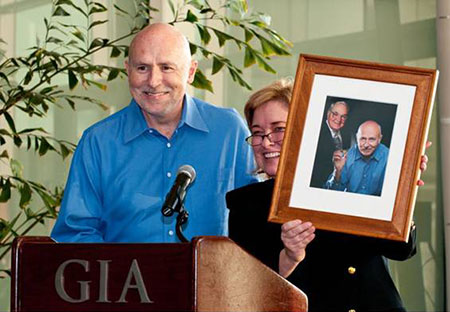 |
| Donna Baker presents an image of John Koivula and Richard T. Liddicoat. (Image: Kevin Schumacher/GIA) |
In accepting the award, Koivula said, “This award, named after Richard T. Liddicoat, has a very special meaning. Mr. Liddicoat was one of a small number of special people that built and strengthened GIA’s international gemological reputation through decades of hard and innovative work. I was extremely fortunate to have known him, and I considered him to not only be an excellent teacher, but also a very good friend. Gemology is a great profession. I would be doing this anyway even if I was not being paid because this is what I love to do,” he said. Koivula currently is being paid by GIA as the institute’s Chief Research Gemologist, but it goes without saying that he would receive the award anyway because of his his stature in the field of gemology, due to his groundbreaking research and innovations in the laboratory.
Koivula’s writing should be well known to our readers; he has authored or co-authored more than 800 articles. With the late Dr. Eduard Gübelin, Koivula produced all three volumes of Photoatlas of Inclusions in Gemstones, but one title he has written or contributed to. His resumé is colorful and rich, including work on the development of a television series. For more on Koivula’s career, see the GIA website. [back to top]
Carat Gem Lab Opens
 |
Bad time to go entrepreneurial? Apparently not for Dr. Eric Erel, the director of Carat Gem Lab, which opened its doors on January 4, in a suburb of Metz, in the northeastern région of Lorraine. While this Gallic city has roots that date back to pre-Roman Celts (known as the Mediomatrici, from whom Metz derives its name), Dr. Erel studied there for years in fields that are hardly prehistoric. He received his master’s and doctorate degrees in molecular physics and chemistry from the University of Metz. We should note the city’s other cutting-edge door-opening this year—of the Centre Pompidou–Metz (yes, associated with that other Centre Pompidou).
Erel spent four years studying the characterizations of trace elements in minerals and laser ablation processes at the school’s Laboratoire de Spectrométrie de Masse et de Chimie Laser. He also studied natural and synthetic gemstone characterization. The last six years have been spent at Vancouver’s European Gemological Laboratory followed by the Gübelin Gemological Laboratory in Lucerne. He has authored and co-authored articles on diamonds and colored gemstones, several of which are posted, covering topics of interest to our readers. Also browse the lovely Gallery. [back to top]
The Science Sutra: Gemology and gemology discussed
by John Emmett and Richard Hughes
We can draw a fine portrait, but can we draw life?
—from a South Indian devotional poem by Allama Prabhu
As indicated by the evolving career of Carat Gem Lab’s director, a grounding in the science of Gemology is requisite in the laboratory. But how to account for the fact that, as John L. Emmett points out in a new article, “with few exceptions, gemologists have not received formal scientific training”?
Richard W. Hughes offers an initial response: “In my opinion, the decision to purchase a gem is based more on emotion than analysis.”
Gemology involves analysis and aesthetics, left-brain and right-brain skills and sixth-senses. A duality prone to mesh and clash. In “Betwixt Two Worlds: A search for gemology in the 21st Century,” Emmett and Hughes explore a field that is enhanced by and sometimes diminished by human nature. [back to top]
GIT-GTL on Mozambique Ruby
Last month we pointed to Vincent Pardieu’s expedition to the ruby mines of Mozambique. This month, we look at a lab report from The Gem and Jewelry Institute of Thailand Gem Testing Laboratory (GIT-GTL). The accompanying photomicrographs were taken for the lab by Wimon Manorotkul, Pala’s former resident photographer.
Chemical compositions of Mozambique ruby were found to be similar to those of Winza, Tanzania, and other east African localities. Heat treatment can be detected chemically, as in other localities worldwide.
Characteristics revealed under microscopic examination were twin lamellar planes as well as extended needles of böhmite, as shown here.
The report is available from the home page of the GIT website.
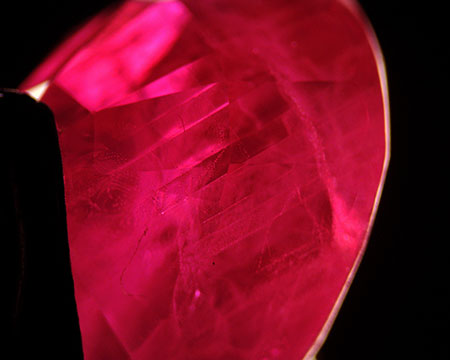 |
| Planes and needles. Above, lamellar twinning. Below, partially melted böhmite needles. Both samples were heat-treated. (Photomicrograph: Wimon Manorotkul, courtesy of GIT-GTL) |
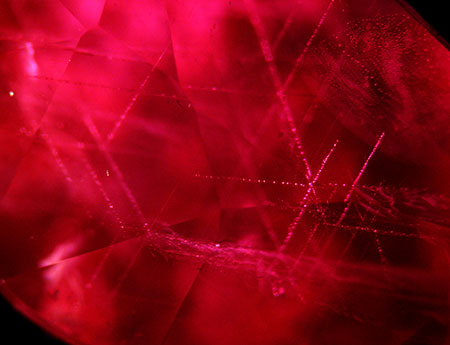 |
[back to top]
Industry News
Headstone for Colored Stone...
Trade bimonthly begins 23rd year with an end?
 |
In our November issue, we mentioned in passing that Colored Stone, the bimonthly trade magazine, would begin its twenty-third volume with an all-digital, biweekly format. A risky move? Alas, it seems so…
According to an e-newsletter distributed last week by Gary Roskin’s eponymous Gem News Report, Colored Stone’s departure from the scene has been confirmed by David Federman, the e?-zine’s editor-in-chief. Roskin states that Colored Stone, which Federman has edited since his appointment in July 2007, will have no presence—physical or virtual, hard-copy or digital. Indeed, the magazine’s publisher, Interweave, does not include Colored Stone in its list of bead, gems, and jewelry periodicals.
Subscriptions are no longer available via the magazine’s website. Come to think of it, Colored Stone’s own GemMail e-newsletter ceased offering subscriptions to the magazine in early October, with ads for Interweave’s Lapidary Journal Jewelry Artist taking up the slack.
Nevertheless, our January/February issue of Colored Stone was delivered on Friday along with the Tucson Show Guide. (A swan-song stack of that edition may yet await visitors to Tucson show venues.)
Some might have quibbled from time to time with what graced the pages of Colored Stone and GemMail, but that meant for engaging reading. Come what may, we wish David Federman and his crew all the best, especially at a time when the craft of publishing, as well as the trade of colored gemstones, both experience monumental challenges. [back to top]
— End January Newsletter • Published 1/18/10 —
Note: Palagems.com selects much of its material in the interest of fostering a stimulating discourse on the topics of gems, gemology, and the gemstone industry. Therefore the opinions expressed here are not necessarily those held by the proprietors of Palagems.com. We welcome your feedback.