Treated Pink-Orange Sapphire
Note from Palagems.com: On May 4–5 2002, the Gemological Institute of America (GIA) hosted a meeting in Carlsbad, CA to discuss developments regarding treated sapphires from Thailand. In attendance were, among others, representatives from the GIA, American Gem Trade Association Gem Testing Center (AGTA-GTC), Gem and Jewelry Institute of Thailand (GIT) and Swiss Gemmological Institute (SSEF). Below is a short summary of a briefing presented by John L. Emmett at that meeting.
Palagems.com has been closely reporting on developments regarding the treated sapphires from Thailand (see ‘The Skin Game’ and ‘Questions about Treated Sapphires from Thailand’ for full details). The first gems of this type appeared in mid-2001; we learned of the stones in October of that year. Initially such treatments were limited to orange stones, but today it is known that the same or similar processes have been applied to yellow sapphires, orange sapphires and rubies. John Emmett has been at the forefront of the work to identify and properly describe the specifics of this treatment and has graciously permitted us to reproduce the progress report below.
Since first informing readers in January 2002 that there appeared to be problems with these stones, we have been awaiting the results of scientific studies to provide the final proofs. Dr. Emmett and Troy Douthit’s article below is an important step in that direction. It is clear from reading this report, along with others that have been recently issued by the AGTA and GIA, that this process is indeed a form of outside-in diffusion (surface diffusion or simply diffusion to most gemologists; more properly termed bulk diffusion).
This treatment has prompted traders and gemologists here in the US and elsewhere to entirely re-examine the issues involved with enhanced/treated gems. What is a natural stone? When does a treated stone become so radically altered that it approaches a synthetic gem? We believe honest answers to these questions are crucial to the success of our business. Thus we welcome this reappraisal and will be reporting on it in the coming months. For more on heat treatment, see also the authors’ paper:
-
Emmett, John L. and Douthit, Troy R. (1993) Heat treating the sapphires of Rock Creek, Montana. Gems & Gemology, Vol. 29, No. 4, pp. 250–272.
Understanding the New Treated
Pink-Orange Sapphires
by John L. Emmett and Troy R. Douthit
Crystal Chemistry
22721 NE 123 Circle
Brush Prairie, WA 98606
USA
In early January 2002, Kenneth Scarratt of the AGTA Gemological Testing Center issued an alert warning traders that orange sapphires enhanced by a new process in Thailand appeared to be surface-diffusion treated (note: while gemologists and traders typically use the term surface diffusion for this process, we will employ the more scientifically correct term bulk diffusion). Evidence of this was a layer of orange color concentrated at the surface and just below the surface of stones, with that layer exactly conforming to the shape of the cut stone. Later examination of rough stones showed the same feature, i.e., a layer of color at and beneath the surface exactly conforming to the external shape.
This sent gemologists scrambling to find the precise cause of color. Initial reports suggested a number of possibilities, but further studies have revealed that such stones are colored by bulk diffusion, with beryllium (Be) thought to be the primary culprit.
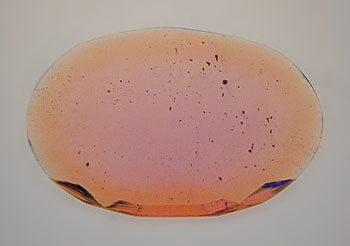 |
| This bulk-diffusion treated orange sapphire is typical of those which have created the recent controversy. Note the obvious layer of orange color that exactly conforms to the surface contours of the gem. In some stones, the color may penetrate all the way through. Photo: Richard Hughes/Pala International |
Early observations of the surface conformal color layers in the pink-orange Madagascar sapphires indicated to us that the likely cause was the bulk diffusion into the stone of light elements such as beryllium, magnesium, or calcium (or perhaps lithium, sodium or potassium) and we so advised both GIA and the AGTA-GTC staff. These light elements substituting for aluminum in the sapphire lattice often create what is known in the scientific literature of corundum as “trapped-hole color centers.” The trapped-hole color center in corundum causes a yellow coloration. This yellow coloration superimposed on a gem with a pink body color appears as orange. In colorless stones it appears yellow but a very different color of yellow.
We first studied these trapped-hole color centers in connection with our work on the heat-treatment process for sapphire from Rock Creek, Montana (see: Emmett, J. L., and Douthit, T. R., Heat treating the sapphires of Rock Creek, Montana, Gems and Gemology, Vol. 29, No. 4, pp 250–272, 1994.). In the case of these Montana sapphires, they developed a yellow color after heating in a pure oxygen atmosphere. This coloration appears to be caused by the treament producing trapped-hole color centers (involving magnesium naturally present prior to the treatment). But given the nature of the trapped-hole color center, it is not expected that the coloration will be strongly dependent on the specific element that causes it.
The absorption strength of trapped-hole color centers is quite sensitive both to temperature and oxygen partial pressure of the furnace atmosphere during processing. We have used these sensitivities to study a group of stones processed in Thailand.
As part of our study, we took quantitative absorption spectra on the stones as received. Stones were then reheated to either 1650°C or 1800°C, but in an oxygen partial pressure of 0.01 atmospheres (still an oxidizing atmosphere). After this heat processing (which does not affect the iron or chromium absorption spectra), absorption spectra were re-measured.
Heat processing in the lower oxygen partial pressure reduced the strength of the yellow coloration. Thus when we subtract the “processed” spectra from the“as received” spectra, all that remains is the spectra of the trapped-hole color center. The trapped hole color center spectra obtained in this way were very similar to the spectra obtained on the Montana stones, and nearly identical to the spectra obtained from a high purity synthetic sapphire crystal doped with magnesium.
At the February 2002 Gem Industry Lab Committee (GILC) meeting in Tucson, we discussed the coloration caused by trapped-hole color centers and the observations that some light element had obviously been diffused into the stones. At that meeting, Shane McClure of GIA presented data that indicated enhanced beryllium concentration in the colored layer.
Experiments and results
Following the 2002 Tucson Show, we initiated a set of experiments by diffusing beryllium into a wide variety of sapphire types. The sapphire types were pink and pale yellow from Madagascar, Songea sapphire, the “colorless” Sri Lanka sapphire that results from heat treating some types of geuda material, and high purity synthetic colorless sapphire. We chose both to diffuse from a flux and to diffuse from a dry powder in the manner of the old Union Carbide Corp. patent. In the case of flux diffusions, we used fluxes of calcium borate, calcium phosphate, or sodium phosphate. In each case we used small additions of alumina and zirconia to raise the viscosity of the flux at high temperature. (In retrospect, at these temperatures a silicate based flux may have been better.) For the dry powder diffusion experiments, we used high purity alumina powder. The beryllium source for both types of experiments was a fine powder of either beryl or chrysoberyl at a concentration of 2–4% in the flux or in the powder. The flux experiments were run at 1800°C, in oxygen for 25 hours, and the powder diffusion experiments at 1780°C (to stay well below the beryllia-alumina eutectic) in oxygen for 100 hours.
These experiments have reproduced both the complete range of colors and diffusion phenomenology that are observed in gemstones that are in the marketplace, plus a few more colors. We observed little differences among fluxes. The flux-processed stones show well-defined surface conformal color layers, while the powder-diffused stones are colored nearly completely through. This is, of course, because of the longer diffusion times in the powder experiments. As a result of these experiments, we have obtained a rough estimate of the chemical diffusion coefficient as being 100 times that of titanium or magnesium, or about 1/100th that of hydrogen for these conditions.
These experiments are continuing and we are studying other temperatures, fluxes, and other beryllium source compounds. There is much that we don’t know about these processes. We occasionally observe, as have others, that this process does not color some stones. We do not understand yet what aspect of the impurity chemistry of the stone is responsible for this. While we believe that beryllium is the causative agent of the yellow color, we have not ruled out the diffusion of other elements that may also have an important effect. We also have observed a yellow coloration in a few stones colored by this process that seems to have a somewhat different absorption spectrum. Again, we do not have an understanding of why. And finally we wish to note that the actual color center involved may be much more complex than a single hole trapped on an oxygen ion near a beryllium ion. Defect centers in solids are rarely that simple, and thus some type of point defect cluster is quite likely.
We will continue this experimentation with the objective of elucidating the subject more completely. It is our intent to publish in some format all of the information we develop, including details of all of the processes we test.
We fully realize that the above does not constitute real scientific publication, but we wanted to provide the information immediately to all those who are trying to unravel this subject. Responding individually to all of the questions we have received is quite difficult.
Finally, we wish to note that, given the negative response of the marketplace to the blue bulk-diffused sapphire introduced many years ago, the introduction of this new bulk-diffused product without informing buyers appears to raise serious ethics questions.

Acknowledgements
The authors would like to thank Terry Coldham, Mark Smith, Hans-Georg Wild, Markus Wild, Joe Belmont, Dick Hughes, and Bill Larson for graciously supplying stones and other materials for these experiments. We would also like to thank Ken Scarratt, Tom Moses, Shane McClure, and Wuyi Wang for the instant sharing of data they developed. A number of stimulating conversations with George Rossman are also greatly appreciated.
About the Authors
Dr. John Emmett obtained his Ph.D. in physics from Stanford University. From 1975–1988, Emmett was Associate Director for Lasers at Lawrence Livermore National Laboratory in Livermore, CA. John is considered a world authority on the physics and chemistry of corundum and has for years been involved in heat treatment.
Troy Douthit is also a graduate of Stanford and has been involved in many projects in Silicon Valley, including the design and operation of high-temperature furnaces. Together, Emmett and Douthit formed Crystal Chemistry in 1988.