Suspect Blues
Suspect Blues: Coming in from the Cold?
Note: On April 14, 2004, the GIA announced that they could find no evidence of diffusion treatment with these stones and would simply describe the stones as: “NATURAL SAPPHIRE, Comments: Evidence of heat treatment is present.”
January 16, 2004 – The International Colored Gemstone Association (ICA) has just issued an ICA Lab Alert summarizing the latest gemological findings regarding suspicious treated blue sapphires from Sri Lanka. Gemologists at two of the world’s premier gemological labs have independently studied these blue sapphires with unusual colorless rims. One lab has cleared these stones, but others believe still more study needs to be done before a definitive conclusion can be reached.
These suspect blues first came to the attention of gemologists when the American Gem Trade Association (AGTA) lab’s director, Kenneth Scarratt, noticed the suspicious color pattern on a stone submitted for testing in December, 2002. Following closely on the heels of the beryllium diffusion controversy (see ‘The Skin Game’ by R.W. Hughes), this immediately raised concerns. Scarratt quietly informed other gemologists of what he had found, seeking their opinions/advice.
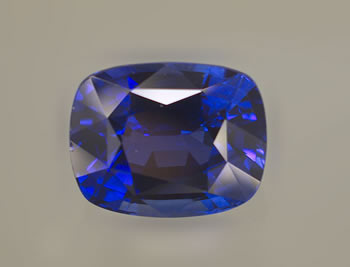 |
| This 5.94-ct. Sri Lankan sapphire is an example of the type recently suspected of being treated by a new process. Photo: Wimon Manorotkul |
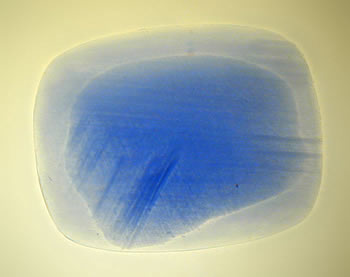 |
| The same stone viewed in immersion in di-iodomethane. A near-colorless rim can clearly be seen. While it was originally suspected that this rim might result from some sort of dissolution and regrowth during heating, it now appears that this can be ruled out. The origin of these color rims is still the subject of much speculation. Photo: Richard Hughes |
Following these discussions, three different theories developed:
- These light rims represented synthetic corundum overgrowths on natural cores, probably developed during high-temperature heat treatment, where the skins of crystals or cut stones were dissolved and molten corundum was redeposited.
- These light rims represented outside-in diffusion of color bleaching agents such as beryllium, magnesium or lithium during the heating process. Evidence of this is suggested by the surface-conformal nature of many (but not all) of these lighter rims.
- These light rims occurred due to compositional differences existing in the original crystals, highlighted by application of high-temperature heat treatment.
We all know that composition/conditions often change during a crystal's growth and this is often evidenced by changes in color zoning, inclusions, etc. A classic example of this is the ottu sapphires of Sri Lanka, which feature blue skins covering near-colorless cores. Thus it is possible that these rims simply reflect underlying compositional/structural differences present in the original crystals. Such features might be difficult to see in the untreated stone, but could became manifest following a unique treatment regimen.
Of course, this begged the question why such features were not found before, with sapphires having been cooked at high temperatures for close to three decades? Would a variation of heating time and temperature be sufficient to produce such unusual features? Or had we been seeing such features all along, but simply ignoring them? Is the reason they now attract attention because the recent beryllium business has gemologists wielding their weapons with hair triggers, ready to blast away at the slightest movement in the bushes?
These were the questions gemologists sought to put to rest. Slowly more stones with these suspicious rims came to light, to the point where it was felt that traders had to be warned. Meetings were held, information was exchanged, inventories were checked, the latter revealing a surprising number of such stones. All appeared to be of Sri Lankan origin, and most were larger than five carats.
Eventually, many stones were traced back to the ovens of Punsiri Tennakoon of Punsiri Gems in Sri Lanka. He was contacted and held a number of candid discussions with both AGTA and GIA gemologists. Out of these discussions came a December 2003 visit by Christopher P. Smith and Matthew Hall of the Gemological Institute of America (GIA) to witness first-hand Punsiri Tennakoon’s heating methodology.
|
Following a number of experiments, they were able to entirely rule out the possibility of a synthetic overgrowth. Smith and Hall also concluded that there appeared to be no evidence that the colorless rims were the result of a beryllium bulk (lattice) diffusion treatment. The GIA stressed that this conclusion is preliminary, and more study is planned. Their report concluded:
At present, we cannot state conclusively the role that lattice diffusion plays in this peculiar color phenomenon or which elements may be involved. However, we are continuing our research into the exact mechanisms responsible for these unusual color concentrations, and will release our findings to the trade as they become available.
Henry Hänni of the Swiss Gemmological Institute (SSEF) has also studied these stones and in the ICA Lab Alert was quoted as suggesting that the white rims result from a defect in the heating process where oxygen accidentally enters the furnace chamber during the final stages of heating, thus decolorizing the rims of the stones. In the light of the above explanation, SSEF said that it would describe the stones it tested as “heated” when issuing its laboratory test reports. “We do not see evidence of diffusion of a foreign element, as in the case of the beryllium treated orange and yellow sapphires,” SSEF declared.
Others have suggested that a defective heating process is probably not the case, that to bleach color from the rim, something would have to be diffused in. According to current knowledge, hydrogen would diffuse in far too fast for the above scenario and oxygen far too slow. That’s the theory, anyway, but as we learned from the beryllium business, theories will need to be tested by rigorous experiments.
Thus it is clear that more work remains before a definitive answer can be given. But without question, the recent cooperation between Punsiri Tennakoon and the world gemological community is an example of the right way to solve a serious problem (in contrast to the earlier beryllium fiasco, where burners in Thailand tried to hide what they were doing, with disastrous consequences for that nation’s entire gem industry).
In the current case, the outcome is looking far better. Perhaps these blues will eventually come in from the cold. This would be a plus for all parties, but particularly for the science of gemology, showing as it does that gemologists are not “out to get” anything except the truth.
• • • • •
Afterword
This article has been revised slightly from the originally posted version.
Shortly after this was posted, GemResearch Swisslab (GRS) posted an excellent article giving detailed LA-ICP-MS analyses on one sectioned sapphire of the suspect type. They found no elemental differences between the skin and core. See this on the “News” page at their website (link below):
- Peretti, A., Günther, D. and Mouawad, F. (2004) New Sapphire Treatment Producing Colorless Rims Analyzed by LA-ICP-MS. Contributions to Gemology, On-line GRS Newsletter No.1. Posted Jan. 20, 2004.
Further reading
- AGTA (2003) Sapphire treatment update. Posted Oct. 9, 2003 (removed since; see archive).
- GIA (2003) Latest Findings on Heated Blue Sapphires with Unusual Color Concentrations. Posted Dec. 19, 2003 (removed since; see archive with some images missing).
- Hughes, Richard W. (2001) The Skin Game. Posted February 2002.
- Scarratt, Kenneth (2003) A review of preliminary data on heated blue sapphires with an unusual color distribution - a work in progress. Posted Nov. 13, 2003 (removed since; see archive).
Acknowledgements
The author would like to thank all those who took the time to share share information with me on this subject. Too many to name, but you know who you are. Merci!