Walking the Line in Ruby & Sapphire
Walking the line in ruby & sapphire
By Richard W. Hughes
starving hysterical naked…
In this humble scribe’s opinion, there exist two ideas that deserve to be eternally banished. First, the use of the phrase “improved stability” with any software upgrade. And second, the notion that narrowing the definition of a variety label like ruby or padparadscha will somehow protect the gem-buying public.
When it comes to crimson corundums, despite a decade’s worth of McCarthyism we Yanks still cannot sort out the difference between a pinko and a true red.
And padparadscha is even worse. Gemologists and dealers treat this fair dame like some kinda überrock. If she isn’t buff enough to make the centerfold of Gem & Gemology, the poor lass is sniffed at as literally unworthy of the name.
By now I know what you’re thinking: Do I really want to continue reading? Straight out of the gate this man is three sheets into a gale-force Beat ramble.
But follow me here, people. The crux of what I’m about to discuss is a desire for a simple word to separate something that has stymied the best minds of my generation. The question is whether or not a variety name (such as ruby or padparadscha) should encompass a broad hue range, or segregate gems of the same basic color into different varieties based on tone and saturation ranges – factors that often have a direct bearing on quality.
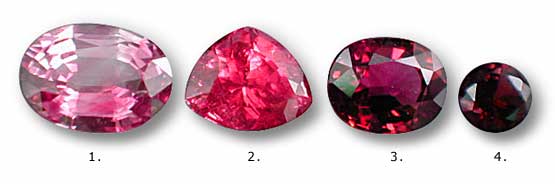 |
| Four corundums of the same hue (red), but showing a variation in saturation and tone. Most gem dealers would classify stones 3 and 4 as rubies, while stone 1 would be a pink sapphire. Stone 2 walks the line, a ruby to some, while a mere pink sapphire to others. This clearly illustrates the problems created by overly narrow variety definitions. Photos: Wimon Manorotkul |
Ruby or pink sapphire? A lesson from the past
Today it is the fashion of our land to refer to the pinks as something other than reds. But it wasn’t always that way.In days gone by, pink corundums were termed female rubies, as opposed to the deeper red male stones. Witness the following:
Rubies, for which Ceylon was renowned at a very early period, are seldom found at present of any considerable size; and are not often larger than particles of gravel or grains of barley: The Indians speak of them as more or less ripe, which means more or less high-coloured.
A search of the gemological literature reveals that the term pink sapphire did not appear until the beginning of the twentieth century. Prior to this, all corundums of a red color (pink is merely a light red) were referred to as rubies. Typical was the following:
 |
| Which of the above is pink? According to the Methuen Handbook of Colour, the sample at right is pink, while the left sample is a purplish red. This illustrates how the line between one color and another is often quite subjective. |
The Pink-ruby (“patmaraga” Singh.) is a beautiful stone and seldom met with. It is by some prized equally with the ruby. It is of a light ruby colour with a strong dash of pink in it. This is likewise rarely found without blemish. It sells well when defectless, both among Europeans and Asiatics.
Gems and Gem Searching in Saffragam
Ceylon Observer, June 11, 1855
(from Ferguson, 1888)
Here’s another from 1873:
The colour of the ruby varies from the lightest rose-tint to the deepest carmine. Those too dark or too light are not esteemed.
Then someone decided that pink was not red. In the late 19th and early 20th century, the term pink sapphire makes its first appearance:
The tint of the red stones varies considerably in depth; jewellers term them, when pale, pink sapphires, but, of course, no sharp distinction can be drawn between them and rubies.
So what exactly is pink? The Methuen Handbook of Colour (1989) provides the following definition:
Pink: Same as rose; a general name which may have been derived from that of the pink family of plants. It is used somewhat arbitrarily in reference to pale and light reds.
Riding the edge
Exactly where does one draw the line? Neither gemologists or traders can agree, which has led to the ridiculous situation of stones being brought to labs solely to determine if they are rubies or pink sapphires. Hello? Anyone home?
The color purple |
It is a common, but erroneous, belief that Thai/Cambodian rubies are more “purple” than those from Mogok. Using the proper definition of the term purple (i.e., a hue or hues lying between red and violet), we actually find that Mogok rubies are more purple than those from the Thai/Cambodian border. Gem dealers know what they are seeing, but do not describe it in terms consistent with the use of those same words in other industries. To the color scientist, purple is merely a hue position. In order to properly describe the color, saturation and darkness must also be defined. The problem with most dealer descriptions of gem colors is that they try to describe all colors and color differences in terms of changes in hue position and darkness. In fact, when judging the color of gems, saturation of hue is of paramount importance, not tiny nuances in hue position. When a gem dealer says that a Thai/Cambodian ruby is too purple compared to those from Mogok, he is confusing the low-saturation red (grayish red) of the Thai ruby with the higher saturation (but more purplish) red of the Mogok stone.
Which of the above colors is more purple? Surprisingly, the answer is neither. Both have identical hue positions, differing only in saturation and tone. |

Where can such madness lead? Allow me to illustrate. A stone was sold to a client. In an attempt to give a conservative description, the seller tagged it a pink sapphire. The buyer sent it to a major lab, and was crushed when her fine “pink sapphire” was labeled a mere “ruby” by the rock docs. This is precisely the type of misunderstanding that results when one relies on the word, as opposed to what is manifest with the eye.
In the case of pink sapphire, our corundum conundrum has resulted from a quirk of language. In the Queen’s English, “red” is dissected into two separate words. To the layperson, “pink” is synonymous with “rose” and refers to pale or light reds, while “red” encompasses deeper tones and intensities only. Since ruby is defined as being red, someone decided that pink must be a sapphire and problems began. However, to the color scientist, pink is a subvariety of red. Logically, they would fall under the same heading.
A comparison can be made to the Thai language, which features two distinct words for blue. See fah refers to light blue, while see num ngun covers only the richer variety. If Thais used the same logic for blue sapphire as we apply for ruby/pink sapphire, then blue sapphires from Ceylon would have a different name than those from Australia.
Make sense? Not to me, but much of the gem trade apparently thinks so, because this is exactly how we subdivide red corundum.
We don’t have this problem with blue sapphires; light or deep blue, they are still blue sapphires. So why not label all red corundum ruby, regardless of depth or intensity, just as was done prior to the 20th century? This would eliminate the above problem.
In 1989, the International Colored Gemstone Association (ICA) adopted just such nomenclature. Unfortunately, the powerful American market continues to use the term pink sapphire, leading producing countries both by the nose and all of us into needless problems.
The princely kiss of padparadscha
Hail the jewel in the heart of the lotus
Just what is in a name? Plenty when it comes to the jewel known as padparadscha. The debate over its use pits those who believe that romantic terms are vital sales aids against others afraid that buyers will be taken advantage of if the padparadscha brush is too broad. But before getting into that, let’s look at the root word of our padparadscha.
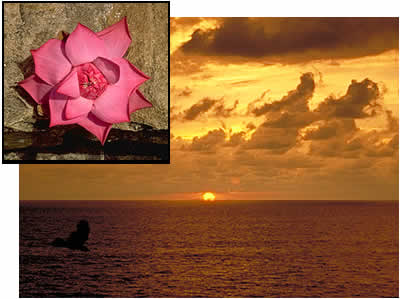 |
| The ideal color of a padparadscha has been described by some as the marriage between a Sri Lankan lotus flower and a sunset, each shown above (Author’s photos) |
Today, many narrowly define padparadscha as a Sri Lankan sapphire of delicate pinkish orange color. But the original use of the term was somewhat different. Padparadscha is derived from the Sanskrit/Singhalese padma raga (padma = lotus; raga = color), a color akin to the lotus flower (Nelumbo Nucifera ‘Speciosa’). Wojtilla provides the following from a Sanskrit source under his description of ruby:
Arthasastra [an ancient Sanskrit book] knows the following names: saugandhika (lotus-coloured), padmaraga (the same)…
Ever look at a lotus? I’ve stuffed my snout into blossoms all the way from Bangkok to Colombo and have come up with only one conclusion – they are far more pink than orange. Indeed, in ancient times padma raga was a sub-variety of ruby.
Location, locotion, loco? |
One problem with names like padparadscha is that they are intrinsically associated with the localities where they were first found. When a rhododendron-colored garnet was first discovered in North Carolina, G.F. Kunz, who was well aware of the marketing value of an attractive name, dubbed it rhodolite. Upon finding that garnets of similar color could be found in other locales (‘rhodolite’-like garnets had been mined for over two millennia in Sri Lanka), gemologists attempted to “prove” that true rhodolites were unique and locality-specific, even going so far as to identify the rhodolite variety not just by color, but by refractive index. This led to the ridiculous situation where garnets of identical color and composition were labeled differently. One point too high or low on the RI meant a gem would not be awarded the coveted rhodolite title, but shot at dawn as a lowly almandine or pyrope spy. Locality is not a practical way of defining gem varieties. Even if it were possible to determine, it becomes meaningless when a new source is discovered that produces similar qualities. Quite frankly, the best “padparadscha” this author has ever seen was unearthed in Vietnam, not Sri Lanka. And if we need further evidence, the recent discovery of Cu-bearing “Paraiba” tourmalines in Nigeria should put the question to rest once and for all. |
While virtually every writer on the subject makes the lotus comparison, certain others also add the concept of fire or sunset, almost an aurora (sunrise) red-orange. Here is an early definition from the Indian subcontinent, dating from about 1200–1300 AD:
Varieties of Ruby
That which spreads its rays like the sun, is glossy, soft to the touch (komala?), resembling the fire, like molten gold and not worn off is paümaraya [padmaraga].
Thakkura Pheru’s Rayanaparikkha –
A Medieval Prakit text on Gemmology
Molten gold? That sounds nothing like a lotus color. Even today in Sri Lanka there is no agreement. Some use the term to describe stones more pink than orange, while others compare the color as a lotus flower married to a Sri Lankan sunset. The following from 1855:
The Topaz (puspa raga, Singhalese) claims notice next. There are two varieties of it: the “ratu puspa raga” and “kaha puspa raga.” The former is of a bright yellow color, with a reddish tinge and is the more valued. The latter is pure bright yellow. The first variety is scarce, and the second is comparatively plentiful. The topaz and the sapphire seem to be species of the same stone differing only in color – it is not unfrequent to find a piece of stone partly yellow and partly blue. This stone is not much sought after by Europeans, but it is prized among the Singhalese. It is said to sell well at the Presidencies of India and in Arabia.
J.F. Stewart,
Gems and Gem Searching in Saffragam
Ceylon Observer, June 11, 1855
(from Ferguson, 1888)
Moving to a more recent reference from Sri Lanka, we have:
A sapphire of orange-red or pink colour, is locally referred to as padmaraga (padma – lotus flower; raga – colour). Many scholars call this variety padmarascha, which is a misnomer. The term raga means colour, attraction, desire, musical rhythm and pollen; therefore, the name for the lotus-flower coloured corundum should be padmaraga, and not padmarascha. However, lotus flowers are also found in white, but in this instance the colour referred to is the orange-red or pink lotus flower, growing in Shri Lanka.
There is also the yellow sapphire of Shri Lanka, commonly called pushparaga in Singhalese. The term pushpa means flower; as raga is colour and also means pollen, hence pushparaga is the “colour of pollen.” Although pollen can be brownish yellow or yellow in colour, the Shri Lankan gem trade from ancient times to the present, has always referred to pushparaga as a yellow variety of corundum.
The important words to consider in the latter example are flower, colour and pollen, in the origin of the name, pushparaga. However, in both examples of padmaraga and pushparaga, the term raga refers to the colour. Therefore, the word padmaraga also confirms that the correct term for the orange-red or pink sapphire should be accepted as padmaraga and not padmarascha.
And yet still another recent reference from Sri Lanka:
 |
| Sri Lankan padparadscha sapphire crystal, 8 by 5 cm; Collection: Paul Ruppenthal Photo: Studio Hartmann From Gem & Crystal Treasures by Peter Bancroft |
The term pathmaraga is a Singhalese term applied to a very special colour variety of corundum, so named after the lotus flower as its colour is sometimes akin to a variety of this flower…. The colour combination produces the rare and beautiful colour of a sunset red at its best as seen across a tropical sky.… The colour of pathmaraga is apparently a combination of yellow, pink and red, with mildly conspicuous flashes of orange.
And if one reads the Western gem literature, we find that padparadscha is sometimes different again, often being used to describe stones that are more Sunkist than anything else. Indeed, what some hold out to be the mother of all pads, the 100.18-ct. stone in the Morgan collection at New York’s American Museum of Natural History is, to put it politely, pink-challenged.
I think readers by now are getting the picture – this is one poorly understood word, with no general agreement as to its meaning. Even our word – padparadscha – adopted from a German gem text early in the 20th century – is a corruption. Which should probably make all of us feel good, since the whole process of defining this thing has the word “bastard” written all over it.
Kiss the frog
It seems logical that, should the gem trade decide the name padparadscha is worth keeping, it should define the accepted color range. A gem could then be compared to a set of color references to see if it merited the princely padparadscha kiss.
The AGTA Lab recently did just this. They took a variety of stones that dealers suggested met the criteria of padparadscha and scientifically defined the color range using an imaging spectrophotometer.
Unfortunately, the results of that attempt almost entirely excluded the stones produced from Tanzania’s Umba Valley, changing the temperature of one dealer holding said goods from well-beyond the padparadscha hue to a flame color which any gemologist worth his salt would clearly agree fell into ruby country.
Most dealers and gemologists feel that the Umba stones do not qualify because of their overly dark tones and strong brown (’garnety’) component. But what about the spectacular “aurora” red-orange stones from Vietnam and Madagascar, colors which, to this Philistine’s eye, wee-wee all over any pad ever out of Lanka? Certainly ain’t no brown in those babies.
Although I have not personally examined the AGTA data, from what I understand in my discussions with the relevant authorities, the definition excludes oranges of high saturation and/or dark tone, mainly because Sri Lanka has traditionally never produced such colors. In other words, when it comes to getting pad papers, think P – as in past and pastel.
Pad vs. Pink
So what exactly is a padparadscha and how does it differ from our pink sapphire? Good question. We can see that padma raga was originally applied to a lotus-colored ruby, but for some that might even include a ratu puspa raga (a reddish yellow sapphire). And what of the padma raga – which in ancient times was also said to refer to a pink ruby? Well duh – we call those pink sapphires.
Hope that clears the whole thing up. Now I’m getting back to my prayers – praying for world peace, to be sure – but most importantly, praying that the Sri Lankans never unearth anything like the stones from Vietnam or Madagascar.
If we only had a word…
Ours is a strictly visual medium. Unfortunately, when it comes to questions like ruby vs. pink sapphire, or padparadscha vs. lesser branches of the corundum family tree, we behave as though we are all graduates of the Braille Academy of the Visual Arts. Too often, we feel for the dots on the lab cert, rather than looking with our own eyes to see if it is beautiful.
Most gem varieties encompass a broad range, including both highbrow and low. Sapphire alone takes under her wing everything from powder blues through indigo to dark, inky stones where hue is all but MIA. We the-gem-buying-traders and they-the-gem-buying-public have no problem with such variety descriptions. Why should we?
Think about it. When was the last time you awoke shaking at night at the thought of innocents being led down the primrose path of an overly dark blue or – worse still – a yellow of poor saturation? We do not have this problem with either blue or yellow sapphires because the broad nature of the variety definition forces us to do something we don’t seem to like doing – use our eyes.
Dear, dear. Were we all promised blindfold judgment when we signed on in this business? I don’t know about you, Martha, but not once did I believe that, after mixing my blood with that of my fellow gem cultists, I could retire my eyes.
In this business, some words work, others don’t. Words like blue work. Why? Because they are simple and based on hue position alone, not lightness/saturation. If it is blue, it is sapphire, and all sleep soundly at night.
Yet other words are the source of endless insomnia. Pink and padparadscha are two for trouble, largely because people attempt to use them to describe poorly understood color and quality attributes (lightness/saturation), rather than simply hue position.
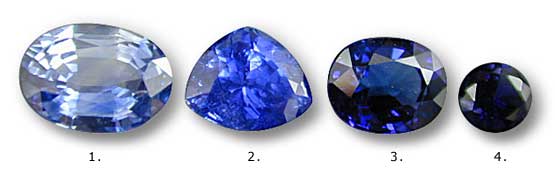 |
| Four blue sapphires showing a variation in saturation and tone. Unlike with ruby/pink sapphire, the gem trade places all stones into the same variety, no matter what the tone/saturation range. Broad variety definitions such as this actually enhance consumer protection, because they force buyers to use their eyes, rather than looking for definitions on a gemological certificate. Photos: Wimon Manorotkul |
Angelic
“Marco, keep your eyelids up and see what you can see.”
Okay, I know what you’re thinking. He’s finally lost it – the silly bugger’s now reduced to citing Dr. Seuss.
But stay with me here people…
I see just fine. Really. I see the past – the dozens of meetings where the best minds of my generation have dissected definitions like padparadscha and pink sapphire with the religious fervor of pinhead priests and their prancing angels. All to no avail. And I see the future – all of us starving – hysterical – naked – doing exactly the same. Unless we relearn that most basic lesson – how to use our eyes.
On my shelf I keep a hundred books on truth, my neighbor that times three. Each one different. How can that be? Because we listened to our fathers. We keep our eyelids up. We see what we can see.

Acknowledgments. The author would like to thank Pala International’s William Larson for once again forcing the author to increase the size of his reptilian world view.
About the author. Richard Hughes is the author of the classic Ruby & Sapphire, and can be contacted at: rubydick@ruby-sapphire.com.
Afterword. This article was first published in The Guide (2002), July/August, Vol. 21, Issue 4, Part 1, pp. 4–8. The author has since edited it and added additional photos.
References
- Ariyaratna, D.H. (1993) Gems of Shri Lanka. London, self published, 5th edition, 109 pp.
- Crowningshield, R. (1983) Padparadscha: What’s in a name? Gems & Gemology, Vol. 19, pp. 30–36.
- Emanuel, H. (1873) Diamonds and Precious Stones. New York, G.P. Putnam’s Sons, 2nd edition (1st ed., 1865), 266 pp.
- Ferguson, A.M. and Ferguson, J. (1888) All About Gold, Gems and Pearls in Ceylon and Southern India. Colombo, London, A.M. and J. Ferguson, 2nd edition, 428 pp.
- Gunaratne, H.S. and Dissanayake, C.B. (1995) Gems and Gem Deposits of Sri Lanka. Colombo, National Gem and Jewellery Authority of Sri Lanka, 1st ed., 203 pp.
- Kornerup, A. and Wanscher, J.H. (1978) Methuen Handbook of Colour. London, Eyre Methuen Ltd, 3rd edition, 252 pp.
- Philalethes, A.M. (1817) A History of Ceylon from the Earliest Period to the Year MDCCXV. London. The author is believed to have been the Rev. G. Bissett.
- Sarma, S.R. (1984) Thakkura Pheru’s Rayanaparikkha: A Medieval Prakit text on Gemmology. Aligarh, India, Viveka Publications, 84 pp.
- Smith, G.F.H. (1913) Gem-Stones and their Distinctive Characters. London, Methuen & Co., 2nd edition (1st ed. 1912), 312 pp.
- Wojtilla, G.Y. (1973) Indian precious stones in the ancient East and West. Acta Orientalia Hungaricae, Vol. 27, No. 2, pp. 211–224.
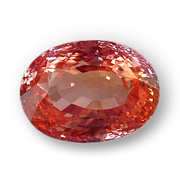
Palagems.com Padparadscha Sapphire Buying Guide Introduction/Name. Padparadscha sapphire is a special variety of gem corundum, featuring a delicate color that is a mixture of pink and orange – a marriage between ruby and yellow sapphire. The question of just what qualifies for the princely kiss of “padparadscha” is a matter of hot debate, even among experts. Today, padparadscha is narrowly defined by Western gemologists as a Sri Lankan sapphire of delicate pinkish orange color. But the original use of the term was somewhat different. Padparadscha is derived from the Sanskrit/Singhalesepadmaraga, a color akin to the lotus flower (Nelumbo Nucifera ‘Speciosa’). Most lotus blossoms are far more pink than orange, and in ancient times, padmaraga was described as a subvariety of ruby (cf. the Hindu Garuda Purana). Today, some define the gem's color as a blend of lotus and sunset. A further complication is with orange sapphires from Tanzania’s Umba Valley. While they are orange, their color tends to be much darker than the ideal, with brownish overtones. Thus most traders do not feel they qualify as true padparadschas. Color. Unlike other rubies and sapphires, the finest color of padparadscha is not directly a function of color intensity (saturation). The most valuable padparadschas display a delicate mixture of pink and orange, similar to the crystal shown above. Lighting. Sapphires generally look best viewed with fluorescent light or daylight (particularly around just after sunrise and before sunset). Incandescent lights, whose output is tilted towards the red end of the spectrum, do not do most blue sapphires justice. Clarity. In terms of clarity, padparadscha sapphires tend to be cleaner than ruby. Buyers should look for stones which are eye-clean, i.e., with no inclusions visible to the unaided eye. Because of the pastel shades of most padparadschas, any inclusions will be quite visible. Thus again, the emphasis is on eye-clean stones. Cut. In the market, padparadschas are found in a variety of shapes and cutting styles. Due to the shape of the rough, stones are often cut with overly deep pavilions. Ovals and cushions are the most common, but rounds are also seen, as are other shapes, such as the emerald cut. Slight premiums are paid for round stones. Cabochon-cut padparadschas are not often seen (this cut is used for star stones, or those not clean enough to facet). The best cabochons are reasonably transparent, with nice smooth domes of good symmetry. Prices. Padparadscha is one of the world‘s most expensive gems, with prices similar to those fetched by fine ruby or emerald. But like all gem materials, low-quality (i.e., non-gem quality) pieces may be available for a few dollars per carat. Such stones are generally not clean enough to facet. Prices for padparadschas vary greatly according to size and quality. At the top end, they may reach as much as US$30,000 per carat. Stone Sizes. Padparadscha sizes tend to be similar to ruby. Probably the largest fine stone known is the 100.18-ct. oval in New York’s American Museum of Natural History. But any fine untreated padparadscha of quality above two carats is a rare stone. Fine untreated padparadschas above five carats can be considered world-class pieces. Phenomena. While star sapphires in other colors are common, star padparadschas are practically unknown. This is because yellow and orange sapphires from Sri Lanka generally lack the concentrations of well-defined silk necessary to produce distinct asterism. Sources. The original locality for padparadscha is Sri Lanka (Ceylon) and many purists today believe the term should be restricted only to stones from Ceylon. However, fine stones have also been found in Vietnam’s Quy Chau district, Tanzania’s Tunduru district, and Madagascar. Stones from these latter three areas are often heat-treated and may reach rich “orange-juice” or “papaya” oranges that are quite beautiful. Tanzania’s Umba Valley also produces orange sapphires and some dealers argue that these qualify as padparadschas. However, their color tends to be much darker than the ideal, with brownish overtones. Thus most traders do not feel they qualify as true padparadschas. Enhancements. Today, many padparadscha sapphires are heat-treated to improve their appearance. The resulting stones are completely stable in color. In lower qualities, heat treated stones sell for roughly the same as untreated stones of the same quality. However, for finer qualities, untreated stones fetch a premium that is sometimes 50% or more when compared with treated stones of similar quality. A fraudulent treatment sometimes seen is where a pink stone is irradiated to give it a padparadscha color. The resulting color is unstable and will fade with prolonged exposure to sunlight. Other treatments, such as oiling, dying and surface diffusion are seen on occasion. Beginning in late 2001, sapphires of padparadscha colors began appearing from the ovens of Thai burners. It was later found that these gems owe their color to a form of outside-in bulk (‘surface’) diffusion. See this link for more on these stones. As with all precious stones, it is a good practice to have any major purchases tested by a reputable gem lab, such as the GIA or AGTA, to determine if a gem is enhanced. Imitations. Synthetic padparadscha sapphires have been produced by the Verneuil process since about 1908 and cost just pennies per carat. They have also been produced by the flux, hydrothermal, floating zone and Czochralski processes, but such stones are rarely encountered. Doublets consisting of natural sapphire crowns and synthetic sapphire pavilions are sometimes seen, particularly in mining areas. Synthetics are also common at the mines, in both rough and cut forms.
Properties of Padparadscha Sapphire
For further information on padparadscha, see also:
|